





The Pan-African Paradigm of Peacekeeping Sacrifice and Institutional Accountability
Across the African landscape, blue-helmeted peacekeepers have long occupied an uneasy space between guarantor of stability and reminder of unresolved sovereignty, deployed precisely because a state’s own institutions cannot yet secure its population, and vulnerable precisely because that same incapacity extends to protecting the peacekeepers themselves. The killing of two Ethiopian peacekeepers and the wounding of seven others in a deliberate ambush in South Sudan’s Jonglei State is the latest and starkest expression of this paradox, bringing to nine the number of United Nations personnel killed in malicious acts worldwide this year. The episode forces a continental reckoning with a structural question: what does it mean for a mission’s legitimacy when the forces sent to stabilize a territory become targets within it, and what obligations follow for both the host state and the international architecture that deployed them? As Jonglei’s volatile patchwork of intercommunal fighting, armed youth mobilization, and government clashes claims yet another set of casualties, the incident reasserts a broader Pan-African imperative: that genuine self-determination requires not the presence of external stabilizing forces indefinitely, but the institutional capacity to render such deployments unnecessary — a trajectory South Sudan remains, by any measure, far from completing.
The Ambush in Detail: Casualties, Command, and Confirmation
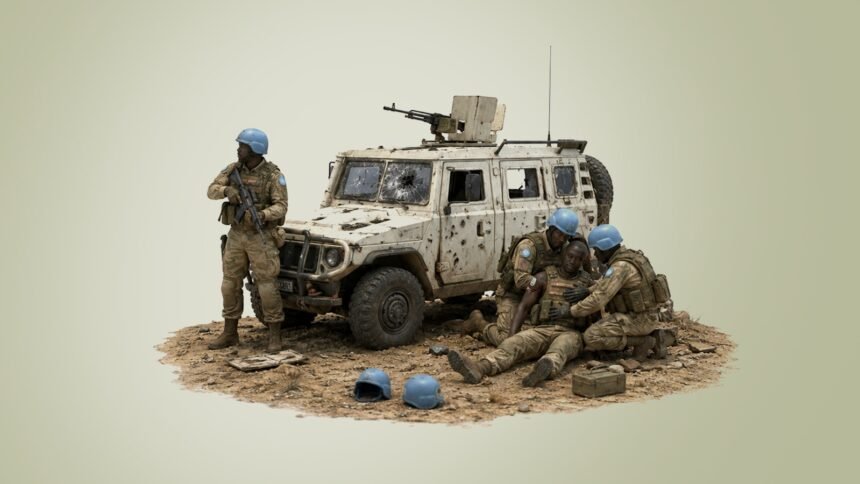
The ambush occurred on Monday during what UN spokesperson Stéphane Dujarric described as a routine patrol, one of the regular movements the mission conducts in an effort to manage what he called the area’s “constant insecurity.” Two peacekeepers from Ethiopia were killed outright; seven others were wounded, among them three additional UN peacekeepers, two South Sudanese police officers, and two civilian staff members, according to Dujarric’s press briefing account. The perpetrators remain unidentified, but the United Nations has assessed that the patrol “appeared to have been deliberately targeted” rather than caught in incidental crossfire, a distinction with significant legal weight, since deliberate attacks on peacekeeping personnel may, in the UN’s own characterization, “constitute war crimes under international law.” Dujarric confirmed that the organization has called on South Sudanese authorities for a thorough and prompt investigation to identify and prosecute those responsible, a demand that carries particular resonance given the mission’s location within Jonglei, a state whose recurring cycles of intercommunal violence and militia mobilization have made it one of the most operationally hazardous zones for UN personnel on the continent.
A Pattern of Vulnerability: Nine Deaths and a Security Council Response
Monday’s ambush brings to nine the total number of peacekeepers killed in malicious acts since January 1. This toll situates South Sudan within a broader, troubling pattern of violence against UN missions that has prompted institutional response at the highest levels. In June, the UN Security Council adopted a resolution explicitly aimed at strengthening accountability for attacks on peacekeepers, a measure driven by mounting concern over both the frequency of such incidents and persistently low prosecution rates for their perpetrators. That resolution followed a particularly grim episode in March, when seven peacekeepers serving with the United Nations Interim Force in Lebanon were killed after fighting between Israel and Hezbollah resumed. While Dujarric noted that attacks on UN personnel remain “rare” in South Sudan specifically, he acknowledged they are “not unprecedented,” a candid admission that reflects the operational reality of a mission deployed into some of the country’s most volatile terrain, areas defined by intercommunal fighting, armed youth mobilization, and clashes involving government forces themselves. The recurrence of such violence, even against a backdrop of Security Council action, underscores the limits of accountability frameworks that operate at a distance from the local power structures actually driving the insecurity.
Ethiopia’s Contribution and the Continental Stakes of Troop-Contributing States
The fact that the fallen peacekeepers came from Ethiopia is itself significant within the continental architecture of peace operations. Ethiopia has for decades ranked among the largest troop-contributing nations to UN and African Union missions across the continent, from Somalia to Abyei to South Sudan itself, effectively subsidizing regional stability with its own military personnel even as it manages significant internal security pressures. Each fatality among Ethiopian peacekeepers therefore carries a dual weight: a human loss mourned domestically, and a data point in the broader calculus troop-contributing governments must make about the costs of sustaining Africa’s peacekeeping commitments. This dynamic exposes a structural asymmetry within the continental security order: nations with functioning military institutions are repeatedly called upon to stabilize territories where such institutions have not yet taken root, absorbing casualties in service of a sovereignty that is not their own to build. Jonglei’s ambush, in this light, is not merely a South Sudanese security failure but a continental one, implicating the burden-sharing arrangements that undergird African peacekeeping and raising urgent questions about whether troop-contributing states are receiving the protective infrastructure and accountability guarantees their sacrifice warrants.
Toward a Durable Peace: Sovereignty Beyond the Blue Helmet
The ambush in Jonglei should be read as a signal moment in South Sudan’s unfinished journey toward the kind of durable, self-sustained peace that would ultimately render peacekeeping missions obsolete. Every death of a UN peacekeeper on South Sudanese soil is a reminder that the country’s institutions, its police, its judiciary, its mechanisms for intercommunal reconciliation, remain insufficiently developed to secure the peace nominally established years ago. The path forward demands more than an investigation into a single ambush; it requires sustained investment in the state capacity that would make external stabilizing forces unnecessary, alongside a Security Council willing to translate its accountability resolutions into enforceable consequences for those who target peacekeepers with impunity. For Ethiopia and the other troop-contributing nations bearing the human cost of this continental commitment, and for the South Sudanese communities still trapped in cycles of intercommunal violence, genuine sovereignty will be measured not by the presence of blue helmets on patrol. Still, by the day such patrols are no longer required.