




The Pan-African Paradigm of Epidemic Sovereignty and Institutional Resilience
An epidemic curve is never merely a biomedical fact; it is a referendum on whether the continent’s public health architecture is engineered for its own realities or borrowed, underfunded, and perpetually catching up. The Democratic Republic of Congo’s current Ebola outbreak, declared on 15 May 2026 and now the largest in the country’s history, forces that referendum into stark relief. With more than 6,000 confirmed cases and nearly 2,911 deaths recorded by 31 August across six provinces, the epidemic has already eclipsed the 2018-2020 outbreak that once defined the ceiling of Congolese Ebola response. Driven by the rare Bundibugyo strain, for which no approved vaccine or treatment exists, and unfolding amid armed conflict, mass displacement, and a health-worker strike, this crisis exposes how thin the margin remains between a functioning surveillance system and epidemiological freefall. The World Health Organization’s warning that the outbreak could surpass the catastrophic 2014-2016 West African epidemic is not alarmism; it is a structural diagnosis. Reclaiming health sovereignty on the continent will mean building response capacity that does not collapse the moment insecurity, funding gaps, or strain variance depart from the textbook case.
Numbers That Outpace the Record Books
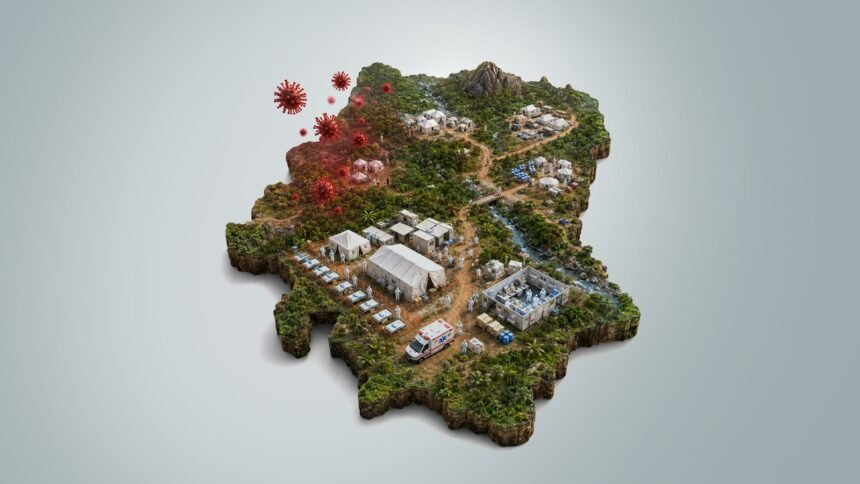
The statistics alone justify the outbreak’s designation as unprecedented. As of 31 August, Congolese health authorities had confirmed 6,041 cases and 2,911 deaths since the outbreak’s declaration on 15 May, with 1,366 patients recovered. That case count has already surpassed the 3,317 infections recorded during the 2018-2020 epidemic that, until now, stood as the largest in the country’s history, and the World Health Organization has described the current crisis as both the largest Ebola outbreak DRC has ever recorded and one of the fastest-expanding epidemics of the virus anywhere. The disease has spread across six provinces and reached sixty distinct health zones by 26 August, with Ituri province serving as the epicenter and confirmed transmission chains extending into North Kivu, South Kivu, Haut-Uélé, Tshopo, and Bas-Uélé. Most sobering is the case fatality ratio, hovering around 48 percent according to the latest WHO figures. This mortality rate underscores both the virulence of this outbreak and the structural gaps in early detection and access to treatment across the affected zones.
A Strain Without a Shield
Much of the outbreak’s severity traces to the specific pathogen involved. This epidemic is being driven by the Bundibugyo virus, a comparatively rare Ebola strain distinct from the Zaire strain for which internationally approved vaccines and therapeutics already exist. No approved vaccine or specific treatment currently covers Bundibugyo, leaving responders to rely on supportive care, contact tracing, and containment measures that have proven less effective at halting transmission than the tools available for more familiar strains. This gap is not incidental; it reflects a longstanding asymmetry in global pharmaceutical research priorities, where investment has clustered around strains most likely to threaten wealthier markets or those that triggered the highest-profile past emergencies, leaving rarer variants under-resourced despite their demonstrated capacity for catastrophic spread. For a continent seeking genuine health sovereignty, including the vaccine manufacturing ambitions championed by the Africa Centers for Disease Control and Prevention, the Bundibugyo gap is a pointed illustration of why reliance on externally developed and externally prioritized countermeasures leaves African populations structurally exposed precisely when novel or rare pathogens emerge.
Insecurity as a Force Multiplier for Disease
The outbreak is unfolding in an unstable operating environment. Eastern DRC’s affected provinces are simultaneously grappling with armed conflict, mass population displacement, and chronically fragile health infrastructure, conditions that compound every layer of epidemic response. Health workers face acute difficulty reaching communities and completing contact tracing as populations move between conflict-affected and outbreak-affected zones, sometimes crossing the same routes used by combatants and displaced families alike. A strike by health workers, driven by grievances over pay and working conditions, has added further strain to an already overstretched system at precisely the moment surge capacity is most needed. The WHO’s own risk assessment reflects this compounding danger, rating the threat as very high within the DRC and high in neighboring states, driven largely by the rapid, conflict-driven movement of people across borders that could seed transmission chains well beyond the current provincial epicenters.
The Price Tag of Containment and the Politics of International Aid
The response is unfolding alongside, and in competition with, the DRC government’s other urgent priorities. Kinshasa is simultaneously navigating a fragile ceasefire process with the M23 armed group, with a verification mission newly underway in South Kivu following peace-roadmap talks in Doha, even as opposition figures have rejected President Félix Tshisekedi’s offer of a national dialogue. The United Nations has separately said that an additional 1.1 billion dollars is urgently required to fund the Ebola response adequately. This figure illustrates the scale of the financing gap facing a government simultaneously managing armed conflict, a contested political dialogue, and the largest epidemic in its history. This convergence of crises is itself a structural story: a state whose institutional bandwidth is already consumed by security and political negotiation is being asked to absorb an unprecedented public health emergency without a commensurate surge in either domestic fiscal capacity or guaranteed international financing.
Toward an Epidemic Response Built From Within
The Bundibugyo outbreak will eventually be brought under control, as previous Ebola epidemics on the continent have been, through some combination of surveillance, community engagement, and international support. But the deeper question this crisis poses is whether the continent can convert repeated emergencies of this kind into durable investment in African-led epidemic infrastructure: vaccine research capable of covering rare strains, manufacturing capacity that does not depend on a single emergency appeal cycle, and health systems resilient enough to function even where conflict and displacement are constants rather than exceptions. Reclaiming health sovereignty will mean the next rare strain to emerge in a conflict-affected province does not once again catch the global pharmaceutical pipeline flat-footed. Until then, the burden of that gap will continue to fall, as it has in Ituri and North Kivu this year, on the communities least equipped to bear it.