



The Pan-African Paradigm of Security Sovereignty and Foreign Patronage
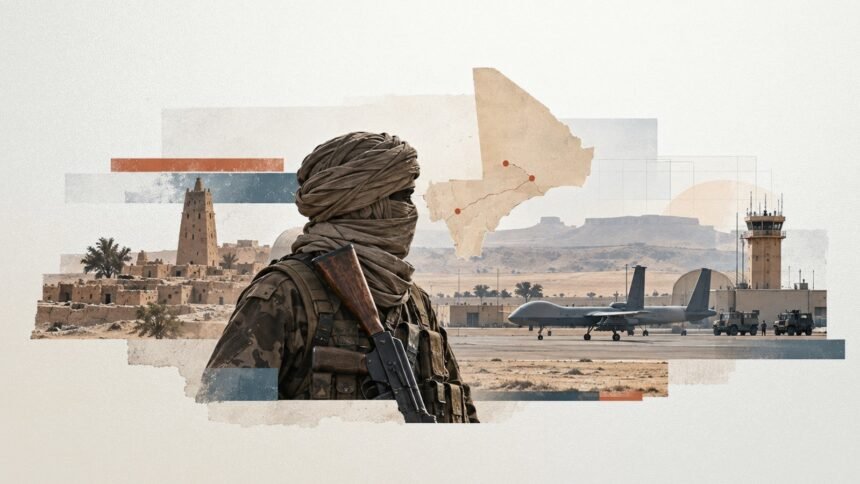
Six consecutive nights of shelling at an airport that houses military aircraft and drones. More than a hundred soldiers dead in a single attack on a garrison town. Motorbike-mounted fighters encircling a military camp fifty-five kilometers away. The picture emerging from central Mali this month is not of an isolated skirmish but of a sustained, multi-front campaign by al Qaeda-linked Jama’at Nusrat al-Islam wal Muslimin against a military government that seized power in successive coups in 2020 and 2021, promising, above all, to restore security. That promise now looks further from fulfillment than at any point since the juntas took Bamako. The episode crystallizes a dilemma facing security-focused governments across the Sahel: regimes that justify constitutional rupture on the grounds of counterinsurgency competence face a particular kind of legitimacy collapse when the insurgency not only persists but escalates under their watch. Mali’s military rulers have leaned heavily on foreign paramilitary support to compensate for a hollowed-out conventional army. This substitution raises its own question about what security sovereignty even means when the fighting force defending the nation’s soil answers, in significant part, to Moscow rather than Bamako.
Dioura’s Death Toll and the Fog of Junta Reporting
The September 10 attack on the town of Dioura produced wildly divergent casualty accounts that themselves speak to the opacity Mali’s junta has cultivated around battlefield losses. A security source told Reuters that 130 soldiers died with more than 100 taken hostage; a diplomatic source put the toll closer to 120; JNIM itself claimed 150 killed. The Malian army’s own statement acknowledged only that “some of our brothers-in-arms unfortunately fell on the field of honor,” while asserting that “significant losses were inflicted on the attackers,” a formulation that concedes the scale of the fighting without offering a verifiable number. This gap between institutional messaging and ground-level reporting is not incidental; it is structural to how military governments across the region manage battlefield setbacks, particularly when those setbacks undermine the security rationale that justifies continued suspension of civilian rule. Whatever the precise toll, a retaliatory operation described by the army itself as lasting more than a week indicates an engagement of a scale well beyond routine insurgent harassment.
Sevare’s Six Nights
JNIM’s parallel claim to have struck air defense systems at the airport in Sevare, a facility housing military aircraft and drones central to the junta’s counterinsurgency operations, points to an insurgency capable of sustained, targeted pressure on strategic infrastructure rather than opportunistic hit-and-run raids alone. A resident who visited Sevare’s hospital reported seeing roughly forty wounded Malian soldiers and Russian fighters, describing six consecutive nights of shelling as of Monday, a detail that speaks to both the intensity and the endurance of the assault. The same resident noted that Russian troops, present in Sevare in the recent past, were no longer visible in the town, a small but telling data point about where foreign paramilitary forces are choosing to concentrate, or withdraw, amid the fiercest fighting central Mali has seen this year. In nearby Konna, roughly fifty-five kilometers away, JNIM fighters on motorbikes appeared to have encircled the military camp entirely, according to two residents, suggesting an insurgent force operating with a level of mobility and coordination that a purely defensive counterinsurgency posture struggles to counter.
Africa Corps and the Cost of Outsourced Security
The Russian paramilitary group Africa Corps, the rebranded successor to Wagner’s Sahel operations, continues to support the Malian army in combat in both Dioura and Sevare, a partnership Bamako’s junta has defended as a necessary substitute for Western security cooperation withdrawn after the 2020 and 2021 coups. Yet the reported casualties among Russian fighters, wounded alongside Malian soldiers in Sevare’s hospital, and their apparent withdrawal from visible positions in the town this week, raise uncomfortable questions about the durability of that partnership under sustained pressure. Outsourcing national security to a foreign paramilitary force was always a wager that battlefield competence could substitute for the accountability and local legitimacy a national army is meant to embody. Six nights of uninterrupted shelling on a strategic airport, defended jointly by Malian and Russian forces, suggest that wager is not yet paying the dividends Bamako promised its citizens when it made it.
A Coup Government’s Widening Credibility Gap
April’s coordinated attacks, in which JNIM joined forces with the Tuareg-led separatist Front de Libération de l’Azawad to kill Mali’s defense minister and strike the country’s main airport, already exposed how far the insurgency’s reach extends beyond its traditional rural strongholds. This month’s assault on Dioura and the extended siege of Sevare deepen that exposure, demonstrating that even garrison towns and strategic military infrastructure, the assets a junta most needs to project competence, remain acutely vulnerable more than five years after the first coup promised to reverse this trajectory precisely. Each unverified casualty figure, each foreign paramilitary withdrawal from a contested town, chips further at the credibility Mali’s military government has staked its constitutional legitimacy on.
Sahelian Sovereignty at the Breaking Point
Mali’s crisis is no longer a localized counterinsurgency problem; it is a test of whether a military government that dissolved civilian rule in the name of security can survive the sustained demonstration that it cannot deliver that security, even with a foreign paramilitary force fighting alongside its own troops. The path toward genuine Sahelian sovereignty, one in which national governments rather than insurgent groups or foreign patrons control the country’s territory and its narrative, will require far more than retaliatory operations lasting a week at a time. It will require a reckoning with why five years of military rule, and years of reliance on Africa Corps, have produced an insurgency capable of encircling garrisons and shelling strategic airports six nights running. Until that reckoning happens, the residents of Sevare and Konna will keep counting the nights, and Mali’s junta will keep issuing statements that concede loss without ever quite naming its cost.