





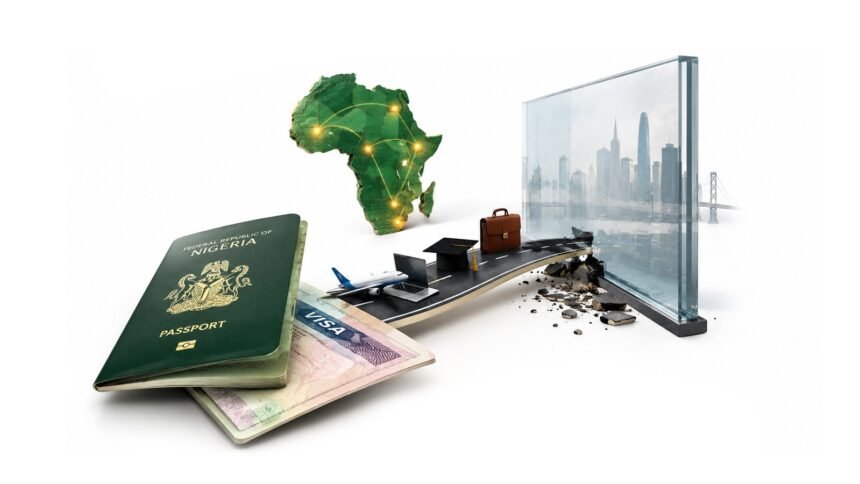
The Pan-African Paradigm of Mobility and Structural Exclusion
A Nigerian software engineer with a US job offer in hand, a Ghanaian graduate student weighing a fellowship, an Ethiopian founder hoping to pitch investors in San Francisco, all of them are now navigating an American visa system that has contracted more sharply against African applicants than against almost anyone else. New US State Department data shows non-immigrant visa issuances to African nationals fell by half in the five months after Washington’s $100,000 H-1B surcharge took effect, with Nigeria, long the continent’s largest source of US visa issuances, suffering an 86.7% collapse. This is not a story about skilled-worker visas alone; across nearly every category tracked, from student visas to tourism, the door has narrowed simultaneously. The paradigm this data forces into focus is one of structural exclusion dressed as immigration reform: a policy ostensibly targeting offshore outsourcing has instead fallen hardest on individual African mobility, at the exact moment the continent’s youth population and tech ambitions were beginning to command global attention.
The Numbers Behind the Squeeze
H-1B visa issuances fell 52% in the first five months of fiscal year 2026 compared with the same window a year earlier, dropping from 115,164 to 55,057, according to State Department data. The decline followed President Donald Trump’s extension of a $100,000 fee on the visa, first introduced in September 2025 and now set to run through September 2027 despite pending legal challenges. India, the program’s largest beneficiary, saw issuances collapse by 90% in January and February alone, reflecting the outsized role of Indian IT services firms in offshore H-1B sponsorship, precisely the model the fee was designed to disrupt. But the contraction did not stop at H-1B: total non-immigrant visa issuances fell by roughly one million over the same five-month window, from 4.54 million to 3.50 million, spanning categories from tourism to student exchanges to seasonal agricultural labor.
No Substitution, Just Contraction
Analysts and immigration advocates initially expected displaced H-1B applicants to pivot toward alternative pathways — the O-1 visa for extraordinary ability, or student and exchange visas as a foothold. The data does not support that theory. O-1 issuances fell 10.5% over the same period rather than rising to absorb displaced demand, while F-1 student visas dropped 44.7% and J-1 exchange visas fell 10.8%. Of the twelve visa categories tracked, only E-1/E-2 treaty trader and investor visas grew, and only marginally, by 1.8%. The uniformity of the decline across employment, education, and travel categories suggests the H-1B fee functioned less as a redirection of demand and more as a signal accompanying a broader tightening of US entry across the board — a distinction that matters because it forecloses the adaptive workarounds that skilled migrants and mobile professionals have historically found when a single visa route narrows.
Africa’s Disproportionate Loss
African countries received 168,078 US visas across tracked categories in the five months from October 2024 through February 2025; a year later, that figure had fallen to 84,485, a 50% decline, and a 58% drop compared with the same window in fiscal year 2023. Nigeria absorbed the sharpest fall of any African nation, plunging from 34,643 visas to just 4,595, with business and tourism visas alone dropping 90%. Nigeria had ranked as Africa’s top source of US visa issuances for three consecutive fiscal years; in the latest data, it ranks sixth, trailing Morocco, South Africa, Egypt, Ghana, and Kenya. Ethiopia’s issuances fell 72.6% and Egypt’s 52.7%, while African student visas fell 62.5% continent-wide. Morocco was the lone outlier, its business and tourism visa issuances rising 60%, possibly reflecting the clearance of a consular processing backlog in Casablanca rather than any change in US policy toward African applicants broadly.
What Gets Lost Beyond the Headline Visa
H-1B petitions have historically represented a small share of African migration to the US-Nigeria, the continent’s top beneficiary, recorded just 497 H-1B issuances in early FY2025, falling to 199 a year later. The far larger losses sit in business, tourism, and student visa categories, the everyday channels through which African entrepreneurs attend conferences, students pursue degrees, and professionals build the international networks that increasingly underpin the continent’s tech and business ecosystems. That distinction matters for how African governments and institutions should respond: the policy fight over H-1B fees, however consequential for individual skilled workers, obscures a much broader contraction in mobility that will shape African access to global capital, education, and markets for years, regardless of how ongoing legal challenges to the surcharge are ultimately resolved.
Reclaiming Mobility as Continental Leverage
The data makes clear that African mobility to the United States is contracting not because African applicants are being outcompeted for a fixed number of slots, but because the slots themselves are shrinking across nearly every category simultaneously. For a continent whose leaders have spent the past several years promoting the African Continental Free Trade Area, courting diaspora investment, and building tech ecosystems from Lagos to Nairobi that depend on global mobility and exchange, Washington’s tightening visa wall is a structural headwind that no single policy response can fully offset. What it does clarify is the stakes of continental self-reliance: intra-African mobility frameworks, homegrown venture capital, and partnerships with markets less prone to sudden immigration retrenchment become not aspirational goals but practical necessities, as the door to the pathway that built Silicon Valley’s engineering base continues, for African applicants most of all, to narrow.