




The Pan-African Paradigm of Climate Vulnerability and Fragmented Governance
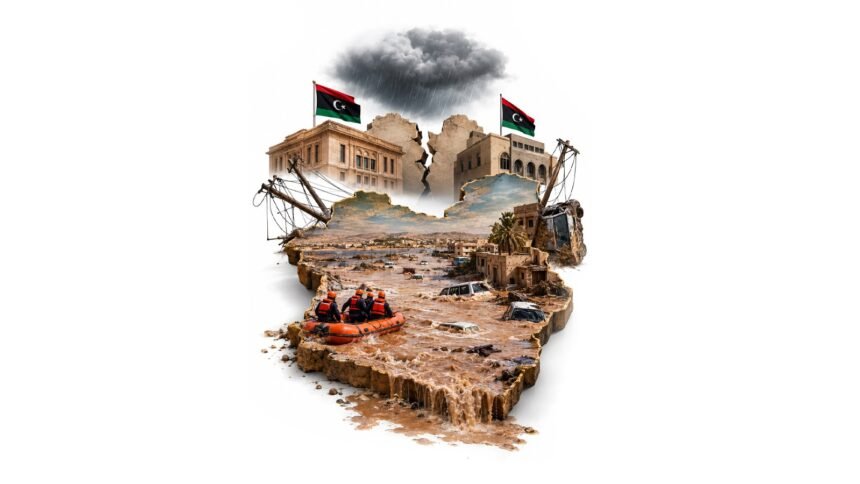
What does disaster response look like in a state that has spent more than a decade without a single, unified government? Overnight Friday, torrential rain tore through towns across western Libya, cutting electricity and running water, toppling power poles, and trapping residents in rivers of mud that swept vehicles from the road. In Mizda, a semi-desert town south of Tripoli where such rainfall is rare, and in Bani Walid and Nasmah further south, the flooding forced rescue operations and at least one formal disaster declaration. Libya’s exposure to extreme weather has intensified in recent years even as its capacity to respond has fragmented across competing administrations and militia-controlled territory. The paradigm the floods expose is a familiar one across the continent: climate volatility increasing at precisely the moment institutional capacity to absorb it is at its weakest. Reclaiming resilience will require Libya’s fractured political structures to coordinate around infrastructure and emergency response in ways they have struggled to manage on almost any other issue.
The Damage, Town by Town
In Mizda, a town of fewer than 30,000 people in a semi-desert region south of Tripoli where heavy rainfall is uncommon, municipal spokesman Omar Kachaka described a widespread power outage after numerous electricity poles collapsed, alongside additional damage and landslides. About 170 kilometers south of Tripoli, in the Bani Walid area, rescue teams worked to free residents trapped inside vehicles that had been swept away by mudflows. Further south still, in Nasmah, mayor Ahmed al-Sid declared the municipality a disaster zone, citing extensive damage from rainfall and overflowing wadis — the dry riverbeds that flash-flood rapidly and violently when rain arrives in quantities the terrain is not built to absorb. Social media video showed people trapped in cars or scrambling to escape the mud, images that circulated widely even as authorities had, as of Friday, confirmed no deaths.
A Government’s Limited Levers
Prime Minister Abdulhamid Dbeibah ordered authorities to mobilize resources immediately across affected areas, directing officials to clear roads and restore electricity, drinking water, and telecommunications. His office said he was closely monitoring the situation. But Dbeibah’s government is one of at least two rival administrations claiming authority in Libya, a fracture dating to the 2011 fall of Muammar Gaddafi and the civil conflict that followed, meaning the practical reach of any single set of orders varies considerably by region and by which armed factions control a given town. Emergency coordination in this context depends less on formal chains of command than on ad hoc cooperation between municipal officials, local security forces, and whichever national authority holds sway in a given area, a patchwork response model tested anew by every subsequent disaster.
Climate Volatility Meets Institutional Fragility
Libya’s semi-desert terrain, with limited natural drainage and infrastructure not designed for intense rainfall events, makes it particularly vulnerable to flash flooding when unusual weather systems arrive, a vulnerability starkly illustrated by the catastrophic 2023 Derna flood that killed thousands after dam failures. This week’s flooding, while so far less severe, again exposes the same underlying weakness: a country whose electricity grid, water systems, and road networks have not received sustained investment through more than a decade of political division cannot easily absorb climate shocks that are, by most projections, becoming more frequent across North Africa. Rebuilding that resilience would require exactly the kind of sustained, cross-factional infrastructure investment that Libya’s fragmented governance has consistently struggled to deliver.
Reclaiming Infrastructure as a National Priority
No deaths had been confirmed as of Friday, a relatively fortunate outcome given the scale of disruption described across Mizda, Bani Walid, and Nasmah. But fortune is not a resilience strategy, and Libya’s recurring exposure to catastrophic flooding, from this week’s mudflows to the far deadlier Derna disaster two years earlier, points to an unresolved structural question that outlasts any single storm: whether a country still governed by rival administrations can summon the sustained, depoliticized investment in drainage, grid resilience, and emergency response that climate volatility now demands. Reclaiming that capacity will matter more with each passing storm season, in a region where the underlying climate trend points toward more rain concentrated into more destructive, less predictable bursts.