




A Twice-Yearly HIV Prevention Shot Could Change How East Africa Fights the Virus, But Only If Supply Reaches the Clinics Where the Risk Is Highest.
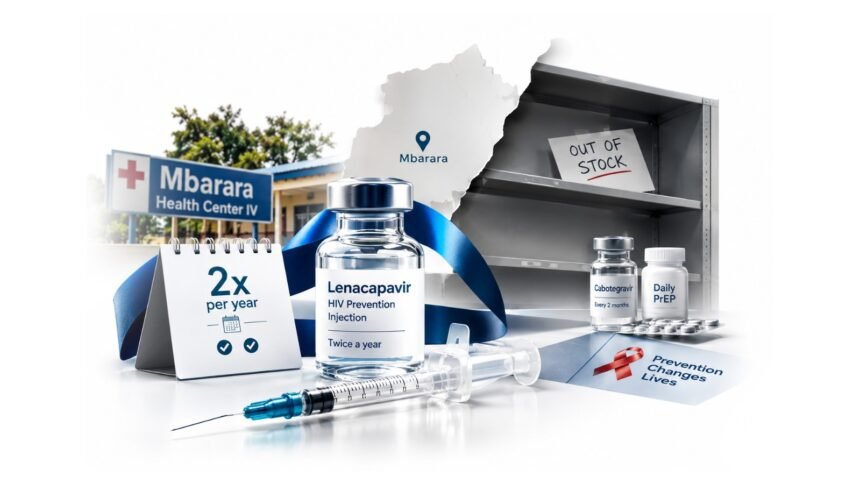
A medicine protects no one from a shelf in another country. In Mbarara, a city in western Uganda where the HIV rate is 10 percent, double the national average, the most promising prevention tool in years exists mainly as a name that people ask for at the clinic and are told has run out.
The drug is lenacapavir, made by Gilead Sciences. In 2025, the United States approved it as the world’s only twice-a-year shot to prevent HIV. In two major studies of people at high risk, it nearly eliminated new infections, doing better than daily preventive pills that users can forget to take. Some experts see it as the next best thing to a vaccine, which is still needed.
Rationed Across a Country of 45 Million
Uganda, a country of roughly 45 million people, has about 1.5 million people living with HIV. Health authorities identified Mbarara as one of the priority areas for lenacapavir after Uganda was included last year on the list of countries the United States government would help to obtain the drug. But only a few thousand doses are available, and they have been rationed across the country, sent to districts such as Lira in the north and to Mbarara.
So in Mbarara people are often offered cabotegravir instead, a pre-exposure prophylaxis injection given every two months. It is a real option, but it requires six visits a year rather than two. Dorcus Twinabaitu, a clinician who described herself as Mbarara’s HIV/AIDS focal person, called lenacapavir “the way to go, unless something even better comes on board.”
Why Six Months Matters in Kijungu
Mbarara has its own red-light district, Kijungu. Health authorities say infection trends in Uganda are now driven largely by paid sex in urban hot spots like Mbarara, where condom use is low and inconsistent. Tarsisio Biryeija, a nursing officer who works as a counselor at Mbarara Health Center IV, says many people do not understand the risks. “People go and enjoy their money; we have gotten these institutions (nightclubs) that are nearby us, and when it comes to the weekend, people go and enjoy without knowing that HIV is around the corner,” he said.
Immaculate Nyamwija, founder of the Mbarara-based organization Action for Improved Health and Wealth, which supports women who would face discrimination elsewhere, says sex workers are asking for lenacapavir because it gives them “breathing space” before the next injection. “Six months at least can give someone a breathing space and again, Len, once they inject it in your body it is good, because it is not like these pills that you are carrying every day,” she said.
One Rwandan sex worker in Mbarara, who did not want to be shown on camera because her family and friends do not know her work, described the same gap. She took daily oral prevention pills for a year before moving onto cabotegravir. She would prefer lenacapavir but says that when she asks for it, she is told it is finished. Women who move elsewhere for five months or longer, she says, would be far better protected by a shot that does not depend on remembering a daily pill.
Funding Cuts and Late Arrivals
Shortage of one drug is only part of the problem. Nyamwija says recent funding cuts have ended the outreach that once took services into communities. “We used to have outreaches whereby these outreaches were bringing services nearer to the communities – CBOs (community-based organizations), community peers working hand in hand with the health facilities. And they bring in these hotspot outreaches; they test people, they give PrEP,” she said. “But due to the funding cuts, those activities are no longer happening, and many people have poor health-seeking behaviors.”
Her concern is that people now wait until they feel ill before visiting a health facility, by which time the virus may already have passed to someone else. A long-acting jab can only change that pattern if someone is still in the community to test people and offer it.
The Global Numbers Behind the Local Shortage
The United States and the Global Fund want to buy lenacapavir for up to 3 million people by the end of 2028. The projection for 2026 is to reach 600,000 people in 24 countries. By mid-September, according to the Global Fund, 430,000 doses had been delivered, 327,000 of them initiation doses and 103,000 continuation doses, and national programs reported more than 118,000 people receiving the drug.
Gilead said in a statement that it shares “the sense of urgency” on expanding access. It said it will provide lenacapavir on a no-profit basis through its partnerships with the Global Fund and PEPFAR. At the same time, licensed generic manufacturers scale up, with initial generic supply expected in late 2026 and widespread generic availability expected in 2027. For Mbarara, that timetable means at least another year in which demand runs ahead of supply.
Prevention on Whose Timetable
Uganda’s access to a drug that could reshape its HIV response depends, for now, on purchasing plans made in Washington and Geneva and on the production schedule of one company. That is a familiar position for African health systems, and an uncomfortable one. The arrival of generic supply offers a way out, but only if African governments and regional bodies plan now to buy, distribute and deliver it themselves.
Health self-determination in this case is practical: enough doses in Mbarara’s clinics, outreach workers funded to reach Kijungu, and a supply line that does not run dry when a donor’s budget changes. Until then, the women most at risk will keep asking for protection and hearing that it is finished.