




A Divided Country, a Russian Port Call and a War Fought Far From Ukraine
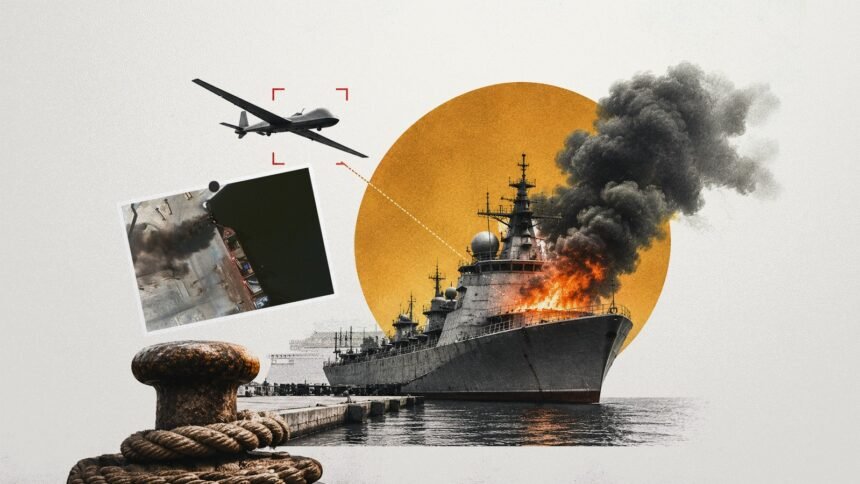
On Sunday 22 November, a column of smoke rose from the naval base in Benghazi, the main city of eastern Libya. A Russian vessel that had docked to refuel and take on supplies on its way home had been hit by an explosion and caught fire. Within hours, the eastern-based government backed by military commander Khalifa Haftar said the blast was most likely the work of drones. “Initial investigations indicate that the explosion occurred onboard a Russian ship docked in the port,” the administration said. “It is suspected that drones attacked the ship.”
Nobody has claimed responsibility, and there was no immediate reaction from Russian authorities. Yet the incident lands at a sensitive point for a country that has been split between rival authorities for more than a decade. For a continent where the war between Russia and Ukraine has repeatedly spilled beyond Europe through grain, fuel, mercenaries and now, it appears, naval strikes. For Libya, the question is less who fired than what it means when a North African port becomes a target in someone else’s war.
What Is Known So Far
The eastern authorities said the vessel had stopped in Benghazi under maritime cooperation agreements between Russia and the administration in the east. They gave no details of the ship or its cargo. A photograph circulated with satellite imagery identifies the vessel as Merkury, described as a Russian warship. Two medical sources said there were injuries but no deaths, although the number and nationalities of the injured were not known on Sunday.
The eastern government said port and naval facilities, including warehouses, were safe, that the fire had been brought under control and the site secured, and that normal operations would resume. It also said it had opened a joint investigation with Russia to “uncover the circumstances of the attack, its source, and the party behind it”. Accounts differ on the type of weapon: the eastern administration speaks of drones in general, other descriptions refer to a sea drone, and early footage has been read as showing a strike from above, potentially by an aerial drone launched only a few kilometers away. Until the investigation reports, the method remains unconfirmed.
A Statement Aimed at Both Moscow and Kyiv
The eastern government condemned the strike as a violation of Libya’s sovereignty and a threat to maritime safety, and promised legal and diplomatic measures against anyone found responsible. “The Libyan government will not allow Libyan ports, territory or territorial waters to be turned into an arena for settling scores or exporting international conflicts,” it said, adding that Libya was “not a party to the Russian-Ukrainian war”.
That line carries a double message. It reassures Moscow, a close partner of the Benghazi authorities, that the east will cooperate in finding the culprit. It also signals to Western governments and to the rival, UN-recognised government in Tripoli that the east does not want to be treated as a Russian base in a wider confrontation. Whether it can be both at once is the open question, since the port call itself took place under agreements with Russia.
A Pattern of Strikes Far From the Front
The Benghazi blast came a day after a drone struck the Russian cargo ship Sparta II in the eastern Baltic Sea, an attack that Finland’s military said was probably carried out by Ukraine. The vessel drifted into Finnish waters; its 16 crew were evacuated, and one was slightly injured. Earlier incidents connect the Mediterranean to the same pattern: a Russian liquefied natural gas carrier sank off the Libyan coast in March after an attack that President Vladimir Putin blamed on Ukraine, and last December Ukraine said it had used aerial drones to strike a Russian-linked oil tanker in the Mediterranean.
There are also unverified claims about Libya’s own soil. A small unit of Ukrainian special forces is believed to have been based at Misrata, in western Libya, and to have coordinated drone attacks on Russian tankers and transport ships over the past year. That presence has not been publicly confirmed, and nothing published so far ties any such unit to Sunday’s strike. The claim should be read as an allegation, not a fact.
Why Benghazi Matters to Russia
Russia is close to the eastern authorities and uses Benghazi port to supply Russian mercenary forces operating in Africa and as a foothold in the Mediterranean. That foothold has grown in importance since Russia lost its bases in Syria. That makes the port more than a refueling stop: it is a link in the logistics behind Russia’s military presence on the continent, which several African governments now rely on for security.
If a Ukrainian strike is confirmed, it would rank among the most successful naval attacks of the war and the farthest from the front line. It would also extend the fighting into a busy African port, with risks for civilians, dock workers and shipping that have nothing to do with the war. For an oil exporter that depends on its ports and on foreign partners’ confidence, a reputation as a place where drone attacks happen is a cost in itself.
Who Decides What Libya’s Ports Are For
Libya has been divided since the 2011 uprising that toppled Muammar Gaddafi, with a government in Tripoli and a rival administration in the east, each courting foreign backers. That division is what made the Benghazi port call possible in the first place: an eastern authority able to sign maritime agreements with Moscow on its own terms. The suspected strike exposes the cost of that arrangement. A country that cannot speak with one voice on who may use its harbors is poorly placed to stop others from fighting in them. The eastern government’s promise that Libyan waters will not become “an arena for settling scores” is the right principle. Making it real will require Libyans, not foreign partners, to agree on the rules for their own ports.