




When a Weather Shock Meets a Price Shock
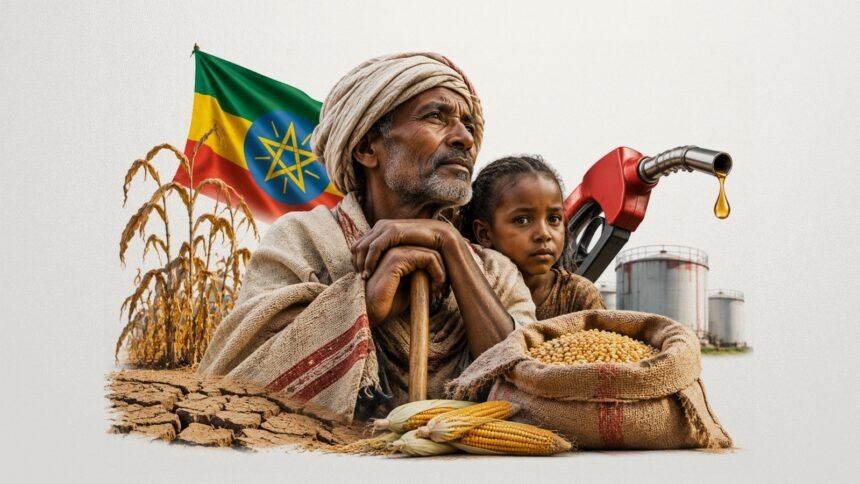
Drought rarely arrives alone. In Ethiopia, next year it may arrive alongside a fuel bill set by a war far beyond its borders. A new analysis by the International Food Policy Research Institute (IFPRI) projects that nearly 905,000 additional Ethiopians could be pushed into poverty in 2027, and 2.8 million more into undernourishment, as the effects of a potentially exceptionally strong El Niño converge with higher global fuel prices linked to the Iran war.
The study, published on 17 November by IFPRI researchers Emerta Aragie and Chris Hillbruner, uses the institute’s Rural Investment and Policy Analysis (RIAPA) model to trace how the two shocks could move through farm output, growth, household incomes, food prices, poverty and nutrition. It projects that gross domestic product could fall between 0.4 and 1.1 percent below its expected baseline, with an average decline of 0.8 percent. Agriculture takes a disproportionate share of the damage, with agricultural GDP projected to shrink by 2 percent in the average scenario.
The Meher Harvest Carries the Country
The reason lies in Ethiopia’s farming calendar. The meher harvest, gathered mostly between October and December, accounts for more than 95 percent of the country’s annual agricultural production. A poor main rainy season therefore reaches almost every household that grows or buys food. The researchers model three scenarios for the 2026 meher harvest: mild, moderate and severe El Niño effects, with national agricultural productivity falling by 1, 2 and 3 percent respectively.
The losses would not be spread evenly. Production in dry highland areas is projected to fall by 9.6 percent and in dry lowland areas by 6.5 percent, while moist highland and lowland systems would be hit far less. The same weather pattern that threatens drought in the north and east may also bring flooding in parts of the south, which is why humanitarian agencies have stressed anticipatory action: repairing water systems, strengthening early warning and preparing communities for floods and waterborne disease as the October to December rains unfold.
Fuel Prices From the Strait of Hormuz
El Niño is the main driver of the projected slowdown, the researchers say, but the second shock matters for poverty. Higher global fuel prices tied to disruption of shipping through the Strait of Hormuz add pressure on household incomes, purchasing power and food security. The fuel shock has comparatively small effects on farm output and national GDP. Yet, it accounts for about 472,000 of the additional people projected to fall into poverty and 699,000 of those projected to become undernourished.
Agricultural commodity prices could rise by 0.3 to 1 percent under the El Niño scenarios. Real household spending could drop by an average of 1.9 percent, with urban households facing a steeper fall of 2.8 percent against 1.5 percent for rural households. Even so, more than 57 percent of those newly pushed into poverty, and about 76 percent of those falling into undernourishment, would be in rural areas. Poverty is measured against the international $3-a-day line, and undernourishment as consuming fewer than about 1,850 kilocalories per adult equivalent a day. “These price and income effects have a significant impact on the population’s well-being,” the researchers write.
Scenarios, Not Certainties
The authors are careful about the limits of their numbers. They say climate-related projections carry more uncertainty than those based on global market prices, especially without large-scale crop assessments. They describe their results as scenarios intended to inform early intervention, not definitive forecasts. The final impact will depend on how rain falls, how the harvest performs, where crop losses are concentrated, and how ongoing conflicts evolve. They also warn that continued fighting in northern Ethiopia could deepen food insecurity, although its specific economic and nutritional effects are hard to quantify.
Those caveats do not make the warning less urgent. Ethiopia already faces insecurity, displacement and high food prices. The World Food Program’s September 2026 country brief put food inflation at about 15 percent and identified insecurity and climate shocks as forces eroding household resilience.
Safety Nets and a Shrinking Aid Pool
Ethiopia has tools to cushion the blow, above all the Productive Safety Net Program (PSNP). But IFPRI’s projections already include the food and cash transfers the program normally provides, which implies that extra assistance will be needed to prevent further harm. The researchers expect emergency food needs to peak between June and August 2027, making early planning and resource mobilization essential at a time when key donors are cutting humanitarian contributions. The Food and Agriculture Organization has appealed for $50 million to help 4.66 million people in 114 priority woredas between June 2026 and March 2027, including livestock protection, farm inputs, and emergency cash for drought-affected communities in Afar, Amhara, northern Somali, and Tigray regions.
Planning on Ethiopia’s Own Terms
The value of a study like this lies in its timing. It gives Ethiopian planners a window of several months before needs peak. Countries that act on early warnings with their own budgets, their own safety nets and their own data keep more control over how a crisis unfolds and who is helped first. Countries that wait for appeals to be funded after harvests fail tend to lose that control to the speed and priorities of outside donors. With aid budgets shrinking and two global shocks arriving at once, the most important decisions about Ethiopia’s 2027 lean season will be made, or missed, in the coming months in Addis Ababa.