


A Government-Founded Biennale Meets a Year of Debt and Departures
Visitors walking into the Democratic Republic of Congo’s exhibition at this year’s Dakar Biennale find themselves facing a large mirror that surrounds them. “You are standing in front of a large mirror that surrounds you, and you imagine what we have done to these people and to Africa, what we have done to the DRC,” says the curator, Steve Bandoma. The pavilion, titled “Fourth Movement: Time as Living Matter”, turns the viewer into part of the work, and it sets the tone for a 16th edition of the Biennale of Contemporary African Art built around a single, awkward idea: that fragility can be a starting point rather than an end.
The theme, “(Anti)fragility”, explores repair, resilience and rebound. Its timing is not accidental. Senegal is living through a hard year, with living costs rising as the government wrestles with heavy debt, and with thousands of people taking the dangerous Atlantic route towards Europe. Around the continent, cultural institutions are asking a version of the same question: whether art made and shown in Africa can do more than decorate a crisis, and whether it can help people understand and survive one. Dak’Art, founded by the Senegalese government in 1989 and held every two years, has become one of the most important meeting points for African artists, which gives its answer more weight than most.
A Theme Built on a Paradox
The artistic director, Morad Montazami, describes the concept as deliberately contradictory. “It’s a paradoxical concept. We put ‘anti-‘ in parentheses because, to be ‘anti-fragile,’ you must first embrace or accept fragility,” he said. He set out three possibilities: something that shatters under a shock is fragile, something that withstands it is robust, and something that becomes stronger because of the shock belongs to a third category.
For Montazami, that third category is where the region now finds itself. “Crises give rise to new systems of thought,” he said. He argues that this makes it more important, not less, for artists to create, gather and exhibit, and he rejects the idea that culture is something to be funded only in good times. “At its core, our struggle is about demonstrating that art is not an accessory, that it is not a luxury,” he said. “Ultimately, it is a common good and a resource.”
Fifty-Four Artists in an Old Courthouse
The official selection brings together 54 artists, alongside 22 participants in the design section, from across Africa and its diaspora, with three artists given carte blanche. One count puts the artists at 17 African countries. The flagship exhibition occupies Dakar’s former courthouse, a building that is slightly decaying but still majestic. Around 450 further projects make up the OFF program, in venues ranging from five-star hotels to neighborhood galleries in Dakar and in other Senegalese cities, and the Biennale runs until 19 December. The edition opened this week, with Friday 20 November the first day open to the general public.
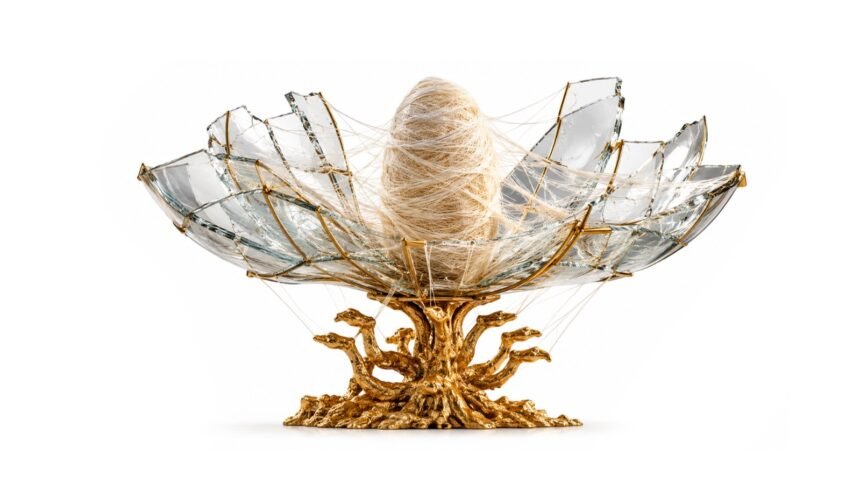
The works on show range widely: an installation made of thousands of silkworm cocoons, intimate watercolors on the fragility of the human body, large canvases about the joy and pain of motherhood, and marble-like centaur statues. The official exhibition also includes work by patients from Senegal’s psychiatric hospitals and by marginalized groups, and a large section devoted to children, stretching the boundaries of who is recognized as an artist.
Gold Miners as a Monster That Will Not Die
Among the most direct pieces is the work of the Cameroonian artist Jean-David Nkot, who reimagines the Hydra of Greek myth, the monster that grew new heads whenever one was cut off, as gold miners in eastern Cameroon. The choice speaks to a regional debate: across West and Central Africa, governments are moving to reclaim control over natural resources, yet working conditions for miners remain poor.
“I wanted to show the ability of bodies to overcome and to re-create themselves in the context of confinement and suffering,” Nkot said. “The living conditions of these miners are so improbable that I want to show the strength that they bring to society, and show how that even in the most difficult times, they manage to surpass themselves and rebuild themselves.”
Memory, Democracy and an Audience
Younger artists are using the Biennale to reach people they would not otherwise reach. Whitney Chinonye Ernest, a Ghanaian data artist, works with a collective of women artists who chronicle the continent’s journey towards democracy. “It is important to me to be here, because as an artist, the work becomes useful, at least to me, when it can reach people and when it can educate,” she said. She wants visitors to understand “how much effort it has taken for African nations to get where they are.”
Collectors are watching too. Claire Whitner and Samantha Cataldo, curators at the Worcester Art Museum in Massachusetts, came to scout new African artists. “Our city has a lot of West African immigrants, and so we want our collection to be able to respond to what our community looks like,” Cataldo said, adding that it now “feels unethical to collect traditional African art” and that contemporary work offers a different path. For first-time visitor Kuadio Adai, the experience was simpler: “It’s been very rewarding; it’s very powerful to feel and see all this artwork and the energy here.”
Who Gets to Show African Art
Dak’Art’s lasting value lies in where it happens. For a month, African artists are shown in an African capital, at an event founded and still run by an African state, with foreign museums arriving as guests and buyers rather than as the people who decide what counts. That matters at a moment when restitution claims and debates over who owns African heritage are sharpening. The test for Senegal’s government, which founded the event and still carries it through a difficult budget year, is whether it keeps funding culture as a public good, as Montazami insists it is, and whether the artists shown in the old courthouse can build careers at home rather than only on the route to galleries abroad.