




The Pan-African Paradigm of Human Security and Territorial Sovereignty
Across the African landscape, the contemporary execution of regional stability frameworks faces severe pressure from overlapping internal conflicts that challenge the traditional foundations of state sovereignty. The Pan-African vision for long-term development and structural transformation relies fundamentally on creating safe environments where civil populations can participate in education, trade, and civic life without fear of violence. When non-state armed actors and asymmetric insurgencies intentionally target public infrastructure and learning centers, they disrupt the baseline stability of local communities. Reclaiming the continent’s collective security future requires a decisive shift away from reactive, localized policing toward comprehensive, integrated regional defense networks that protect civilian spaces and ensure that state authority remains strong across all borders.
Overlapping Crises and Multi-Front Vulnerabilities
The contemporary macroeconomic and political profile of the Federal Republic of Nigeria is heavily challenged by overlapping security crises that span its entire territory. The nation’s administrative architecture must simultaneously manage a persistent jihadist insurgency in the northeastern corridor, heavily armed criminal networks in the northwest, and recurring sectarian violence over land and resources across the middle belt. This highly complex threat environment places an extraordinary burden on national defense budgets and fractures the state’s military deployment capabilities. For central planners in Abuja, stabilizing the domestic public sphere requires an integrated strategy that addresses the underlying economic marginalization and governance deficits that allow these multi-front vulnerabilities to expand.
The Legacy of a Fifteen-Year Fractured Insurgency
The primary source of long-term destabilization within the northeastern borderlands remains driven by the radical Islamist campaigns of Boko Haram and its highly active offshoot, the Islamic State West Africa Province (ISWAP). For more than 15 years, these extremist groups have waged a relentless conflict against the federal state, aiming to dismantle secular governance and establish strict ideological enclaves across the Lake Chad basin. Borno State has long served as the violent epicenter of this Islamist insurgency, enduring thousands of casualties, structural destruction, and mass displacements. While prolonged counter-insurgency operations have successfully fractured the groups’ centralized command networks, their remaining factions continue to utilize asymmetric hit-and-run tactics to disrupt municipal integration and terrorize rural populations.
The Rise of Armed Gangs and Rural Bandits
Beyond the ideological operations of religious extremists, the stabilization of the Nigerian interior is further complicated by the rapid proliferation of other militias, local defense groups, and heavily armed syndicates. In the northwest and north-central zones, fluid networks of rural bandits operate outside formal political frameworks, taking advantage of vast, unmonitored forests to establish fortresses for criminal economies. These heavily armed groups frequently exploit ethnic and sectarian grievances, turning long-standing resource disputes between pastoralist and farming communities into violent conflicts. The rise of these decentralized militias undermines the state’s monopoly on the use of force, creating a highly volatile social landscape where local communities feel compelled to fund private security forces for basic protection.
The Targeting of Educational Infrastructure in Borno State
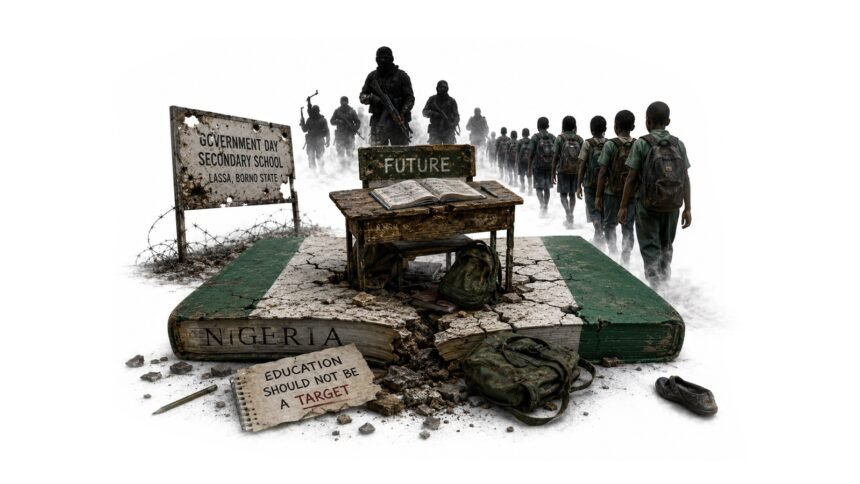
The economic model of rural criminality reached a distressing manifestation on Monday morning, June 29, 2026, during a high-profile mass kidnapping targeting educational infrastructure in northeastern Borno State. Heavy gunfire burst into the Government Day Secondary School in the town of Lassa, firing sporadically as they charged the complex. The assault was intentionally timed to disrupt national examinations usually taken by vulnerable 16- and 17-year-old students.
Following the initial attack, a swift military intervention tracking the armed gang led to a fierce firefight, enabling troops to rescue 10 students and teachers unharmed. However, the operational reality remains difficult; one soldier and one member of a paramilitary support force were killed during the rescue, and numerous other students remain unaccounted for in nearby forests as security agencies conduct emergency searches. This incident highlights a continuous, regional pattern of mass abductions for ransom, where criminal networks intentionally target vulnerable youth to extract financial concessions from the state and terrorize local populations.
Tactical Counter-Insurgency and Intelligence Sharing
The long-term defense of West Africa’s primary economic engine relies heavily on the continuous maintenance of strategic bilateral frameworks, specifically the ongoing Nigeria-US security cooperation matrix. Washington has historically provided significant technical assistance, tactical counterinsurgency training, and advanced logistics equipment to help the Nigerian Armed Forces address high-consequence threats. This partnership focuses primarily on expanding intelligence-sharing networks, upgrading aerial surveillance capabilities, and strengthening precision-strike capabilities against entrenched insurgent fortresses. However, international military analysts emphasize that to be fully effective, this bilateral cooperation must transition from short-term tactical assistance to supporting comprehensive military reforms that enhance operational accountability and tactical discipline in active combat zones.
Multilateral Stabilization and Post-Conflict Reconstruction
The macro-level response to the regional security crisis is reinforced by the synchronized interventions of the African Union and the United Nations through multi-layered stabilization programs. These multilateral initiatives provide essential funding for regional joint task forces, secure cross-border transit corridors, and deliver immediate humanitarian relief to hundreds of thousands of internally displaced persons. Beyond providing immediate physical protection, AU-UN programs are increasingly focused on post-conflict reconstruction and civic reintegration. By funding local governance modernizations, de-radicalization centers, and community infrastructure repairs, these international bodies work to rebuild the basic social fabric necessary to prevent the re-emergence of violent extremist networks.
Rebuilding Rule of Law and Civilian Safeguards
The path forward for Nigeria and the wider West African economic corridor depends on an absolute commitment to upholding human rights, restoring the rule of law, and creating inclusive civilian safeguards. Managing deep-seated internal conflicts through purely militarized strategies can provide temporary relief. Still, long-term peace cannot be achieved if the basic rights and dignity of local populations are compromised during security operations.
National planning ministries must prioritize sustainable investments to secure public classrooms, expand rural economic opportunities, and guarantee equal protection under the law for all citizens, regardless of region or ethnicity. By combining disciplined security operations with an unyielding commitment to social justice and constitutional integrity, the republic can transform its current defense challenges into a lasting foundation for a stable, prosperous, and completely self-determining future.