



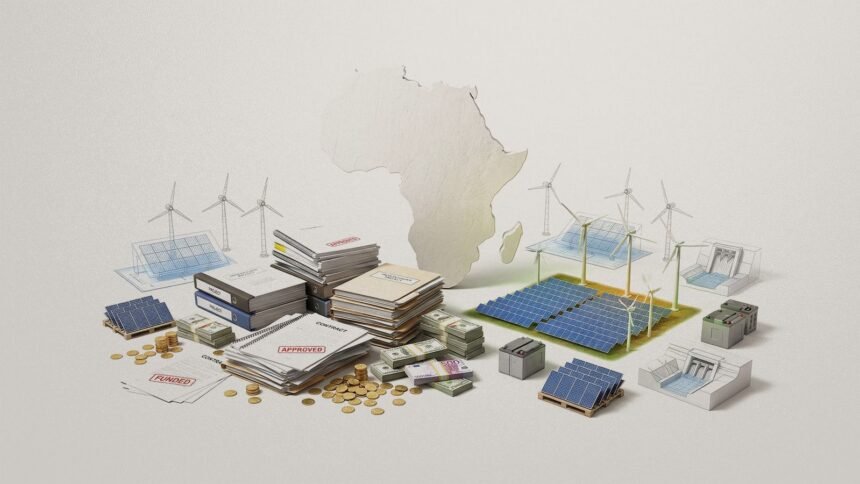
Backed by fresh European pledges, the Sustainable Energy Fund for Africa aims to mobilize $2.5 billion for renewables, even as it approves fewer projects and shifts to bigger bets.
On March 4 in Nairobi, as African leaders and development bankers filed out of yet another energy summit, one announcement stood out: the continent’s flagship clean energy fund said it planned to more than double the capital it mobilizes for renewables to about 2.5 billion dollars over the next two years.
The Sustainable Energy Fund for Africa, or SEFA, housed at the African Development Bank, cast the move as evidence that investors were finally treating African clean energy as an opportunity, not charity.
The catch was buried in the details. The money is rising, but the number of projects SEFA is backing has dipped. In a continent where hundreds of millions of people still live without electricity, the math raised a pointed question: can bigger, fewer projects deliver the just energy transition African governments have been promised.
How the Fund Got Here
SEFA was created in 2011 as a blended‑finance vehicle within the African Development Bank, designed to take early risks on projects that private investors considered too uncertain, ranging from mini‑grids to efficiency schemes and small renewables. Since then, it has helped mobilize roughly 1 billion dollars in additional commercial capital alongside its own concessional funding, according to bank officials.
By 2025, donor appetite had clearly shifted. Contributions to SEFA rose to about 88 million dollars that year, up from 54.3 million dollars in 2024, with most of the increase coming from European Union member states.
Cumulatively, donor commitments to the fund have climbed to around 577 million dollars, backed by countries led by Denmark, Germany, Italy, and others.
The March announcement, a target of roughly 2.5 billion dollars in total capital mobilized for clean energy projects within about two years, based on the current pipeline, is not all SEFA’s own money. Rather, it reflects the larger pools of private and institutional finance the fund believes it can draw into African projects using its grants, concessional loans, and guarantees as leverage.
Bank officials say the portfolio could generate more than 10 billion dollars in commercial capital by 2030 if current trends hold.
Europe’s Money, Africa’s Transition
SEFA’s growth sits within a broader wave of European climate finance promises to Africa. Under the Africa–EU Green Energy Initiative, “Team Europe”, the European Commission, member states, and development banks have pledged more than 20 billion euros to support green energy investments, aiming to deploy at least 50 gigawatts of renewable capacity and provide electricity to at least 100 million people in Africa by 2030.
Those efforts feed into the EU’s Global Gateway Africa–Europe Investment Package, which seeks to leverage up to 150 billion euros across sectors, with energy a central pillar.
Germany recently committed about 40.1 million dollars in additional support to SEFA for universal energy access and green hydrogen programs, while Italy pledged around 5.9 million dollars, according to fund disclosures.
European officials describe this as hard‑headed industrial policy as much as climate diplomacy: supporting African renewables and green hydrogen, they argue, could help secure future supply chains for clean fuels and critical minerals while stabilizing a region acutely vulnerable to climate shocks.
More Money, Fewer Approvals
Yet SEFA’s own portfolio tells a more complicated story. In 2024, the fund approved 14 renewable energy projects in countries including Kenya, Nigeria, Burkina Faso, Ethiopia, and Chad, with about 108 million dollars in AfDB financing, adding roughly 840 megawatts of new capacity and 1.5 million new electricity connections.
In 2025, the number of approved projects fell to 13 and total financing to about $ 97 million, even as donor pledges increased.
“The last two years have been among our strongest, with 27 projects approved, broadly comparable in funding volumes and significantly higher than earlier years,” João Cunha, manager of SEFA at the AfDB, said in remarks cited by the bank.
Kevin Kariuki, vice president for power, energy, climate, and green growth at the bank, argued that “SEFA is proving its catalytic value on the ground, with accelerated approvals and disbursements and growing impact.”
Fund managers say the tilt toward fewer projects reflects a shift into larger, more complex investments in “green baseload”, grid‑connected renewables and storage, alongside mini‑grids and efficiency projects that can unlock larger volumes of follow‑on capital.
In 2024, eight of SEFA’s approved operations were green baseload, two were mini‑grids, and four were energy efficiency initiatives; in 2025, most approvals again fell under green baseload, with fewer mini‑grid and efficiency deals.
Critics warn that a focus on scale can come at a cost. Smaller developers and community‑level initiatives can struggle to meet the stringent technical and financial criteria set by big blended‑finance vehicles, leaving promising but modest projects stranded in what practitioners call the “missing middle.”
In politically fragile or low‑income countries, where project preparation is slow and regulatory risk is high, some analysts worry that capital will continue to gravitate toward a handful of comparatively “safe” markets, such as Morocco, Kenya, or South Africa.
What It Means on the Ground
For African governments, SEFA’s March 4 announcement is both a reassurance and a reminder. It signals that, despite global economic headwinds and tight public budgets, there is still a growing appetite among European donors and development banks to finance African renewables. It also underlines how much of that support is now channeled through instruments that expect to crowd in private capital, rather than traditional grants.
Advocates argue that this model is necessary if Africa is to close an energy financing gap that major outlooks estimate at tens of billions of dollars per year. They point to SEFA‑backed mini‑grid and distributed solar projects that have helped bring first‑time electricity access to rural communities, often at lower lifetime costs than diesel generators.
But the trend toward larger, more sophisticated projects and fewer approvals raises questions about who will benefit first. Countries with stronger institutions and clearer policy frameworks are best placed to absorb complex blended‑finance packages. Places where the need for energy access is greatest are often those where it is hardest to assemble bankable deals.
That tension mirrors a broader debate over climate finance. Whether the priority should be maximizing total gigawatts installed and private capital mobilized, or ensuring that money flows to the poorest and most energy‑poor communities, even if projects are smaller or harder to structure.
A High-Stakes Bet to 2030
SEFA’s 2.5‑billion‑dollar target is, in one sense, a bet on Africa’s political and regulatory future. It assumes that governments will keep pushing reforms that make it easier for private investors to enter renewables markets, from clearer tariff rules to faster permitting and more independent regulators.
If those conditions materialize, the fund’s managers say, each dollar of concessional funding can unlock many more in private capital, with the portfolio potentially mobilizing more than 10 billion dollars by 2030.
If they do not, Africa could find itself with well‑funded vehicles and ambitious targets but too few viable projects to absorb the money, a mismatch already visible in the gap between growing donor contributions and slightly shrinking annual approvals.
For now, though, the March 4 announcement offers a rare story of expansion in a climate finance landscape where many funds are struggling to raise new resources. Whether more money and fewer deals can add up to a fairer energy transition for the continent will be measured not in pledges from Brussels or Abidjan, but in megawatts on the grid and lights switched on in homes and businesses from Dakar to Dar es Salaam.