





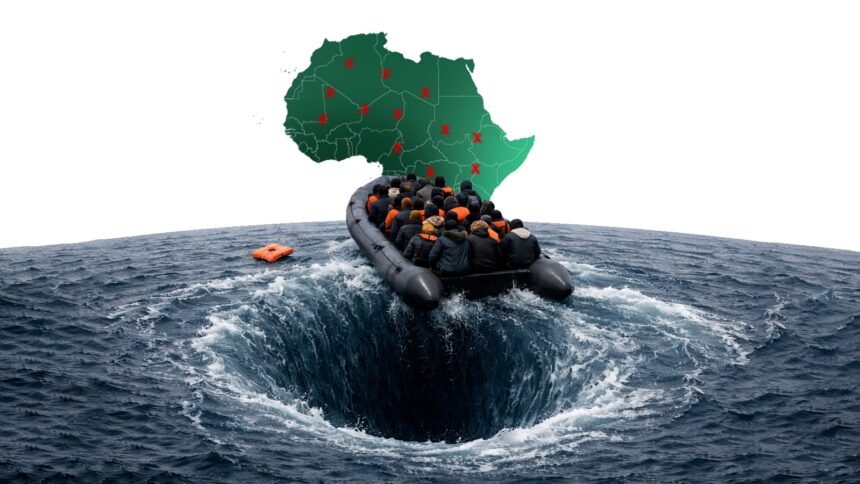
The relentless surge of migrant fatalities at sea from African shores to Europe paints a harrowing portrait of desperation unmet by adequate safeguards, with 2026’s early tragedies underscoring the urgent imperative for enhanced protections. In February 2026 alone, a capsized vessel off Libya’s Zuwara claimed 53 lives or presumed missing, including two infants, amid a rubber boat carrying 55 African nationals that succumbed to water ingress mere hours after departing Zawiya. This incident, rescuing only two Nigerian women who lost husbands and children, elevates the Central Mediterranean’s 2026 toll to at least 484, building on a grim continuum: over 33,000 dead or missing since 2014, with yearly escalations from 1,450 in 2020 to peaks of 3,155 in 2023 before dipping to 1,873 in 2025. Harsh weather, unseaworthy vessels, and smuggling operations perpetuate this lethality, necessitating robust measures, from expanded legal pathways to robust rescue operations, to honor human dignity and stem the oceanic hemorrhage of Africa’s displaced.
Pan African Perils: Continental Crises Fueling Fatal Crossings
Across the Pan-African landscape, systemic perils rooted in conflict, scarcity, and inequity propel fatal sea crossings, where sub-Saharan hardships converge with North African gateways in a deadly exodus. Youthful populations facing unemployment gradients exceeding 50 percent in Ethiopia or Nigeria, intertwined with Sahelian insurgencies displacing millions from Mali and Burkina Faso, ignite northward imperatives that culminate in maritime gambles. Sudan’s strife and encroachment of desertification amplify this, funneling families through Saharan gauntlets into Libyan limbo, where over 850,000 migrants linger in vulnerability. The 2026 Zuwara tragedy, mirroring 2025’s 1,873 Mediterranean losses, predominantly on Central routes with 895 fatalities, highlights how Pan-African unity falters amid developmental lags: stalled free movement pacts exacerbate irregularity, binding continental aspirations to lethal waves that claim one in 120 on perilous legs, urging collective safeguards to retain human capital within Africa’s bounds.
Libya’s Lethal Launchpads: Fractured Gateways to Oceanic Graves
Libya’s lethal launchpads, marred by schisms and predation, serve as fractured gateways where migrant dreams dissolve into oceanic graves, amplifying calls for localized protections amid enduring turmoil. The nation’s balkanization, eastern Haftar’s domain versus western Tripoli’s fragility, exacerbated by a 2025 command plane crash and oil graft siphoning $20 billion, fosters anarchy that smuggling syndicates exploit, dispatching overloaded dinghies from Zawiya or Zuwara. The February 2026 capsizing, with 53 presumed lost in frigid waters, echoes 2025’s Central Mediterranean surge: 1,745 regional deaths amid militia economies blending fuel diversions with human cargo. Detention horrors in Kufra or Tobruk, where mass graves unearthed 21 tortured bodies in January 2026, prelude fatal voyages, demanding Libya-specific measures: unified coast guards, anti-corruption drives, and humane repatriations to curtail the launchpads’ toll.
Illegal Immigration Imperatives: Desperate Voyages Demand Deterrence Alternatives
The imperatives of illegal immigration from Africa underscore desperate voyages that exact oceanic tolls, where fortified borders reroute perils and necessitate alternatives to deterrence that prioritize life. Rerouted paths, Mauritania’s EU-pacts slashing departures yet channeling to Guinea’s 2,200-kilometer Atlantic hauls, inflated 2025’s Canary fatalities to 1,906, with 303 shipwrecks including 70 vanishings. Libya’s Central corridor, which claims 484 in early 2026, intertwines with eastern arms pacts, such as Pakistan’s $4 billion deal that bolsters Haftar, potentially loosening coastal oversight. These imperatives reveal the rationale for irregularity: absent legal conduits, Sub-Saharan migrants risk the seas, with 2020-2026 tallies rising from 1,450 to partial-year spikes, prompting visa liberalizations and skilled labor exchanges to mitigate the deadly drift toward Europe’s borders.
Human Trafficking Shadows: Exploitation Chains Leading to Sea-Borne Tragedies
Human trafficking casts long shadows over African migrations, forging exploitation chains that culminate in sea-borne tragedies, where predators profit from vulnerability and highlight the need for dismantling networks through vigilant protection. In Libyan dens, traffickers, emboldened by oil heists funding militia fiefdoms, ensnare transients in torture auctions before overloading vessels, as in the 2026 Zuwara incident, where African nationals perished en masse. Mauritanian abuses, amid €210 million EU funds, propel victims to Balearics routes, claiming 1,037 in 2025, blending coercion with crossings. These shadows, claiming 437 minors and 192 women in Spain attempts alone, extend from Sahelian recruitments to Saharan extortions, with 2026’s early 484 amplifying a decade’s 33,000 toll. Eradicating them requires cross-border investigations, survivor-centered rescues, and empowerment in the origin zones to sever the chains that bind desperation to death.
UN-AU Efforts: Collaborative Shields Against Maritime Losses
UN-AU efforts erect collaborative shields against maritime losses, yet implementation gaps call for stronger commitments to protect Africa’s migrants from the sea’s hazards. IOM’s Missing Migrants tallies, over 1,300 Central Mediterranean deaths in 2025, 484 in early 2026, spur repatriation drives airlifting thousands with reintegration aids, while advocacy exposes detention atrocities. AU synergies emphasize upstream stabilizations, infusing Sahel with development to curb outflows, as in voluntary returns from Libyan limbo. These efforts, navigating Libya’s divisions post-2025 crash, include distress protocols that facilitate rescues in Zuwara. Still, scale mismatches persist: humanitarian capacity lags demand, prompting fortified UN-AU pacts for timely interventions and legal pathways that transcend palliative responses.
Khartoum Process: Dialogues for Safer African-European Transits
The Khartoum Process, a pivotal dialogue for safer African-European transits, convenes stakeholders to combat trafficking and losses at sea, yet requires deeper enforcement to stem fatalities like 2026’s tragedies. Launched in 2014, this EU-Horn of Africa initiative, encompassing 40 nations, fosters border management, anti-smuggling operations, and return mechanisms, addressing root causes through development aid. Amid 2025’s 1,873 Mediterranean toll, it bolsters Mauritanian patrols curbing Atlantic departures, yet reroutes to deadlier paths underscore limitations: invisible shipwrecks in harsh weather evade responses. Enhancing the process requires expanded legal mobility, joint patrols, and data sharing to preempt risks, transforming dialogue into a lifeline for transit plagued by exploitation.
Protection Paradigms: Urgent Reforms to Avert Oceanic Tragedies
Protection paradigms must urgently evolve to avert oceanic tragedies, where Africa’s migrant deaths at sea, peaking at 3,155 in 2023, with 2026’s early surge, demand reforms centering dignity over deterrence. Bolstering rescues through AU-EU fleets equipped for swift responses could mitigate capsizings like Zuwara’s, while dismantling trafficking via sanctioned networks halts commodification. Legal pathways, visas for skills, climate refugees, decompress irregularity, and origin investments in Sahelian resilience against pushes. Pan-African compacts, amplifying Khartoum’s ethos, urge unified safeguards: humane detention, anti-corruption measures in Libya, and global funds for reintegration. These paradigms, honoring the lost, reposition migration as opportunity, not obituary, forging futures where seas unite rather than swallow Africa’s hopeful.


