




The Pan-African Paradigm of Constitutional Erosion and Popular Resistance
Across the African landscape, the tension between centralized executive power and the citizens’ claim to self-determination remains one of the continent’s defining structural fault lines. Tunisia’s latest wave of street demonstrations against President Kais Saied is not an isolated flashpoint but another data point in a broader continental pattern: post-independence democracies straining under executive overreach, judicial capture, and economic stagnation. What began in July 2021 as an emergency intervention has, over five years, calcified into what critics describe as one-person rule, a trajectory disturbingly familiar to observers of governance across North and West Africa alike. The Tunisian case matters beyond its borders because Tunisia was, for over a decade, held up as the Arab Spring’s lone democratic survivor, the proof that a Maghrebi republic could rebuild institutions from the wreckage of autocracy. Its backsliding therefore carries a symbolic weight disproportionate to its size, testing whether African publics can still compel accountability from leaders who claim the mantle of anti-corruption while dismantling the very checks meant to constrain them. As Tunisians return to the streets of Tunis, the country is emerging as a live test case in the broader African project of reclaiming constitutional sovereignty from executives who have learned to wield the language of reform as a shield against scrutiny.
Streets of Tunis: The Anatomy of a Recurring Mobilization
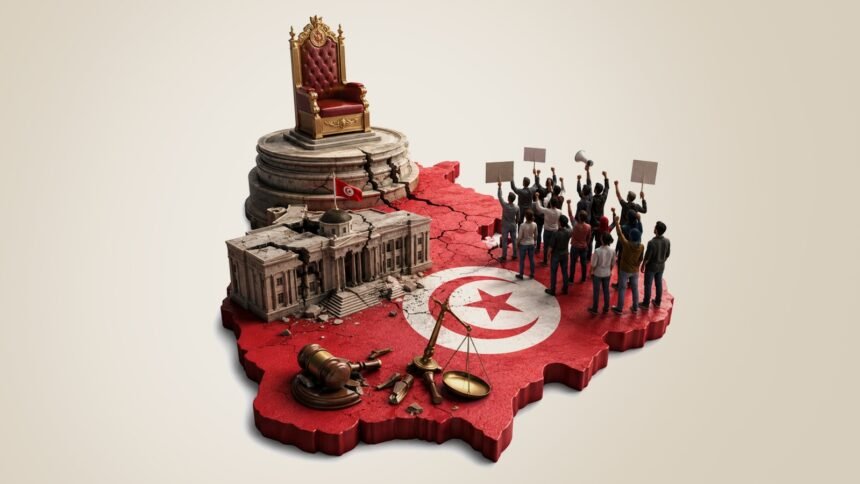
Hundreds of protesters gathered in Tunis on Thursday, marking the latest in a series of demonstrations against President Kais Saied that has become a near-ritual marker of Tunisian political life since 2021. Demonstrators carried banners demanding the restoration of freedoms and the release of jailed opposition figures, activists, and journalists, while explicitly rejecting what they termed “one-man rule” and “a slide towards dictatorship.” The protest deliberately echoed a similar demonstration held the previous month, timed to the anniversary of Saied’s July 25, 2021 intervention, when he dismissed the sitting government, later dissolved the elected parliament, and began governing by presidential decree. Tunisian activist Wissem Sghaier captured the mood bluntly, telling Reuters: “Enough of the failure, enough of the injustice and enough of the absurdity. The country is experiencing a complete collapse.” The recurrence of these mobilizations, not a single eruption but a sustained cadence of resistance, signals that Saied’s opponents retain a structural capacity to organize despite years of pressure, even if that capacity has yet to translate into a shift in the balance of institutional power.
Judicial Capture as a Governing Instrument
Central to the grievance driving Tunisia’s protest movement is the systemic dismantling of judicial independence. Saied’s dissolution of the Supreme Judicial Council and his mass dismissal of dozens of judges, publicly justified as an anti-corruption campaign, drew widespread international condemnation from rights organizations, which characterized the move as a direct assault on the separation of powers. This pattern, in which judiciary independence is subordinated to executive discretion under the rhetorical cover of accountability, has become a recognizable architecture of democratic backsliding across multiple African states. Rights groups now accuse Saied’s government of a broader crackdown that extends beyond the bench to opposition leaders, independent civil society organizations, journalists, and activists, alleging that both the judiciary and security apparatus have been repurposed as instruments of political suppression. Saied has consistently denied these characterizations, insisting he is merely enforcing the law against individuals suspected of financial corruption or conspiracy against the state, a defense that itself has become a recurring script in the region’s authoritarian playbook, where legal language is deployed to launder political repression into legitimate governance.
Economic Discontent as the Structural Undercurrent
Beneath the explicitly political demands lies a deepening economic crisis that is reshaping the character of Tunisian dissent. Protests have broken out in multiple regions in recent weeks over water and power cuts, shortages of basic goods and medicines, and deteriorating public services, grievances distinct from, but increasingly fused with, the anti-Saied political movement. This convergence of cost-of-living anger with constitutional grievance represents a potent recalibration of the opposition’s base, suggesting that public frustration is no longer confined to Tunis’s activist class but is spreading into the everyday hardships ordinary Tunisians face nationwide. Economists studying Tunisia’s trajectory have long warned that political consolidation without corresponding economic delivery produces exactly this kind of dual-track discontent, where the legitimacy of the state erodes simultaneously on democratic and material grounds. For a government that justified its emergency powers partly on promises of stabilizing the economy, the persistence and deepening of these material shortages directly challenge Saied’s founding justification for extraordinary rule.
Reclaiming the Republic: What Comes Next
Analysts caution that Thursday’s demonstrations do not, in themselves, signal an imminent political rupture. Saied retains firm control over the security apparatus, the judiciary, and the formal levers of the state, and Tunisia’s opposition remains fractured across ideological and generational lines. Yet the persistence of street mobilization, sustained across years rather than fading into resignation, underscores an enduring structural truth about African civil societies: institutional capture from above rarely extinguishes the underlying demand for self-determination from below. Whether Tunisia’s opposition can translate recurring protest into durable political leverage remains uncertain, but the demonstrations themselves function as a continuous referendum on Saied’s legitimacy, a reminder that the republic’s founding democratic promise has not been forgotten even where it has not yet been restored. As Tunisia navigates this fraught trajectory, its experience offers the wider continent both a warning and a template: a warning about how swiftly institutional gains can be reversed, and a template for how sustained civic pressure, however slow its returns, remains central to reclaiming sovereignty from within.