


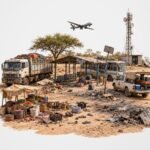



In the cradle of ancient civilizations, where the Nile’s life-giving waters carve through vast deserts and savannas, Sudan emerges as a poignant emblem of Africa’s epidemiological renaissance—a paradoxical revival of long-subdued adversaries like diphtheria, now inflamed by the intersecting tempests of protracted civil strife, erratic climatic shifts, and profound systemic vulnerabilities. This expansive inquiry delves into the multifaceted historical undercurrents of infectious scourges across Sudan’s vast landscapes, elucidating how relentless warfare disrupts communal fabrics and climatic anomalies exacerbate environmental vectors, collectively reigniting diphtheria’s latent threat to the continent’s most vulnerable progeny. Through a distinctly Pan-African prism that celebrates indigenous resilience and underscores imperatives for holistic vector-control strategies, the analysis dissects the synergistic perils of mass displacement, acute malnutrition, and fractured immunization regimens that propel outbreak cascades. It critically evaluates the concerted interventions by United Nations agencies and the World Health Organization to reinforce Sudan’s beleaguered health fortifications, while confronting entrenched challenges and envisioning prospective trajectories. Pathways forward crystallize: fortified integrated surveillance networks, grassroots vaccination mobilization rooted in cultural trust-building, and innovative vector management attuned to Sudan’s pastoral and nomadic traditions, all converging to recast the nation’s epidemiological narrative from one of recurrent peril to proactive prophylaxis, fostering a resilient horizon where Sudan’s youth thrive unencumbered by ancestral afflictions.
Echoes from the Nubian Sands: Historical Trajectories of Disease in Sudan’s Epidemiological Legacy
Sudan’s epidemiological chronicle is profoundly inscribed upon the undulating dunes of the Nubian Desert and the fertile bends of the Blue and White Niles, narrating an enduring saga of human tenacity clashing with microbial incursions over epochs. From antiquity, when the Kingdom of Kush harnessed the river’s rhythms for agrarian prosperity yet grappled with Nile-borne maladies, to the Turco-Egyptian era’s importation of cosmopolitan pathogens via trade caravans, diseases have been inexorable companions to societal flux. The advent of diphtheria, that insidious bacterial marauder orchestrated by Corynebacterium diphtheriae, etched its mark in the 20th century’s turbulent transitions. Emerging as a shadowy predator in urbanizing hubs like Omdurman and Khartoum, it preyed upon the throats of the young, manifesting as pseudomembranous occlusions that transformed labored breaths into fatal silences. The inaugural documented outbreak in 1974 signaled a nascent vulnerability, clustered in under-vaccinated pockets where colonial-era health legacies lingered unevenly.
By the 1980s, diphtheria’s specter loomed larger amid the early tremors of civil discord; the 1988 Khartoum epidemic revealed shifting demographics, with afflicted cohorts extending beyond toddlers into adolescents, reflecting gaps in sustained immunization amid economic strains and infrastructural decay. This era intertwined diphtheria with a broader infectious ensemble—cholera’s aqueous onslaughts during floods, malaria’s mosquito-mediated fevers in the Gezira schemes, and measles’ eruptive fury in nomadic enclaves—forming a syndromic mosaic emblematic of Sudan’s transitional burdens. The diphtheria-tetanus-pertussis (DTP) vaccine’s integration into the Expanded Programme on Immunization in the 1970s marked a pivotal counteroffensive, propelling coverage to peaks near 93% by the late 2010s, consigning the disease to sporadic border flares and textbook relics.
Yet Sudan’s narrative resonates deeply within Pan-African cadences, echoing the continent’s own odyssey from the pestilent exchanges of trans-Saharan trade to post-colonial epidemics that tested nascent sovereignties. Parallels abound with Ethiopia’s highlands and Chad’s Sahelian fringes, where diphtheria flickered amid refugee fluxes. The 2011 secession of South Sudan fractured resource streams, amplifying historical inequities rooted in pastoral migrations and urban-rural divides. Recent South Darfur clusters, emblematic of localized resurgences, underscore how nomadic lifestyles—seasonal transhumance across arid belts—facilitate pathogen dissemination, blending indigenous mobility with modern disruptions. In this legacy, Sudan’s epidemiology transcends national confines, embodying a Pan-African imperative for shared vigilance, where the Nile’s ancient flow symbolizes both a conduit of life and a carrier of contagion, urging a reevaluation of vectorial dynamics from historical precedents to contemporary contingencies.
War’s Crimson Veil: Conflict as the Forge of Diphtheria’s Resurgence in Sudan
No cataclysm has more ferociously reshaped Sudan’s epidemiological forge than the ceaseless anvil of civil conflict, which since April 2023 has unleashed a maelstrom displacing over 13 million—equivalent to entire provinces uprooted—and pulverizing health architectures into irreparable fragments. Khartoum, the erstwhile nerve center of medical prowess, now endures as a warren of besieged enclaves, its premier facilities reduced to improvised triage points where diphtheria wards brim with cyanotic children, their airways besieged by toxigenic membranes. The fratricidal fray between entrenched forces has not merely scattered populations but engineered ideal incubators for diphtheria’s proliferation: teeming displacement camps in Darfur’s parched expanses and Gezira’s fertile corridors, where familial clusters succumb en masse, as evidenced by Al-Jereif’s October 2025 flare-ups that claimed young lives amid resource scarcity.
This martial epidemiology unfolds through insidious cascades: routine DTP inoculations—those critical triads administered at infancy’s dawn—evaporate as nomadic clinics dodge artillery barrages and supply convoys navigate minefields. Over 880,000 infants, Sudan’s emergent “zero-dose” cadre, forfeited inaugural protections in 2024 alone, plummeting coverage to abysmal lows and inviting diphtheria’s unchecked dominion. Malnutrition, war’s cruel adjunct, ravages 40% of under-fives in famine-stricken zones like el-Fasher, eroding immunological bulwarks and magnifying the toxin’s cytotoxic havoc, which shreds pharyngeal linings into asphyxiating barriers. In Sennar and River Nile provinces, pediatric caseloads dominate, intertwining diphtheria with pertussis paroxysms and measles macules in a polymicrobial inferno, where secondary pneumonias hasten mortality.
Pan-African reverberations amplify the peril; Sudan’s implosion spills contagions across the Sahel, with Yemeni and Ethiopian exiles bridging pathogen bridges, while Chadian inflows seed hybrid outbreaks. Yet, within this vortex, Sudanese fortitude shines: intrepid community guardians, navigating cease-fire interstices, orchestrate ad-hoc vaccination relays in canvas citadels, invoking Ubuntu’s ethos of collective defiance. Attacks on healthcare—nearly 1,000 fatalities in 2025 alone—exacerbate the fray, transforming healers into targets and facilities into fortresses, yet these very assaults galvanize a subterranean network of resilience, where oral traditions of herbal palliatives merge with antibiotic salvos to stave off total eclipse.
Whispers of the Desert Wind: Climate Change’s Insidious Hand in Sudan’s Vectorial Reckoning
Interlacing war’s overt brutality, climate change murmurs a more enigmatic dirge, metamorphosing Sudan’s semi-arid tableau into a volatile arena where microbial opportunists flourish unchecked. The Sahel’s volatile “arc”—Sudan’s throbbing core—confronts intensified droughts punctuated by erratic deluges, phenomena that not only parch vaccination depots but inundate transient settlements, breeding diphtheria’s adjuncts in fetid puddles and overcrowded thatch hovels. Though diphtheria evades classic vectors like Anopheles swarms, its respiratory propagation thrives amid climate-induced crowding: anomalous 2025 monsoons, swollen 20% beyond norms, have submerged wadi beds, contaminating aquifers and fostering bacterial reservoirs in the humid interstices of mud-brick refuges.
Precedents from the 1988 Darfur cataclysm, where desiccation dovetailed with diphtheria’s kin in respiratory epidemics, presage today’s synergies; heatwaves cresting 45°C inflame mucosal vulnerabilities, priming airways for Corynebacterium’s insidious ingress, while floodwaters aspirated into lungs spawn pneumonic complicants. Climate’s economic vice—forecast to erode 2-5% of GDP by decade’s end—diverts scant coffers from vector abatement, pitting diphtheria triage against malaria’s perennial siege and cholera’s riparian ravages. In West Kordofan’s nomadic circuits, pastoralists’ adaptive lore—tracking seasonal qoz pastures—intersects with geospatial sentinels to forecast flare risks, yet escalating variability strains these equilibria.
Pan-African vector-control paradigms strain under analogous skies; Sudan’s travails mirror Malawi’s rift valleys and Niger’s dunes, demanding continental frameworks that fuse indigenous phenology with satellite hydrology. Here, climate transcends aggravation, reauthoring epidemiology’s lexicon: emergent toxigenic strains may exploit thermal tolerances, while resilient agro-practices—drought-hardy sorghums buffering malnutrition—offer prophylactic flanks. In this forge, Sudanese ingenuity, honed by millennia of Nile negotiations, pioneers climate-attuned prophylaxes, transmuting environmental whispers into orchestrated defenses against diphtheria’s stealthy advance.
Sentinels of the Souk: UN-WHO Fortifications in Sudan’s Health Bastions
Against Sudan’s epidemiological onslaught, United Nations bastions and the World Health Organization stand as unyielding phalanxes, threading lifelines through conflict’s labyrinthine thorns. The WHO’s African vanguard, contending with diphtheria’s continental resurgence across five active fronts, mobilizes diphtheria antitoxins—those equine elixirs neutralizing toxemic assaults—to Sudan’s remote outposts. However, Darfur’s logistical chokepoints continue to throttle supplies. Gavi’s emergent modalities, inspired by regional precedents, channel boosters to laggard cohorts, bridging the chasm where second-dose measles gaps—hovering at 64%—invite diphtheria’s opportunistic thrusts.
UNICEF’s immunization vanguard pulses resiliently, inoculating 1.3 million with pentavalent vaccines despite 70% facility blackouts, and, post-2024 scarcities, resurrecting routines in Central Darfur’s squalid camps to armor against diphtheria, tuberculosis, and poliomyelitis in unified salvos. Multinational sweeps spanning early 2025 scrutinized 94 diphtheria suspects, augmenting rehydration regimens and antimicrobials amid cholera’s 60,000-case torrent. These maneuvers embody Pan-African vectorial solidarity: WHO’s syndromic blueprints embed diphtheria within surveillance tapestries, capacitating 5,000 grassroots monitors for early detection, while airdrops pierce RSF cordons to el-Fasher, provisioning weekly antitoxins alongside cholera prophylactics.
Convergences of global sinew and Sudanese sinew forge hybrid redoubts; local midwives, versed in fumigant lore, synergize with UN logisticians to vaccinate hinterland herds, embodying a decolonized epidemiology where multilateral architectures amplify endogenous mettle. Amidst ceaseless hostilities, these efforts illuminate corridors of efficacy, where fortified cold chains and community pacts mitigate diphtheria’s toll, sketching blueprints for scalable sanctuaries across Africa’s afflicted arcs.
Fractured Shields: Unveiling Challenges in Sudan’s Epidemiological Arsenal
Sudan’s epidemiological armory harbors fissures too cavernous for panaceas alone to seal, demanding a panoramic reckoning of entrenched impediments. Surveillance citadels crumble beneath martial onslaughts: mere 30% of territories relay punctual dispatches, veiling diphtheria’s veritable harvest in underreported abysses, compounded by a hemorrhaged cadre—40% of medics exiled or extinguished—yielding ratios where solitary practitioners shepherd 10,000 charges, eclipsing WHO’s aspirational equilibria. Vaccine reticence, germinated in historical fissures like the 2019 polio rebuffs and amplified by digital disinformation, permeates transient bastions, with 27% eschewing adjunctive therapies amid entrenched skepticisms.
Malnutrition’s phantom reigns supreme: acute deprivations assail 40% of el-Fasher’s juveniles, micronutrient voids potentiating toxin’s dominion and inflating case-fatality ratios. Water-sanitation-hygiene scaffolds lie eviscerated; 80% of Khartoum’s uprooted quaff from Nile’s tainted tributaries, a miasma nurturing Corynebacterium’s bloom alongside enteric confederates. Vectorial vexations proliferate: diphtheria’s non-entomological essence belies synergies with dengue’s Aedes vectors, taxing finite arsenals in concurrent campaigns.
Pan-African predicaments resound: Sudan’s deluge strains adjacencies—cholera cascades to Ethiopia, diphtheria murmurs to Chad—necessitating supranational compacts akin to the cholera architectures of Africa CDC. Fiscal frailties compound; the 2025 appeals crave $2.7 billion for salubrity, procuring scant 20%, emblematic of attrition in Africa’s perennial pleas. These schisms, forged in conflict’s kiln and climate’s caprice, imperil not merely Sudan but the continental corpus, imploring fortified federations to mend the mosaic.
Dawn Over the Dinder: Charting Sudan’s Epidemiological Odyssey Forward
As 2025’s alluvial sediments settle toward rejuvenation, Sudan’s epidemiological voyage heralds a bifurcated aurora, shadowed by prognoses yet luminous with stratagems. Unfettered, diphtheria portends 25% pediatric lethality, syndemics potentially tripling infant mortalities to 168 per 1,000 by 2030’s cusp; yet, inflection points proliferate—community-orchestrated sentinels harnessing 4G tendrils in encampments for instantaneous alerts, nomadic phalanxes shadowed by neutral envoys to infiltrate contested terrains.
Vectorial metamorphosis proffers balm: embedding diphtheria prophylaxes within malaria’s netted bulwarks, and mucosal reinforcements via fortified staples that mitigate nutritional frailties. Pan-African coalitions—from the AU’s salubrious blueprints to Nile Basin ententes—could cascade inoculants to 8.9 million transients, while genomic cartographies of toxigenic variants calibrate bespoke boosters against mutating menaces. Climate-resilient wadis, sown with agro-forestry sentinels, could staunch floodborne vectors, blending ecological husbandry with epidemiological prescience.
The vista mandates Sudanese primacy—a “Nile Accord” enshrining autonomous epidemiology, wherein Omdurman savants and Wadi Halfa wardens co-forge edicts, amalgamating vectorial empirics with ancestral armors such as smoke fumigation and communal quarantines. Herein, diphtheria’s vice relents to harmonious respirations, a Pan-African exhalation wherein Sudan’s endurance galvanizes continent-wide vigilant vigils, transfiguring gasps into anthems of endurance.
Epilogue: The Nile’s Unyielding Flow
Sudan’s epidemiological weave, lacerated by war’s scythe and climate’s zephyrs, persists as a Pan-African allegory of tribulation and tenacity. Diphtheria’s reawakening, a stark harbinger of structural fissures, summons not dirges but diligence: buttressing brittle ramparts, suturing sundered conduits, and envisioning vectors vanquished. In the Nile’s inexorable meander, where inundations ebb to unveil verdant yields, so may Sudan’s progeny ascend unscathed—labored breaths alchemized to vital cadences, obscurities to odysseys, in an Africa emancipated from antiquity’s specters, where communal currents propel toward salubrious sovereignty.