





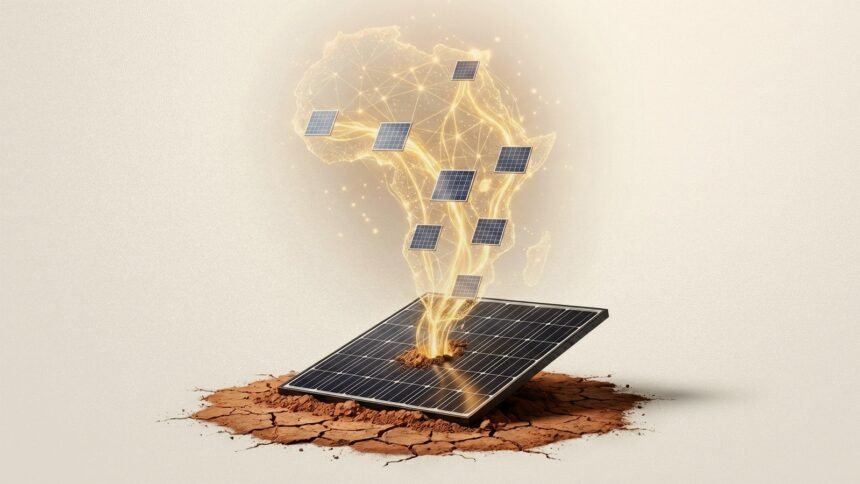
The Pan-African Transition: Reclaiming Energy Sovereignty Across the Continent
Across the African landscape, the structural evolution of macroeconomic policy is shifting from a reliance on legacy, centralized energy grids toward decentralized utility frameworks. The Pan-African vision for sustainable growth, outlined under the African Union’s Agenda 2063, recognizes that traditional infrastructure models have failed to keep pace with demographic expansion. True self-determination requires a complete transition away from large-scale, fossil-fuel-dependent generation systems that enrich external suppliers while leaving vast rural areas in absolute darkness. By establishing decentralized renewable assets, African nations can protect their domestic markets from global energy shocks, build resilience against climatic anomalies, and lay a secure foundation for integrated economic development.
Africa’s Renewable Sector Outlook: Market Dynamics and the Fall in Technology Costs
The contemporary macroeconomic outlook for sub-Saharan Africa’s renewable sector is defined by an exponential growth curve driven by private capital and dramatic shifts in technology costs. Global research providers highlight a substantial decline in the production costs of both photovoltaic solar modules and battery storage systems, largely driven by manufacturing overcapacity in developed markets such as China. This deflationary trend has fundamentally reshaped the economics of clean energy, making small-scale generation cheaper than traditional hydrocarbon alternatives. Furthermore, global energy shocks, including price volatility triggered by ongoing conflict in the Middle East and the domestic removal of fuel subsidies, have forced both commercial entities and informal households to abandon diesel-powered generators in favor of robust solar alternatives.
Electricity Outreach in Africa: Confronting the Reality of Structural Exclusion
The execution of universal electrification goals faces a severe challenge due to deeply entrenched regional disparities in modern grid infrastructure. The International Energy Agency’s declaration of a global “Age of Electricity” comes amid a stark deficit, with an estimated 730 million people worldwide still lacking access to electricity. Sub-Saharan Africa remains the primary laggard in this global transition, accounting for a staggering 80 percent of the un-electrified global population. For millions of citizens residing in rural and underserved areas, the total absence of service infrastructure means that centralized state utility networks are practically nonexistent, leaving local communities completely excluded from the modern digital economy.
Infrastructure & Capacity: Decentralized Systems as Frontline Anchors
To bridge this absolute energy gap, decentralized off-grid solar infrastructure has emerged as the primary mechanism for capacity deployment across sub-Saharan Africa. Private entities, such as Sun King, have successfully deployed standalone installations to serve more than 50 million customers across 11 African nations, operating extensive hubs in major urban gateways like Nairobi and Lagos. This decentralized infrastructure includes consumer-facing solar lanterns, multi-room home systems, and roof panels capable of powering schools, laptops, televisions, and refrigerators. By utilizing pay-as-you-go commercial financing models, in which consumers pay flexible installments via mobile payment networks, off-grid providers have unlocked immense pent-up demand, bypassing rigid grid dependencies and scaling monthly installations from 10,000 a decade ago to approximately 330,000 kits today.
Solar Energy & Great Sahara: Unlocking High-Yield Arid Corridors
The long-term scaling of continental energy capacity depends on turning Africa’s vast geographic assets, most notably the high-yield solar irradiance corridors of the Sahel and the Great Sahara, into organized industrial power zones. The vast, uncultivated expanses of the northern desert belt possess some of the highest solar radiation metrics on earth, offering an inexhaustible foundation for vertical supply integration. Developing these arid corridors requires moving past simple consumer kits toward high-capacity solar arrays and large-scale industrial inverter networks capable of storing direct current and converting it into alternating current for heavy manufacturing. By turning these remote landscapes into macro-generation centers, the continent can produce a massive structural surplus of clean energy, fueling cross-border trade networks and industrial growth across the region.
IMF-World Bank-AU Efforts: Evaluating Capital Allocation and Multilateral Targets
The mobilization of large-scale development finance to support continental energy access relies on ambitious targets set by international financial institutions and regional bodies. The World Bank and the African Development Bank have established a unified target to connect 300 million people across Africa to electricity by 2030, with the Global Solar Council estimating that close to half of these new connections must be delivered via decentralized off-grid systems. However, international development financing remains highly volatile, causing national sales of off-grid equipment to fluctuate wildly, as seen in a 52 percent drop in Rwanda and a concurrent 62 percent surge in Uganda, whenever major subsidy programs end or stall. To mitigate this institutional instability, leading off-grid firms have diversified their capital structures, relying on private equity and global investment banks for 84 percent of their financing needs, proving that high consumer repayment rates can successfully attract commercial capital to developmental markets.
Climate & Environment: Building Long-Term Ecological Resilience
The widespread deployment of decentralized solar infrastructure functions as a critical mechanism for environmental sustainability and long-term climate adaptation. Existing centralized grids are structurally vulnerable to extreme weather events, generation intermittency, and recurring blackouts that threaten public safety during ecological crises. In contrast, off-grid solar infrastructure builds deep, localized community resilience, allowing vital public buildings, clinics, and communications systems to remain fully operational during natural disasters or external shocks. By replacing carbon-heavy kerosene lanterns and diesel generators with clean, direct-current appliances, this solar transition directly mitigates localized air pollution and reduces deforestation. This strategy proves that when environmental policy prioritizes decentralized renewable networks, ecological conservation and human development can advance together, securing a resilient, self-sustaining future for the republic.