




Extractive Preservation and the Spatial Contestation of Rangelands
Across the African landscape, the structural management of protected ecosystems represents a profound point of friction between global capital accumulation and local ecological sovereignty. Under the guise of environmental preservation, large tracts of rangelands have historically been subjected to a form of “extractive preservation,” where landscapes are commercialized for elite international consumption while indigenous populations face spatial containment. The modern Pan-African struggle for land justice requires a deep critical interrogation of this model. True ecological self-determination cannot be achieved through the commodification of African frontiers, but through governance frameworks that integrate indigenous land tenure systems into the core architecture of biodiversity management.
The Agrarian-Commercial Squeeze
An intensifying squeeze among agricultural expansion, biodiversity conservation, and high-value commercial real estate development defines the macro-level land-use outlook for Kenya. As urban boundaries expand and rural demographics shift, the country’s semi-arid and arid rangelands have become highly contested zones of economic development. The state’s land use policies are increasingly pressured by the lucrative foreign exchange generated by commercial tourism, creating a strong structural incentive to prioritize hospitality infrastructure over traditional pastoralist land rights. This commercial landscape risks permanently fragmenting critical wildlife corridors, disrupting migratory networks, and alienating indigenous communities whose land-use practices have historically sustained these delicate ecosystems.
A Fractured Ecosystem
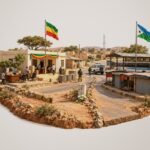
The Maasai Mara National Reserve serves as the definitive case study for the structural contradictions embedded within neo-liberal conservation frameworks. Situated in southwest Nairobi within Narok County, the reserve encompasses an ecosystem whose ecological integrity relies entirely on an open, contiguous rangeland matrix. However, this renowned wilderness is increasingly fractured by an unregulated proliferation of accommodation infrastructure. The uncontrolled construction of commercial properties within the reserve’s outer perimeter and buffer zones has created a landscape of physical barriers. This layout directly disrupts wildlife’s seasonal movements and imposes an unsustainable burden on the local water table, turning a flagship sanctuary into an endangered ecosystem.
The Disruption of the Great Migration
The intersection of high-end ecotourism and spatial land use in the Maasai Mara has led to severe disruption of the “Great Migration”, the annual movement of more than 1 million wildebeest between the open plains of the Serengeti and the Maasai Mara. This biological phenomenon requires unobstructed migratory pathways. However, the positioning of luxury safari camps and permanent lodges along riverbanks and critical crossing points creates an environmental blockade. The physical footprint of these tourist facilities, combined with associated vehicle traffic and human presence, alters the animals’ natural behavior, forcing migratory herds into suboptimal corridors and threatening the stability of the entire regional food web.
Corporate Encroachment and Sovereign Integrity
The influx of international hospitality capital into Kenya’s protected rangelands has raised critical questions regarding the balance between foreign direct investment and environmental sovereignty. Global hospitality conglomerates have aggressively pursued expansion into premium safari destinations, building ultra-luxury eco-lodges designed to capture high-spending international travelers. While the central state defends these investments as vital drivers of macroeconomic growth and national development, local civil society organizations view them as an unregulated corporate encroachment. This unmonitored commercial development often bypasses strict environmental impact assessments, demonstrating how global capital can override local ecological priorities and undermine sovereign conservation policies.
Jurisdictional Friction in Conservation
The governance of Kenya’s natural resources is further complicated by jurisdictional friction between the central government and localized, county-level administrations. Under Kenya’s devolved governance structure, reserves like the Maasai Mara are managed by county governments, such as the Narok County Council, which rely heavily on tourism revenues to fund local budgets. This creates a distinct misalignment of priorities: while national environmental agencies are tasked with enforcing long-term conservation mandates and protecting migratory corridors, local county authorities face continuous financial pressure to approve lucrative new hospitality concessions. This decentralized administrative fragmentation undermines the enforcement of structural zoning laws, leaving protected areas vulnerable to inconsistent and speculative development.
The Marginalization of Maasai Herders
The expansion of commercial tourism infrastructure within the Maasai Mara represents a continuous violation of the socio-economic and cultural human rights of the indigenous Maasai herders. For generations, Maasai pastoralists have coexisted with local wildlife through seasonal livestock grazing strategies that maintain grassland health. The conversion of traditional communal pastures into exclusive luxury tourism concessions has systematically marginalized these herders, cutting off their access to vital dry-season water sources and traditional grazing grounds. This structural exclusion not only threatens the economic survival of pastoralist households but also erodes the cultural practices that are fundamentally tied to the ancestral landscape.
The Battle for Legal Injunctions
The structural tensions surrounding African land use culminated in a significant legal development in early July 2026, when a coalition of Kenyan civil society groups launched a major lawsuit in Kenya’s Environment and Land Court to halt further commercial construction within the Maasai Mara. The petitioners, including the East Africa Law Society, Natural Justice, JustAct, and the Africa Center for Peace and Human Rights, are seeking a sweeping judicial injunction to block any expansion or new development of accommodation facilities within the reserve until 2032.
Furthermore, the legal action explicitly targets several high-profile luxury properties, including the newly established Ritz-Carlton safari lodge, Sala’s Camp, and Sand River Masai Mara by Elewana, requesting that the court declare their operations illegal due to severe corridor obstruction. With the court setting an initial hearing date for July 20, 2026, this landmark case represents a decisive shift away from passive community consultation toward assertive, structural litigation, establishing a critical regional precedent for how African states must legally navigate the balance between global corporate investment and indigenous ecological preservation.