





The Pan-African Paradigm of Fragile Peace Agreements and Renewed Militarisation
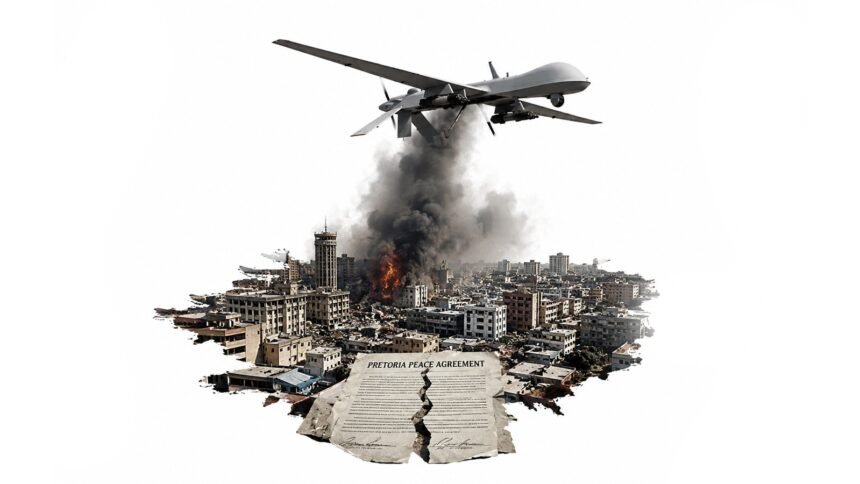
Across the African landscape, peace agreements signed to end devastating civil conflicts too often prove to be pauses rather than resolutions, fragile architectures vulnerable to collapse the moment underlying grievances remain unaddressed. Ethiopia’s Tigray region, still recovering from a 2020-2022 civil war that claimed at least 600,000 lives, now finds itself once again staring into the abyss of renewed confrontation, as a drone strike hit a residential area of the regional capital Mekelle in the early hours of Thursday. The strike is not an isolated event but the latest escalation in a months-long build-up of tension between federal forces and the Tigray People’s Liberation Front (TPLF), which continues to administer the region under the terms of the November 2022 Pretoria peace agreement. What makes the Tigray case a matter of continental significance is precisely its symbolism: the Pretoria accord was held up internationally as a model for negotiated settlement of intra-state conflict on the continent, evidence that African-led mediation could durably end even the most catastrophic wars. Its unraveling, should it materialize, would represent a significant setback not only for Ethiopian federalism but for the broader continental project of demonstrating that African conflicts can be resolved through African-brokered frameworks rather than perpetual militarised stalemate, reclaiming peace as something built and sustained rather than merely declared.
The Strike on Mekelle: What Is Known
Amanuel Assefa, vice president of the TPLF, which continues to govern Tigray under the Pretoria framework, confirmed to AFP that a drone struck a residential area of Mekelle early Thursday. “There was a drone strike today in the city. It targeted a residential area. I don’t have details on casualties yet,” he said. An AFP journalist present in Mekelle corroborated that residents had confirmed the strike, which followed a separate drone strike near the Tigray capital the previous Tuesday that is not believed to have caused casualties. The absence of confirmed casualty figures does not diminish the strike’s political significance: a residential strike on the regional capital represents a marked escalation from the more peripheral drone incidents reported earlier in the year, bringing the confrontation directly into Tigray’s most populous and symbolically significant urban center for the first time in this renewed cycle of tension.
A Documented Escalation Since January
The Thursday strike caps an accelerating tempo of confrontation that Tigrayan officials trace back to January, when the Ethiopian National Defense Force was accused of striking two trucks near Enticho and Gendebta in central Tigray, killing one driver and wounding another. Further drone attacks were reported near Sheraro in northwestern Tigray in June, before the pace of confrontation intensified markedly this month: the TPLF reported clashes between its troops and federal forces near the Sudanese border on August 1, followed by an accusation on August 10 that Addis Ababa had struck Tigrayan positions at Merewa, near the Amhara border, in an attack the TPLF said caused casualties and damaged a secondary school, claims AFP could not independently verify and to which the federal government has not responded. This sequential escalation, moving from isolated rural incidents to strikes on populated administrative centers, reflects broader institutional erosion in the mechanisms established under the Pretoria agreement to manage this kind of incremental crisis before it reaches urban flashpoints.
Structural Fragility in Ethiopia’s Federal Architecture
The renewed militarisation around Tigray’s borders exposes deeper structural fault lines within Ethiopia’s federal system, where unresolved questions of territorial administration, contested areas such as Western Tigray, and competing claims to legitimate authority within the region continue to generate friction years after the guns nominally fell silent. Both federal and Tigrayan forces have accused each other of trying to provoke a new conflict. This mutual suspicion reflects the incomplete implementation of the Pretoria accord’s disarmament, demobilization, and reintegration provisions. The peace agreement’s architecture presumed a trajectory toward normalized governance and gradual military drawdown; instead, the massing of forces on either side of Tigray’s border points toward a securitized standoff that has displaced the political negotiations the accord was meant to institutionalize. Regional analysts have long warned that Ethiopia’s federal structure, built to accommodate ethnic-based regional autonomy, remains acutely vulnerable to exactly this kind of asymmetric militarised pressure whenever central and regional authorities lose confidence in negotiated dispute resolution.
Reclaiming the Peace: A Fragile Path Forward
Whether Thursday’s strike on Mekelle represents an isolated escalation or the opening move of a broader confrontation remains uncertain, but its occurrence alone signals how far the promise of the Pretoria agreement has drifted from lived reality for Tigrayan civilians. A war that killed hundreds of thousands through fighting, starvation, and the collapse of healthcare infrastructure left a peace whose durability depended on sustained political will from both Addis Ababa and Mekelle, will that now appears increasingly strained. For a continent that pointed to the Tigray settlement as proof that African-brokered peace processes could hold, the stakes of this renewed confrontation extend well beyond Ethiopia’s borders, testing whether hard-won continental precedents for reclaiming stability from catastrophic conflict can withstand the slow erosion of trust between former belligerents when the underlying political settlement remains unfinished.