




The Capital of Christian Makuria
More than a thousand years ago, travelers along the middle Nile approached a city of churches, monasteries and grand public buildings on the river’s eastern bank. Old Dongola was the capital of Makuria, one of three medieval kingdoms that emerged along the Nile after Christian missionaries arrived in the sixth century. The city flourished until the 14th century. Today, much of it lies under sand, and one of its largest buildings is only now giving up its secrets.
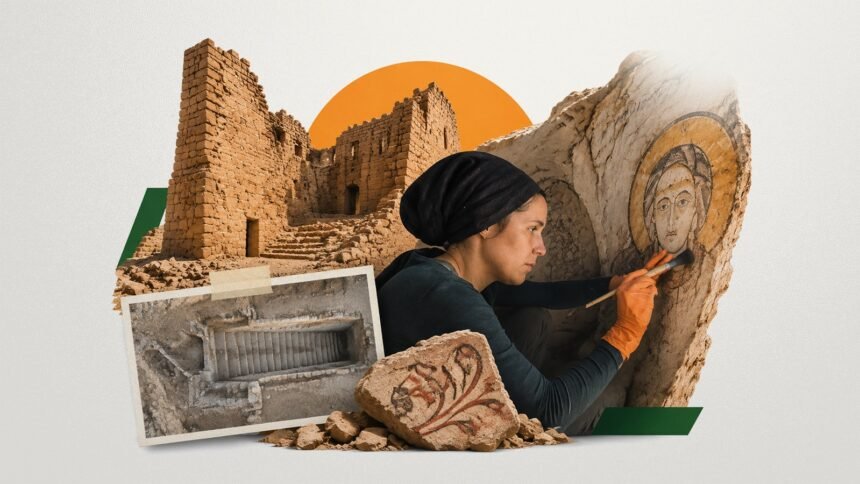
A Polish-Sudanese archaeological mission has uncovered a monumental staircase, flanked by walls still standing about 11 meters high, that led the team to the original floor level of the Great Church of Jesus. It is probably the largest church of medieval Nubia, and its excavators believe it served as the city’s cathedral. The building was first identified in 2021, but most of it remains buried. The stairwell is the only place so far where the team has reached the floor.
A Church Bigger Than the White House
The mission’s preliminary measurements put the building at about 47 meters wide and 57 meters long, with a cautious height estimate of around 21 meters. Its director, Professor Artur Obłuski of the Polish Center of Mediterranean Archaeology at the University of Warsaw, says it was larger than the White House in Washington and that the team intends to excavate it in full. The team also found massive buttresses that supported the church’s apse. Next season, it hopes to determine the building’s full dimensions.
“So, the discovery can be associated with the Great Church of Yesu (Jesus), the cathedral, the most important church of medieval Makuria,” Obłuski says. “This was the largest church in this territory. It was three times larger than the other known Nubian churches. It was also where the head of the church’s ecclesiastical organization stayed. And the archbishop of this church controlled the entire church hierarchy in the Makurian state.” He compares its likely influence to that of Hagia Sophia in Constantinople. This building set architectural trends, and the Great Church is seen as a natural trendsetter for Nubia and perhaps beyond. The find also means scholars must look again at a church outside the city walls that had long been treated as Dongola’s cathedral.
A Second Church, Painted and Upstairs
The excavation produced a further surprise. In a structure added to the side of the cathedral, the team found another, smaller church built on an upper floor. Its walls survive to only about one meter, but they were once covered in paintings. Most of the plaster fell long ago, and the fragments now fill six large shelving units. A comparable church associated with King David of Makuria, dated to the 13th century and found by the same team in 2023 on the cathedral’s north side, kept far more of its paint on the walls.
Among the debris were plaster fragments bearing Greek inscriptions. The mission’s epigraphist, Dr Agata Deptuła, identified them as fragments of biblical odes, the prayer songs that accompanied the Book of Psalms. One preserves part of the Prayer of Hannah, mother of the prophet Samuel, written in a careful book hand with letters only about half a centimeter tall. Psalm texts were the most common biblical writing found at Old Dongola, so the odes are new to the site.
Slow Work With Trowels and Brushes
The work is painstaking. “The documentation process takes a great deal of time,” says Abdel-Hay Abdel-Sawy, head of the Sudanese side of the mission. “After the initial phase of clearing away sand and removing layers of debris comes a more meticulous stage, involving the use of trowels and brushes, and then followed by detailed recording, precise mapping, and complex technical work, all of which are time-consuming.” Because the walls around the stairwell rise so high, the team must dig far deeper than in a normal excavation, with methods and funding well beyond the usual. The dig is run jointly by the Warsaw center and Sudan’s National Corporation for Antiquities and Museums, with funding from Poland’s National Science Center. It forms part of a European Research Council project tracing the city’s growth from the 4th to the 15th century.
Heritage Work in a Country at War
The discovery comes as Sudan endures a devastating war that began in April 2023. Old Dongola, in Northern State, lies far from the main front lines, but the conflict and the climate have still reached it. In autumn 2024, the worst flooding since 1988 damaged some of the protective roofs over the ruins, and conservation came first this season, with support from the Warsaw University of Technology. The mission also completed a solar power system, funded through Poland’s Polish Aid program, that runs pumps drawing Nile water for the homes and fields of around 10,000 people, with eight booster stations sending water to higher ground where residents had lost access because of the conflict.
The team runs train-the-trainer workshops on protecting Dongola’s heritage, and residents have formed an association to help the antiquities authority and the archaeologists care for the site. Sudan’s antiquities authority supports full excavation, partly because a cathedral of this size could one day draw visitors.
Whose History Is Being Uncovered
Nubia’s medieval kingdoms are still too often treated as a footnote to the histories of Egypt, Byzantium or the Islamic world. A cathedral larger than most buildings of its age, run by an archbishop who controlled a whole church hierarchy, says something different: that the middle Nile was a center of power, faith and architecture in its own right. As Sudan’s people endure war and displacement, the work at Old Dongola is a reminder that their country’s past belongs first to them. The partnership between Sudanese and Polish archaeologists, and the residents who now help guard the site, will decide whether that past is recovered as a shared Sudanese inheritance or studied from afar.