


A War Now Fought Through Substations
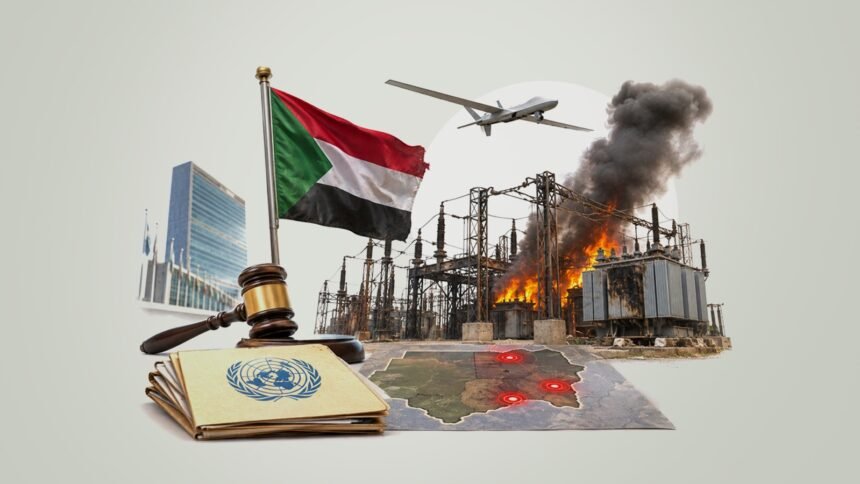
Before dawn on Monday, the lights went out across parts of Sudan once again. Drone strikes hit three electricity substations in eastern and northern Sudan: facilities in New Halfa and Aroma in Kassala state, and the al-Ghazali substation in the Northern State. Videos circulating on social media appeared to show fires at the sites, with civil defense teams trying to put them out. The footage has not been independently verified.
The attacks caused widespread power outages and brought the number of strikes reported against Sudan’s electricity network over the past week to 18. A separate tally puts the damage at 14 electricity distribution stations across El Gedaref, Khartoum, El Gezira, Red Sea, Sennar, White Nile, South Kordofan, River Nile and Northern states, causing power cuts in several cities over the course of the week. The two counts measure different things, strikes and damaged stations, but both describe a campaign aimed squarely at the grid.
Sudan’s war between the army and the paramilitary Rapid Support Forces (RSF), under way since April 2023, has moved from the battlefield to the infrastructure that keeps hospitals, water pumps and homes running. That shift is now spilling into regional diplomacy.
Why the Grid Is the Target
Electricity is a force multiplier in modern Sudan. Water stations need pumps, hospitals need generators and refrigeration, and mobile phone networks and banking apps, which millions of displaced people rely on, need power. Hitting substations in areas far from the front lines spreads the costs of war to cities that the army controls and that had been relatively shielded from fighting.
The geography of Monday’s strikes underlines this. Kassala state borders Eritrea to the east, and the Northern State stretches toward Egypt. Neither is a main combat zone. Striking them signals that no part of army-held Sudan is beyond reach.
The Accusation Against Ethiopia
Sudan’s military-led government says the RSF is not acting alone. It accuses Ethiopia of aiding the RSF in carrying out the attacks. On Sunday, the Foreign Ministry said it had filed complaints with the United Nations Security Council and the African Union’s Peace and Security Council, submitting documents which, it says, show that the RSF used Ethiopian territory to launch missile-equipped drones against civilian sites and vital facilities across Sudan.
The ministry described the alleged use of Ethiopian territory as a hostile act and a violation of international law, citing Article 2(4) of the UN Charter, which prohibits the threat or use of force against another state’s territorial integrity. It called on Ethiopia to halt the attacks and urged the international community to hold the RSF accountable. Ethiopia had not immediately commented, and the claims have not been independently verified.
Sudan’s Sovereignty Council has gone further, saying that 187 drones were launched from inside Ethiopian territory in 70 attacks between February and October. It named Asosa Airport and the Bahir Dar base as alleged launch sites, demanded that Ethiopia close the facilities it says the RSF is using, and called for accountability and compensation.
Analysts Divided
Sudanese political analysts disagree over how strong Khartoum’s case is. The analyst Qureshi Awad questioned whether Sudan could establish a credible legal case, arguing that it had not provided enough evidence to prove where the drones were launched. In his view, the complaint is mainly political, intended to prepare the public for the consequences of damage to essential services while deflecting attention from security and defense failures.
The analyst Suhaib Hamid takes the opposite view, describing the complaints as a significant diplomatic step. He argued that detailed reports identifying alleged launch sites inside Ethiopia, along with evidence of Addis Ababa’s knowledge of the operations, could strengthen Sudan’s position and prompt an international investigation or a response from the Security Council.
Both readings can hold at once. A complaint can be politically convenient for a government under pressure and still rest on real evidence. What would settle the matter is independent investigation, which neither the UN nor the AU has yet announced.
Defections in Blue Nile
On the same day, the army reported that a group of RSF members had defected by surrendering to its forces in Damazin, the capital of Blue Nile state in the south-east, which also borders Ethiopia. It described this as the latest in a growing number of defections from the paramilitary in the state.
The army said the group’s commander had provided information about the management of military operations in Damazin, including what it called “Ethiopian support” for the RSF. A senior RSF commander, Siddiq Ander, has separately declared in video footage that he had defected. Claims from defectors in army custody are a common feature of this war, and they will need to be tested alongside the evidence submitted to the UN and AU.
Keeping the Lights on Is Also Self-Rule
A state that cannot protect its power stations cannot protect its people’s water, health care, or livelihoods. For Sudan, the attacks on the grid are a reminder that control over territory means little without control over the systems that make daily life possible.
The regional dimension raises the stakes further. If drones are indeed crossing from a neighboring state, the AU’s founding commitment to non-interference and peaceful settlement of disputes is being tested on its own doorstep. If they are not, the complaint risks deepening a dangerous rift between two Nile Basin neighbors. Either way, the response should be an African-led, credible investigation of the launch-site claims, and serious protection for the civilian infrastructure on which tens of millions of Sudanese depend.
Eighteen Strikes on the Grid in a Week: Drones Cut Power in Kassala and the Northern State as Khartoum Takes Ethiopia to the UN

Leave a Comment