





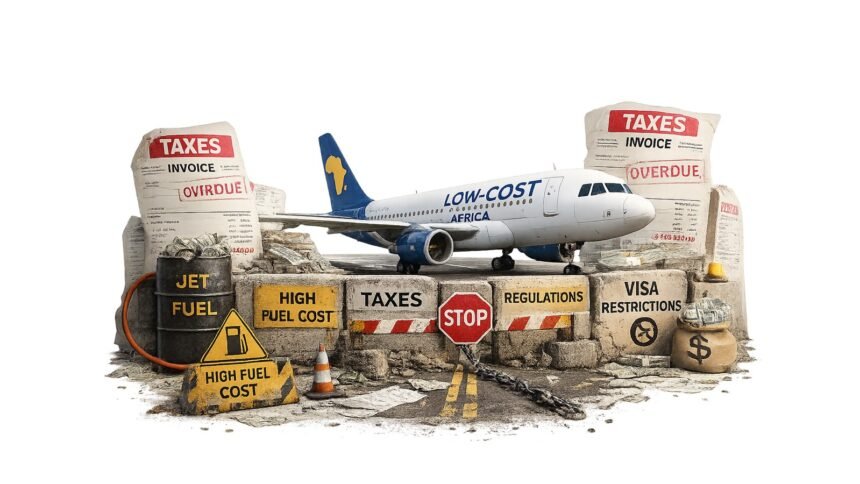
The success of low-cost airlines in Africa will depend less on offering cheaper tickets and more on reducing the high costs and regulatory barriers that airlines face, according to aviation experts.
Low-cost airlines, often referred to as budget carriers, reduce operating costs by simplifying their services. They typically offer lower base fares while charging separately for extras such as checked baggage, seat selection, and onboard meals.
The model is designed to maximize efficiency, keep aircraft flying more frequently, and make air travel more affordable and accessible to a wider segment of passengers.
However, experts argue that low-cost aviation is not simply about selling cheap tickets.
“The low-cost model is a highly disciplined operating system built around simplicity, scale, and ruthless efficiency,” said Aviation Analyst Derek Nseko.
“This is what made Southwest Airlines revolutionary in the United States after airline deregulation in the late 1970s. The airline operated a single aircraft family, maximized utilization, and connected cities directly rather than through expensive hub structures. Crucially, it was born into a liberalized domestic market large enough to sustain scale.”
While budget carriers have transformed air travel in Europe and parts of Asia, aviation expert Alexander Nwuba said building sustainable low-cost airlines in Africa will require more than launching new airline brands.
According to Nwuba, success will depend on structural reforms, stronger enforcement of aviation agreements, and a more integrated continental market.
“A true low-cost carrier is defined strictly by its operational cost structure. If you do not possess the operating environment to keep unit costs low, offering low fares structurally is simply a fast track to insolvency,” Nwuba said.
Across the continent, airlines face high fuel prices, foreign currency exposure, high maintenance costs, and heavy airport charges, all of which make budgeting difficult.
Jet A-1 fuel is often significantly more expensive in Africa due to taxes and supply chain inefficiencies. At the same time, aircraft leases and spare parts are largely denominated in dollars, exposing airlines to exchange-rate shocks.
Nwuba noted that these pressures make it difficult for airlines to sustain genuinely low fares over the long term.
Beyond operating costs, experts say fragmented aviation markets continue to limit the growth of low-cost carriers.
“Beyond costs, the slow implementation of continental aviation agreements remains a major obstacle. Although initiatives such as the Yamoussoukro Decision (agreement aims to open up airspace to eligible African airlines) and the Single African Air Transport Market (SAATM) were intended to open African skies, many countries continue to protect national carriers through licensing delays, flight restrictions, and other barriers to competition,” Nwuba said.
Nseko said the result is an industry divided into small, disconnected markets, despite efforts to deepen regional integration through the African Continental Free Trade Area (AfCFTA).
“A low-cost airline thrives on freedom of movement. It needs flexibility to move aircraft quickly, open routes efficiently, and stimulate demand across large integrated geographies,” he said.
“But African airlines often face route restrictions, approval delays, capacity limits, and regulatory inconsistency before the first ticket is even sold. This is why Africa has struggled to create the scale necessary for low-cost economics. The continent has demand. What it lacks is density.”
Experts argue that African carriers will also need to adapt the low-cost model to local realities rather than replicate approaches used in Europe or Asia.
“This includes using right-sized aircraft for thinner routes, integrating mobile money into ticket distribution, and combining passenger transport with cargo services to diversify revenue. Africa needs a mix of airline models rather than a single imported system,” he said.
Nseko added that a genuine low-cost aviation revolution would require meaningful implementation of SAATM, lower taxes and airport charges, stronger secondary airport infrastructure, easier visa access, improved aircraft financing, and greater operational predictability.
“A true low-cost aviation revolution in Africa would require meaningful implementation of SAATM, lower taxes and airport charges, stronger secondary airport infrastructure, easier visa access, improved aircraft financing access, and greater operational predictability,” he said.
Ultimately, experts argue that Africa’s challenge is not a lack of demand for air travel, but the absence of an integrated aviation market capable of supporting low-cost operations at scale.