



The Fragile Ideal of Continental Solidarity
Across the African landscape, the recurring cycles of anti-migrant sentiment challenge the core tenets of Pan-Africanism and the institutional frameworks of the African Union. The ideal of a unified, borderless continent where labor and capital move freely to foster collective development is increasingly undermined by localized anxieties. Rather than serving as an integrated haven for the African diaspora, regional economic hubs often become spaces of exclusion. This structural friction reveals a deep continental dilemma: the gap between elite-led pan-African integration strategies and the ground-level socio-economic realities of host nations, where regional migration is increasingly treated as a threat to national stability rather than a catalyst for shared prosperity.
The Politics of Structural Scapegoating
The macroeconomic landscape of South Africa is defined by deep structural challenges, characterized by high unemployment rates, persistent inequality, and public anxiety over crime and overstretched state infrastructure. Within this volatile political outlook, immigration has emerged as a powerful lightning rod for political mobilization. Civil society groups and political actors frequently channel domestic frustrations toward undocumented foreign nationals, framing them as a primary source of economic and social strain. To manage escalating tensions and preserve public order during periods of intense mobilization, the state has been forced to deploy the South African National Defense Force to bolster domestic law enforcement agencies.
The June Mobilization
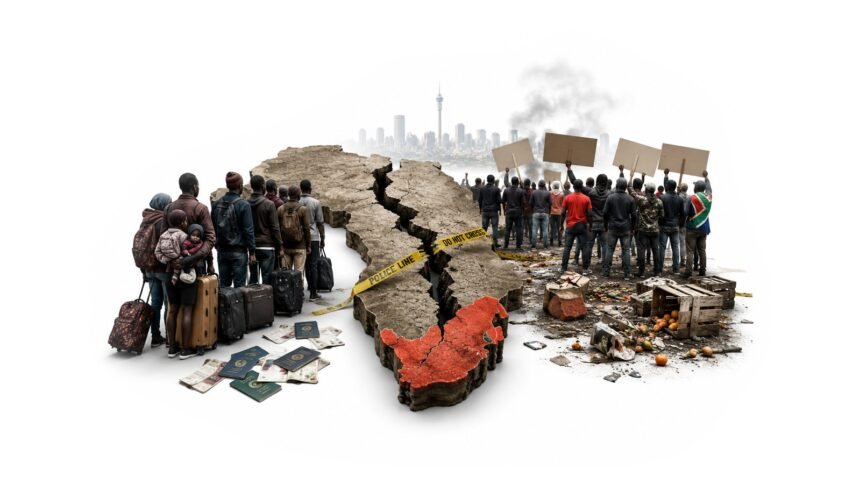
The winter of 2026 witnessed a significant escalation in anti-migrant mobilization, culminating in highly coordinated, nationwide demonstrations. Tensions steadily built up throughout June, driven by activists who issued a public deadline demanding that all undocumented foreign nationals leave the country. This organized pressure led to a series of large-scale rallies in major urban centers, including Johannesburg, Pretoria, and Cape Town. While organizers maintained that the demonstrations were intended as peaceful calls for stricter immigration enforcement and labor-market regulations, the highly charged atmosphere created a precarious environment for foreign nationals, forcing many to secure their property and seek emergency consular assistance.
Vigilantism and State Enforcement
Although several anti-migrant rallies proceeded without major incident, the broader mobilization triggered a wave of political violence and localized civil unrest across multiple provinces. In various townships and commercial districts, community demonstrations rapidly devolved into targeted vigilante actions. Loose groups of individuals systematically targeted foreign nationals, leading to the widespread looting and destruction of foreign-owned retail shops and small businesses. The emergence of these vigilante networks highlights a fragile internal security environment, where the breakdown of local law enforcement allows non-state actors to enforce exclusionary agendas under the guise of community protection arbitrarily.
Living in the Shadow of Precarity
The immediate aftermath of the unrest has left regional diaspora communities living in a state of profound precarity. Groups from Zimbabwe, Nigeria, Mozambique, and Ghana, who form the backbone of various informal trading networks and service industries, face a continuous threat to both their livelihoods and physical safety. Outside foreign consulates, lines of anxious migrants have grown as individuals seek documentation, legal advice, or protection from potential displacement. This climate of fear has severely disrupted the informal economy, as entrepreneurs choose to keep their businesses closed rather than risk falling victim to targeted property destruction or personal assault.
The Human Toll of Intolerance
The human cost of the recent anti-migrant surge has reverberated across the continent, sparking sharp condemnation from several African governments over the loss of life and targeted violence:
- The Nigerian Diaspora: Nigeria’s Ministry of Foreign Affairs reported the deaths of two citizens during the period of heightened tension; one individual was killed in front of his shop in the northeastern city of eMalahleni by unidentified criminals, while another citizen, Emeka Iroegbu, died in Pretoria during an interrogation by local police officers.
- The Mozambican Diaspora: Maputo reported that five of its citizens were killed in the wave of attacks. However, South African authorities disputed the figure, placing the official number of Mozambican casualties at two.
- The Ghanaian Diaspora: Authorities in Accra reported that a Ghanaian national was fatally wounded in a shooting incident during the anti-immigrant demonstrations, an allegation that Pretoria rejected, stating the killing was unrelated to the protests and accusing Ghana of spreading misinformation.
Diplomatic Strain and the Repatriation Alternative
The persistent nature of the violence has brought relations between South Africa and its continental peers to a critical diplomatic chokepoint. In response to perceived failures by local authorities to ensure the safety of foreign nationals, several countries have begun evaluating emergency evacuation and voluntary repatriation schemes for their citizens. Nigeria’s foreign ministry issued a formal warning, stating that if the pattern of intolerance and violence persists, all diplomatic options remain on the table. The activation of these emergency measures starkly reflects the deep fractures within regional migration frameworks, where home countries are forced to treat the repatriation of their skilled diaspora as the only viable mechanism for preserving human life.
The Quest for Institutional Accountability
The latest institutional developments center on intense diplomatic maneuvers and demands for legal accountability regarding alleged state complicity in the violence. Nigeria has formally accused elements of the South African security apparatus of complicity in the attacks, raising serious questions about state responsibility under international law. In response, South Africa’s Independent Police Investigative Directorate, led by spokesperson Lizzy Suping, confirmed that it has opened an official investigation into the actions of the officers involved in the Pretoria interrogation fatality.
Concurrently, South Africa’s foreign ministry, represented by spokesperson Chrispin Phiri, has urged foreign missions to submit substantive proof through established institutional channels rather than relying on public narratives. As diplomatic missions work to de-escalate the standoff, the long-term stability of the region depends on whether South Africa can successfully balance its domestic rule of law with its international human rights obligations, ensuring that the pursuit of national security does not result in the systematic exclusion of its continental neighbors.