





Dul Dul Business Park on Nairobi’s Mombasa Road looked like any other new commercial complex: glass fronts, parking bays, and the hum of highway traffic. Inside one hall, however, under a banner reading “What’s So Cool About AI,” the focus was on the buildings most people never see.
Engineers, students, equipment vendors, and digital‑infrastructure executives had gathered there for a special International Data Center Day 2026 event organized by the Africa Data Centers Association and its partners.
Billed as “What’s So Cool About AI, International Data Centers Day Event,” and running from 4 p.m. to 10 p.m. on March 26, the Nairobi gathering formed part of a global campaign to demystify data centers and inspire the next generation of talent.
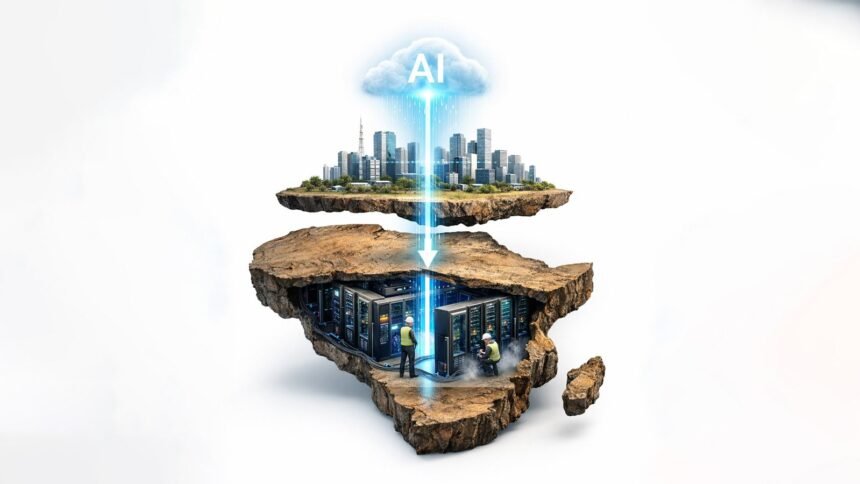
The message, repeated on slides and in speeches, was simple. There is no artificial intelligence without very real infrastructure, racks of servers, rivers of cooling water, and, increasingly, the African engineers who keep them running.
The Infrastructure Behind the Hype
International Data Center Day is a worldwide initiative launched by industry players to “create awareness of the data center industry and to inspire the next generation of talent.” Industry materials describe it as an opportunity for operators to open their doors and show “what data centers are, why they are so important to our connected world, and the wide array of career opportunities” they offer.
In 2026, the African Data Centers Association, a trade body representing operators across the continent, adopted the theme “What’s So Cool About AI” for its International Data Center Day activities, with a focus on inviting students to “explore the amazing world of AI in data centers.”
The Nairobi event, one of several across the region, was promoted through the association’s channels and ticketing sites as an evening to mark International Data Center Day in Kenya’s capital.
An Eventbrite listing for “International Data Center Day 2026 – Nairobi, Kenya,” hosted by the Africa Data Centers Association and Imexolutions, framed the stakes in blunt terms: “Africa’s digital future is built on resilient and sustainable power systems.
This theme highlights the critical role of energy infrastructure in data centers while shining a spotlight on the people, skills, and local talent who design, build, and sustain the digital backbone of the continent.”
That backbone is still thin. Less than 1 percent of global data center capacity is located in Africa, with around 200 megawatts of installed capacity, according to estimates cited by Xalam Analytics and the association.
Yet demand is surging as governments, banks, telecoms, and start‑ups move more services to the cloud and experiment with AI tools. One industry report for the African Data Centers Association said the continent may need to add roughly 700 new data centers over the next few years to keep up.
Human Stories and Real-World Examples
Akim Benamara, the founder and editor of TechAfrica News, has been one of the public faces of International Data Center Day activities in the region.
In a 2025 article on a similar Nairobi gathering, co‑hosted with the Africa Data Centers Association and Vertiv, he called data centers “the backbone of Africa’s digital transformation, enabling cloud adoption, AI advancements, and seamless connectivity across the continent.”
The 2026 event built on that framing, bringing together a mix of engineers, investors, and students to discuss where AI meets infrastructure.
On stage, speakers explained how AI systems, from chatbots to fraud‑detection algorithms, depend on vast quantities of data stored and processed in facilities that must balance speed, security, power, and cooling. Slides flashed phrases like “Data centers run on people as much as power,” and “Today’s infrastructure.
Tomorrow’s engineers,” slogans used by the association to emphasize the human skills behind the machines.
For university students in the audience, many of whom had signed up after seeing social‑media posts about “What’s So Cool About AI?”, the event was part career fair, part crash course. Representatives from operators and vendors discussed roles spanning electrical and mechanical engineering, cybersecurity, software, operations, and sustainability.
International Data Center Day, as noted in association materials, is explicitly designed to “connect with future generations and ensure a steady flow of skilled labor.”
One young attendee, a computer‑science student from a Nairobi university, said she had come because she wanted to work in AI but had not realized how important data centers were. “We always talk about models and apps,” she said during a networking break, “but no one tells you about the buildings and people that make them possible.”
Policy, Debate, and What’s Next
The Africa Data Centers Association’s mission statement describes it as a catalyst for “a thriving, world‑class African data centers and cloud infrastructure ecosystem” that supports economic transformation. TechAfrica News coverage of International Data Center Day has stressed that data centers are now central to financial inclusion, e‑commerce, telecommunications, government digitalization, and AI.
But growth raises difficult questions. One is energy. The Eventbrite description for the 2026 Nairobi gathering put power at the center of the theme: “Africa’s digital future is built on resilient and sustainable power systems.”
In countries where grids are fragile and many households lack reliable electricity, the prospect of energy‑hungry data centers has sparked concerns about competition for power and water.
Operators and policymakers are exploring options such as on‑site renewables, battery storage, and efficiency standards to ensure that AI‑driven digitalization does not come at the expense of broader energy access or climate goals.
Another question is localization. With most hyperscale cloud infrastructure in Africa still operated by global giants, African governments and industry groups are debating how to encourage local and regional data‑center investment, protect data sovereignty, and ensure that AI tools are trained on data that reflects local languages and realities.
While the Nairobi event focused more on careers and awareness than on policy, speakers referenced the need for “coherent regulation” and “public‑private collaboration” to support sustainable growth.
Trust and inclusion form a third thread. As AI tools spread into sectors such as credit scoring, hiring, and policing, civil society organizations have raised concerns about bias and accountability. At an event celebrating the infrastructure behind AI, some participants gently pushed for a broader conversation that included ethics and governance.
The International Data Center Day framework, focused on talent pipelines and awareness, offers a platform; whether it becomes a space for critical debate as well as celebration remains to be seen.
As the Nairobi event wound down around 10 p.m., participants stepped out into the night, past security guards and the glow of server‑room lights visible through tinted windows. The slogans on the flyers, “From electrons to ecosystems”, hinted at the distance still to travel.
Africa’s share of the world’s data‑center capacity is small, but growing fast. Its AI ambitions are even larger. The International Data Center Day gathering in Nairobi suggested that, for at least some of the continent’s young engineers, the future of AI is not just about algorithms on a screen.
It is about the physical, power‑hungry, meticulously engineered spaces that keep those algorithms alive, and about who, in Africa, will get to build and run them.