



Building First, Seeking Approval Later
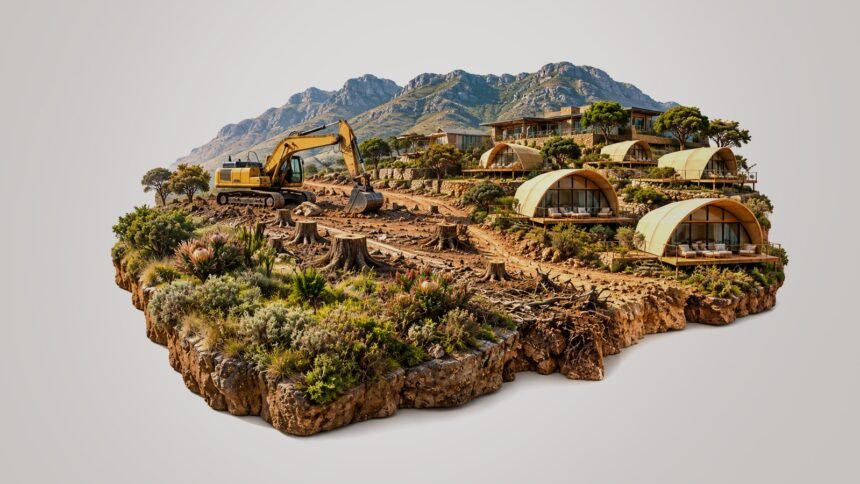
Twenty-three tourism units, ten of them “glamping” pods, rose on a goat stud farm in the foothills of the Riviersonderend mountains between June 2024 and April 2025. None of them had the environmental authorization the law requires. On 16 October, the developer, VEA Group Holdings, pleaded guilty in the Bonnievale Regional Court to two environmental offenses, and the Goats Window luxury safari lodge became the subject of a R15 million fine.
The case is a small one by the standards of national scandals, but it goes to the heart of a common pattern: build first, apply for permission afterward, and treat any penalty as a cost of doing business. How the courts and regulators price that behavior decides whether environmental law in South Africa protects ecosystems or taxes their destruction.
What Was Built, and Where
The development sits on Brakkefontein, a farm about 11 kilometers south of Bonnievale in the Western Cape. It includes three directors’ units, two lodge units, ten glamping pods and four lapa units, along with access roads, parking and related infrastructure. Its builders cleared 4,181 square meters of Breede Shale renosterveld, an endangered indigenous vegetation type. Clearing more than 300 square meters of natural vegetation in an endangered ecosystem requires prior environmental authorization.
The site also lies inside the Riviersonderend Mountain Catchment Area, a declared protected area. In the Western Cape, any tourism or hospitality facility sleeping 15 people or more within such an area needs environmental authorization. Those two “listed activities” under the National Environmental Management Act (NEMA) formed the basis of the charges.
Warnings That Were Ignored
According to the plea documents, work began on 6 June 2024, and the development was completed by 3 April 2025. The developer did not stop when the national Department of Forestry, Fisheries and the Environment (DFFE) served it a NEMA notice, and it also ignored a cease-work order from the Langeberg Local Municipality. The company was fully aware the development was illegal by 2 December 2024, when its farm manager signed a declaration for a retrospective assessment process, and in January 2025 its consultants described the application as one “for the regularisation of the illegal activity already undertaken on Brakkefontein”.
The plea agreement listed aggravating factors: the offenses went on over an extended period, the catchment is environmentally sensitive and strategically important for water security, the clearing was “not minor or trivial in extent”, and the activity was undertaken for commercial gain.
How the Fine Was Shaped
Under the plea and sentence deal with the National Prosecuting Authority, R10 million of the R15 million fine is suspended for five years. The remaining R5 million is payable in five installments of R1 million to Stop Rhino Poaching, a non-profit group that funds anti-poaching rangers and security in reserves. The developer also paid a separate R1.75 million administrative fine to begin a formal application to the DFFE for retrospective approval.
Mitigating factors included the company’s clean record, its guilty plea and remorse, its cooperation with investigators, the jobs and hospitality training created by the lodge, and the roughly R200 million a year in taxes paid by the group’s South African portfolio. The plea documents also noted that no irreversible environmental degradation had so far been identified by the available specialist reports.
Was It Enough?
Not everyone thinks so. Two local landowners, an independent environmental consultant representing an anonymous objector, and the Langeberg Local Municipality appealed the amount of the fine, arguing among other things that it was too lenient. The DFFE dismissed the appeals.
The numbers invite comparison. In its own application, VEA Group put the expected capital value of the completed lodge at R50 million and its expected annual contribution to the economy at R12 million. Measured against those figures, an immediately payable R5 million, spread over five years, is a significant sum but hardly a deterrent that makes illegal building unprofitable. The suspended R10 million matters only if the company offends again.
A First for the Department
DFFE spokesperson Evile Ntshangase said this was the first case involving the department in which a NEMA conviction and sentence included a court-ordered payment to Stop Rhino Poaching. However, similar payments had been ordered in cases involving biodiversity laws. “This outcome reinforces the legal obligation on developers to obtain the necessary environmental authorization before commencing any development activities requiring such authorization,” she said. The lodge’s website now says it is temporarily closed until further notice.
Who Decides What the Land Is Worth
South Africa has detailed environmental laws, but laws mean little if wealthy developers can treat retrospective approval as a routine step. Renosterveld and mountain catchments are part of the country’s natural capital, and this catchment is recognized as strategically important for water security. Real control over that capital means penalties that outweigh the profit of breaking the rules, restoration where damage is found, and local voices, like the municipality and neighbors who appealed, carrying weight in the outcome. Otherwise, the decision over what the land is worth will keep being made by whoever builds fastest.