






Oceanic Legacies: The Deep Roots of Somali Maritime Predation
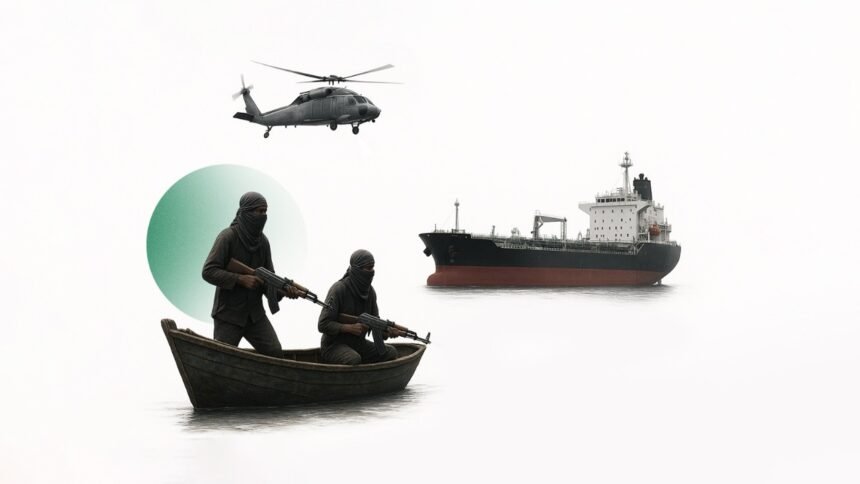
The Indian Ocean has borne witness to centuries of maritime ambition, from the dhows of ancient Swahili city-states to the iron-hulled giants of modern commerce. Yet for the past two decades, no stretch of its waters has commanded greater dread than the 3,300-kilometer Somali coastline. On this jagged frontier, state collapse, ecological plunder, and clan warfare converged to birth one of the 21st century’s most audacious criminal enterprises. On November 6, 2025, that specter re-emerged with chilling precision: a Malta-flagged chemical tanker en route from India to South Africa was stormed southeast of Eyl by armed men wielding rocket-propelled grenades. The 24 crew members barricaded themselves inside the vessel’s citadel as pirates, operating from a hijacked Iranian dhow, raced against the clock to extract hostages before a distant Spanish warship could intervene. This was no random act of desperation—it was the first successful boarding in 18 months, a calculated strike that shattered a fragile calm and reignited global anxieties over the stability of one of the world’s most vital trade corridors.
The resurgence did not occur in isolation. It followed two failed boarding attempts earlier that week—one off Mogadishu—and came amid a seasonal shift: the subsidence of the northeast monsoon’s rough seas, historically the signal for pirate fleets to launch. As Martin Kelly of EOS Risk observed, “The pirates will be acutely aware that a naval response has begun and they don’t want to be there without a hostage.” Their tactics—mothership operations, rapid assaults, and strategic timing—mirror the playbook of 2008–2012, when Somali pirates dominated global maritime security discourse. That era saw 237 attacks in 2011 alone, with ransoms averaging $5 million per vessel and total economic costs soaring to more than $18 billion annually. Insurance premiums for Gulf of Aden transits surged 300%, forcing shipping lines to reroute via the Cape of Good Hope—a 3,500-nautical-mile detour adding up to two weeks and $500,000 in fuel per voyage.
Yet the 2025 incident is not a mere echo of the past. It unfolds against a radically altered geopolitical seascape: Houthi missile barrages in the Red Sea have displaced over 60 vessels monthly, funneling traffic southward into the very waters Somali pirates once ruled. This convergence of threats—ideological militancy in the north, opportunistic criminality in the east—has stretched international naval resources to breaking points, creating windows of vulnerability that Somali networks, dormant but never dismantled, are now exploiting with renewed confidence.
Continental Currents: Piracy as Africa’s Shared Maritime Burden
Africa’s oceanic frontier is not a monolith of peril but a mosaic of overlapping threats, each shaped by local political economies yet bound by common structural frailties. While Somali piracy commands headlines for its theatrical hijackings, the Gulf of Guinea has quietly ascended as the world’s kidnapping capital. Between 2018 and 2022, the region accounted for 95% of global crew abductions at sea, with Nigerian gangs extracting ransoms of $50,000–$200,000 per sailor. Unlike Somalia’s ransom-driven model, West African piracy revolves around oil theft—siphoning crude from tankers and selling it on black markets—or crew abductions for rapid payouts. The tactics differ, but the drivers converge: youth unemployment rates exceeding 60%, collapsed fisheries, and foreign vessels plundering $2 billion in marine resources annually across the continent.
The African Union’s 2050 Africa’s Integrated Maritime Strategy (AIMS) envisions a $1 trillion blue economy, harnessing fisheries, tourism, and offshore energy. Yet piracy erodes this potential at every turn. Somalia alone loses $300 million yearly to illegal, unreported, and unregulated (IUU) fishing—more than the country’s entire national budget in some years. In the West, Ghana and Côte d’Ivoire see tuna stocks decimated by foreign fleets, pushing coastal communities into complicity with pirate networks. The Suez Canal, which handles 12% of global trade and generates $9.4 billion annually for Egypt, serves as the linchpin. When Somali attacks peaked in 2011, Canal revenues fell by $642 million as insurers demanded war-risk surcharges. Today, Houthi disruptions compound the damage: rerouting adds 40% to fuel costs and multiplies carbon emissions fivefold, undermining Africa’s climate commitments and inflating import prices for landlocked states like Ethiopia and Uganda.
Pan-African responses remain fragmented. ECOWAS coordinates zonal patrols in the Gulf of Guinea under the Yaoundé Architecture, reducing incidents by 40% since 2016. In the east, IGAD facilitates dialogue but lacks the teeth to enforce it. The AU’s Lomé Charter calls for a combined exclusive maritime zone, yet only 14 of 55 member states have ratified it. Somali piracy, by choking the eastern corridor, indirectly subsidizes West African insecurity: diverted naval assets leave gaps that Nigerian gangs exploit. A unified African maritime domain awareness system—integrating satellite tracking, drone surveillance, and regional data fusion—remains a distant aspiration, stymied by sovereignty disputes and funding shortfalls.
Clan Tapestry: Somalia’s Fractured Social Fabric and Piracy’s Endurance
To understand Somali piracy is to navigate the labyrinth of clan, a social architecture that predates the Somali state and outlives its collapse. The country’s 15 million people are organized into five prominent clan families—Darod, Hawiye, Dir, Isaaq, and Rahanweyn—each subdivided into hundreds of sub-clans bound by xeer, a customary legal code enforced through blood compensation and collective responsibility. In Puntland and Galmudug, the epicenters of pirate activity, the Majerteen (Darod) and Habar Gidir (Hawiye) sub-clans dominate coastal enclaves. Piracy emerged here not as an alien pathology but as an extension of clan survival strategies.
The 1991 fall of Siad Barre’s regime triggered a cascade of state failure: fisheries collapsed, warlords seized ports, and foreign trawlers—Korean, Taiwanese, European—descended with impunity. The 2004 Indian Ocean tsunami delivered the final blow, destroying 40% of Somalia’s fishing fleet and displacing 50,000 coastal residents. Disenfranchised youth, earning $100 monthly as fishermen, rebranded themselves as “coast guards,” initially targeting IUU vessels. By 2006, this morphed into a full-scale ransom economy. Clan elders invested in skiffs and GPS units; kingpins like Mohamed Abdi “Afweyne” coordinated attacks from Nairobi hotels; and ransoms—$133 million between 2005 and 2012—were distributed via hawala networks according to clan hierarchies.
The 2025 Eyl assault bears these hallmarks. The choice of an Iranian dhow as a mothership reflects tactical continuity: dhows, seized far offshore, extend operational range to 1,000 nautical miles. The location—Eyl, once dubbed the “pirate capital”—signals clan territoriality. Al-Shabaab, despite ideological opposition to piracy, extracts 20–30% “taxes” from ransoms in controlled areas, forging pragmatic alliances with pirate financiers. This symbiosis binds insurgency and criminality: arms smuggled via dhows from Yemen bolster both al-Shabaab’s arsenal and pirate firepower. The federal government in Mogadishu, reliant on 8,000 ATMIS peacekeepers, wields little influence in Puntland, where the Maritime Police Force—trained by the UAE—disrupts low-level cells but cannot dismantle clan-backed syndicates.
Global Shields: The Multinational Counter-Piracy Architecture
The international response to Somali piracy has been one of the most ambitious maritime security operations in history, blending hard power with soft diplomacy. Launched in December 2008, the EU’s Operation Atalanta became the cornerstone: mandated under UNSCR 1816, it patrols 8.3 million square kilometers with an annual budget of €8 million, escorting World Food Programme vessels that deliver 80% of Somalia’s humanitarian aid. By 2012, Atalanta had disrupted 90% of attempted hijackings and facilitated the prosecution of 150 pirates in Seychelles and Kenya under bilateral transfer agreements. NATO’s Operation Ocean Shield (2009–2016) and the US-led Combined Task Force 151 operated in parallel, their coordination formalized through the Shared Awareness and Deconfliction (SHADE) mechanism in Bahrain.
China’s entry transformed the landscape. Since 2008, the People’s Liberation Army Navy has deployed 48 task groups from its Djibouti base, escorting over 6,000 vessels—half foreign-flagged—and rescuing 20 non-Chinese ships. Beijing frames this as “win-win cooperation,” aligning anti-piracy with Belt and Road security. Yet interoperability with Western forces remains limited: Chinese vessels rarely participate in joint boarding operations, and data-sharing is selective. The UN Contact Group on Piracy off the Coast of Somalia, comprising 80 states and organizations, has channeled $250 million in capacity-building aid, training 1,200 Somali coast guards since 2010.
Challenges persist. Naval presence has thinned since 2015 as Houthi threats monopolized Red Sea assets. Legal frameworks falter: UNSCR 1851 authorized land incursions, but sovereignty concerns restrict operations to 12 nautical miles. Prosecutions strain regional judiciaries—Kenya ceased accepting pirates in 2010, citing overburdened courts. The 2025 incident exposed response lags: the nearest warship was over 24 hours away, a window pirates exploited with precision. Emerging technologies—AI-driven anomaly detection, unmanned aerial systems—offer promise, but deployment lags in African partners due to cost and training gaps.
Trade Vortex: The Economic Hemorrhage of Maritime Insecurity
Somali piracy’s economic impact transcends ransom tallies. At its 2011 peak, attacks cost the global economy $7–12 billion annually: $238 million in ransoms, $3 billion in insurance hikes, $2.3 billion in rerouting, and $1.3 billion in accelerated transit speeds. African states bore disproportionate burdens. Kenya’s Mombasa port lost 30% of its container traffic; Seychelles’ tourism revenue halved. The World Bank estimated Somali fisheries losses at $300 million yearly—equivalent to 10% of GDP—while illegal fishing across Africa siphons $2 billion annually.
The Suez Canal’s vulnerability amplifies this vortex. Houthi attacks since 2023 have slashed transits by 50%, diverting 12% of global trade southward. Each Cape reroute adds $1 million in fuel and 10–14 days, inflating African food and fuel prices by 15–20%. Egypt’s Canal revenue, critical for debt servicing, faces a $3 billion annual shortfall. The African Continental Free Trade Area (AfCFTA), aiming for $200 billion in intra-African trade by 2030, hinges on secure maritime corridors. Piracy’s resurgence threatens this vision: a single hijacking can spike regional insurance premiums by 50%, deterring investment in port infrastructure such as Lamu and Bagamoyo.
Sustainable fisheries offer a counter-narrative. Somalia’s 200-nautical-mile EEZ holds 200,000 tons of tuna annually; licensed harvesting could generate $100 million in state revenue. Puntland’s 2012–2015 anti-piracy campaign, backed by $50 million in UAE aid, reduced incidents by 70% by licensing 300 fishing vessels and employing 1,500 ex-pirates as guards. Scaling such models continent-wide—via blue bonds, satellite monitoring, and AU maritime corridors—could transform piracy’s economic logic, replacing ransom allure with legitimate livelihoods.
Forward Watch: Forging a Piracy-Resilient African Maritime Order
The 2025 resurgence is not destiny but a warning. Somali piracy thrives in governance voids, ecological despair, and geopolitical distraction. Closing these gaps demands a renaissance across four fronts.
First, governance integration: Somalia’s 2025–26 UN Security Council seat offers leverage to revive lapsed anti-piracy mandates with federal consent. Clan-inclusive councils—merging xeer with statutory law—can prosecute financiers, not just skiff crews. Puntland’s Maritime Police Force, expanded to 1,000 personnel with $134 million in AU-led funding, could anchor coastal security if paired with transparent revenue-sharing.
Second, multinational evolution: Hybrid patrols—EU-NATO-China triads—must integrate African navies via joint exercises and technology transfer. Drone swarms and AI analytics, piloted in the Gulf of Guinea, can blanket high-risk zones. The Djibouti Code of Conduct, signed by 21 states, should evolve into a binding enforcement pact with real-time data fusion.
Third, economic substitution: $250 million in sustainable fisheries investment—via AfDB blue bonds—can eclipse ransom incentives. Licensing 1,000 Somali vessels under transparent quotas, with ex-pirates trained as monitors, mirrors Puntland’s 50% piracy drop post-2012. Continental fish trade corridors, linking Tunis to Durban, can absorb youth labor.
Fourth, regional solidarity: The AU must operationalize the Lomé Charter’s combined maritime zone, pooling satellite assets and patrol vessels. ECOWAS-IGAD knowledge exchanges can harmonize best practices, while AfCFTA negotiates piracy surcharges into trade agreements, shielding landlocked states.
This is not a requiem for Somali seas but a blueprint for their reclamation. By weaving counter-terrorism with trade equity, ecological restoration with clan reconciliation, Africa can eclipse piracy’s shadow. The Horn’s raiders may have returned, but the continent’s resolve—forged in shared waters and common destiny—can ensure they do not endure.


