





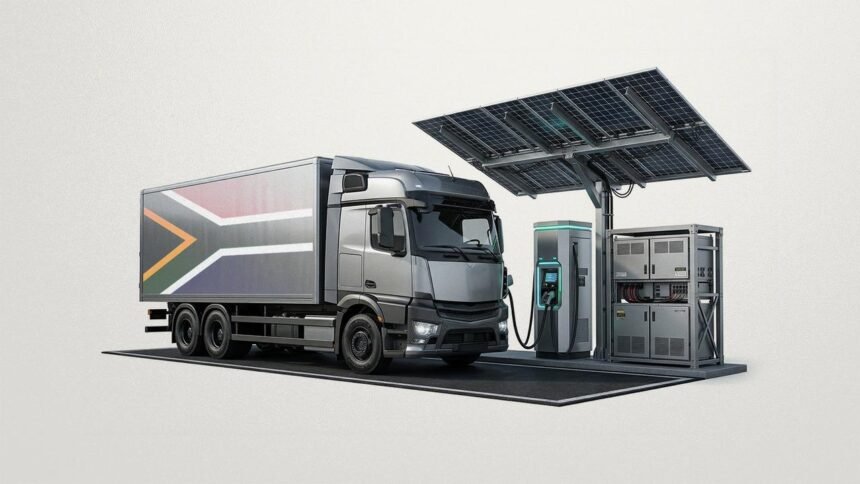
A solar-powered charging experiment for heavy-duty electric trucks in South Africa is offering a glimpse of how the continent could decarbonize freight, and scale renewables far beyond the grid.
On a shimmering stretch of highway between Johannesburg and Durban, the diesel roar that usually defines African freight is briefly interrupted by something quieter: the faint whir of a heavy-duty electric truck rolling into a fenced yard lined with solar panels.
Technicians in reflective vests watch as the driver plugs in; overhead, rows of panels tilt toward a brutal midday sun that will do what coal plants and aging grids often cannot here, keep the power on.
This off-grid station, built by the Cape Town-based startup (Charge), is one of the first solar-powered fast-charging hubs for electric trucks on the continent. If it works at scale, advocates say, it could tackle two of Africa’s toughest problems at once: cutting freight emissions and building out renewables without waiting for fragile national grids to catch up.
Background and Stakes
Africa’s freight corridors have long been the domain of diesel, and of the economic and climate costs that come with it. Heavy trucks moving goods between ports and inland cities are a major source of soot and planet‑warming pollution. Yet, they are often locked into fossil fuels by unreliable electricity and sparse charging infrastructure.
In South Africa, trucking accounts for about 63 percent of transport emissions, according to a 2024 white paper on decarbonizing shipping and trucking sectors published by the World Economic Forum and partners. That paper argues that cutting those emissions will require not only cleaner vehicles but a substantial expansion of solar, wind, and hydropower to replace a grid still heavily reliant on coal.
Rather than waiting for that transformation to flow through the grid, Charge is betting on a different model: fully off-grid, solar-powered charging hubs spaced along major routes.
The company is developing two such stations on the roughly 570‑kilometer N3 highway between Johannesburg and Durban, one of South Africa’s busiest freight corridors.
The project has secured about 6.2 million dollars in equity financing from the state-owned Development Bank of Southern Africa, which has said the investment is intended to help move from “pilot projects to full-scale rollouts.”
Each off-grid site costs around 1.25 million dollars to build, according to company executives and public statements. The long-term plan, the company says, is to extend off-grid, ultra‑fast charging along South Africa’s main long‑distance routes, with hubs roughly every 150 kilometers on national roads.
The stakes reach well beyond one company. Africa holds about 60 percent of the world’s best solar resources, making it one of the cheapest places to generate power from the sun. Yet many countries still depend heavily on fossil fuels, in part because grid expansion has lagged, and capital for large renewable projects often arrives slowly.
Off-grid truck charging, its backers argue, could become a proof of concept that renewables can directly power economic workhorses, trucks, buses, and eventually trains, without detouring through creaking national systems.
Human Stories and Real-world Examples
In a recent demonstration at one of the sites, Charge simultaneously charged two heavy-duty electric trucks supplied by China’s SANY Trucks and four passenger electric vehicles. “We have proven that it’s possible to charge electric trucks using solar energy fully, and now we are building the infrastructure to do that commercially and reliably,” Joubert Roux, the company’s co‑founder, said in an interview.
His pitch is aimed squarely at fleet managers wary of both climate targets and chronic power cuts.
For truck operators, the question is less about the technology’s elegance than about reliability and cost. South Africa’s national utility has struggled for years with rolling blackouts, known as load‑shedding, leaving businesses wary of plugging critical logistics into the grid.
“Our approach is to build energy‑resilient charging hubs that are not dependent on an unstable grid,” Roux told reporters. “By combining solar and storage, we can provide predictable, clean power for fleets.”
Across the continent, operators have been squeezed by volatile fuel prices. In several African capitals, pump prices have surged since 2022 as governments cut subsidies and global markets spiked, according to regional energy trackers and local reporting.
Advocates of electrification say that once the upfront costs of vehicles and charging are covered, running trucks on locally generated solar power could offer more stable operating costs than running on imported diesel. They also acknowledge that few fleet owners will switch on climate grounds alone.
Most of Africa’s electric mobility experiments so far have focused on smaller vehicles. In Rwanda and Kenya, for example, the Kigali-based company Ampersand has deployed thousands of electric motorcycles and an expanding network of battery‑swap stations, some of which are being paired with solar photovoltaics.
A 2024 pilot in Nairobi added a 37‑kilowatt solar system at one swap site to reduce dependence on the grid and lower operating costs, according to company disclosures. Similar projects have drawn attention from policymakers, who see them as early examples of how renewables can plug directly into the transport sector.
Policy, Debate, and Expert Views
The N3 experiment is unfolding amid a broader debate over how Africa should decarbonize transport, and who should pay for it. Analysts emphasize that electric trucks alone will not solve everything.
A 2023 report on decarbonizing South Africa’s transport sector, for instance, highlights shifting more freight to rail, improving logistics efficiency, and deploying cleaner fuels as essential alongside zero‑emission trucks. Even with those changes, freight trucks are expected to remain indispensable for connecting ports, mines, and landlocked neighbors, making their emissions a prime target.
Critics of rapid electrification raise familiar concerns: high upfront costs for vehicles, limited maintenance capacity, and the risk that off‑grid projects will serve only well‑capitalized corridors rather than the informal routes where much of Africa’s commerce moves.
Regulators pose another bottleneck. Roux has said adoption of electric freight technology still faces “regulatory delays for site approvals, high import duties, truck certification requirements, and limited vehicle availability.”
Governments from South Africa to Kenya have proposed electric vehicle strategies and import duty cuts, but specific incentives for heavy trucks remain limited and uneven.
Still, many experts see an opening. Because Africa’s vehicle fleet is relatively small per capita and many roads are still being built or upgraded, the continent has what some researchers call a “latecomer advantage”: the chance to leapfrog directly to cleaner systems rather than locking in decades of diesel dependence.
The World Economic Forum paper argues that shifting to renewables and green hydrogen in sectors like trucking and shipping could boost South Africa’s GDP and create hundreds of thousands of jobs by midcentury, if managed as a just transition.
Off‑grid solar hubs could also help answer a political challenge that dogs electric vehicles everywhere: the charge that they merely move emissions from tailpipes to smokestacks. In sunbelt regions from the Gulf to the Cape, infrastructure that visibly “charges from the sun” may offer both a cleaner emissions profile and a narrative that is easier to sell to skeptical publics.
What Comes Next
Charge has said its first two N3 stations should be operational by mid‑2026, enabling long‑distance electric vehicle travel along one of South Africa’s busiest transport routes.
The company is already looking beyond that corridor, with the N1 route between Johannesburg and Cape Town flagged as the next focus for off‑grid, ultra‑fast charging. If the model proves profitable there, industry observers say, similar networks could follow on freight arteries from West Africa’s coastal ports to East Africa’s regional hubs.
For now, the scene on that sunbaked highway is still a curiosity: a handful of gleaming panels and silent trucks against a backdrop of diesel traffic and distant exhaust. But as more vehicles plug in, and as more of Africa’s vast solar potential is harnessed not just for homes or mines but for the continent’s freight lifelines, the experiment here may start to feel less like a novelty and more like a preview of how goods move in a warming world.