




Eternal Fires: The Pan-African Volcanic Belt in Deep Time
Africa is not merely a continent; it is a slow-motion explosion frozen across geological epochs. The East African Rift System – the planet’s most ambitious continental divorce – stretches more than 6,000 kilometres from the Red Sea to Mozambique, pulling the Horn of Africa away from the rest of the continent at roughly the speed a fingernail grows. Along this widening wound lie more than 150 volcanic centres, some perpetually active, others slumbering for millennia only to awaken with apocalyptic abruptness. Ethiopia, Kenya, Tanzania, the Democratic Republic of Congo, Uganda, Rwanda, Djibouti, and Eritrea together host the overwhelming majority of Africa’s living volcanoes. Farther west, the Cameroon Volcanic Line and isolated giants such as Mount Nyiragongo remind us that the continent’s fiery breath is not confined to the rift alone.
These volcanoes have shaped more than landscapes. They fertilised the soils that cradled early humanity in the Awash and Omo valleys, supplied obsidian for Stone Age tools across the Sahara, and still provide geothermal energy that lights Kenya’s grid and heats Rwanda’s greenhouses. Yet the same magma that gives also takes. Since 1900 alone, African volcanoes have claimed at least 4,000 lives directly, with indirect tolls from famine, displacement, and disease running far higher. The ledger remains incomplete because many eruptions in remote Afar, northern DRC, or the Tibesti massif have gone unrecorded by any authority except oral memory.
The Mountain That Forgot Time: Hayli Gubbi’s Millennium-Long Silence Broken
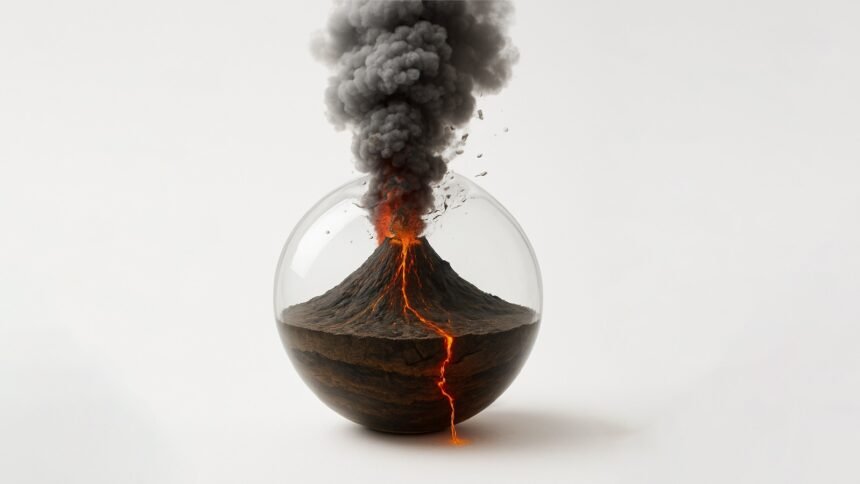
Hayli Gubbi – a low, broad shield volcano barely 547 metres high – sits in the northern Danakil Depression, one of the hottest and lowest places on Earth. For at least 12,000 years, since the early Holocene when the African Humid Period greened the Sahara, it had done nothing more dramatic than exhale faint wisps of steam. Geologists classified it as dormant, almost extinct. Then, in the final week of November 2025, everything changed.
On Sunday, 23 November, a swarm of earthquakes rattled the Erta Ale volcanic range. By dawn the next day, a curtain of fire 800 metres long ripped open along Hayli Gubbi’s eastern flank. Basaltic lava, hotter than 1,100 °C and more fluid than molten glass, surged downslope at speeds exceeding 40 km/h. Within hours, an ash plume punched 14–16 km into the stratosphere, higher than any Ethiopian eruption in recorded history. The roar was heard 80 kilometres away in the highland town of Mekele. Ash fell as far as Massawa on the Eritrean coast and, carried by upper-level winds, dusted Khartoum, Aden, and even Karachi three days later.
Miraculously, no human being died. The eruption occurred in one of the planet’s most sparsely populated regions – fewer than five people per square kilometre – and the Afar people, reading the earthquake omens, had already moved livestock to higher ground. Yet the cultural and economic shock rippled outward: salt caravans were halted, solar salt pans were contaminated, and grazing lands turned to grey deserts overnight.
Ledger of Flames: Historical Toll and the Most Lethal African Volcanoes
To understand 2025’s Hayli Gubbi event, one must place it against the continent’s violent volcanic inheritance:
- Nyiragongo (DRC), January 2002 and May 2021: lava flows through Goma killed at least 400 and displaced half a million.
- Nyiragongo, January 1977: ultra-fast lava killed between 300 and 2,000 (estimates vary wildly because bodies were incinerated instantly).
- Lake Nyos (Cameroon), August 1986: limnic eruption of CO₂ asphyxiated 1,746 villagers and thousands of livestock in a single night.
- Karthala (Comoros), multiple 19th–21st-century eruptions: repeated ashfalls and acid rain have caused famine and mass migration.
- Erta Ale and Dabbahu (Ethiopia), 2005–2010 crisis: the Afar Rift’s mega-dyke intrusion displaced 20,000 and destroyed villages.
Cumulative documented deaths from volcanic activity in Africa since 1500 probably exceed 12,000, with the actual figure closer to 20,000 when oral histories and unrecorded limnic events are included. Ethiopia itself has suffered at least eight lethal eruptions since the 17th century, though none in living memory until Hayli Gubbi.
Sulphur Skies and Carbon Shadows: Volcanic Forcing in a Warming Africa
Every major eruption injects aerosols into the stratosphere, temporarily cooling the planet. Pinatubo 1991 lowered global temperature by 0.5 °C for two years; Hayli Gubbi’s plume, though smaller, is estimated to have caused a hemispheric cooling of 0.05–0.1 °C during the 2025–26 boreal winter. For African farmers already battling erratic rains, this fleeting “volcanic winter” risks shortening growing seasons in the Sahel and Horn.
Conversely, rift volcanoes are prodigious emitters of CO₂. Erta Ale’s lava lake alone releases as much carbon dioxide in a year as a medium-sized European country. Over centuries, these natural emissions complicate Africa’s position in climate negotiations: the continent that contributes least to anthropogenic warming is also home to some of the planet’s most significant natural CO₂ sources.
More immediate are local effects. Ash acidifies rainwater, devastates coral reefs along the Dahlak Archipelago, and strips vegetation that stabilises soils against the flash floods now made more frequent by climate change. In the Anthropocene, volcanoes and greenhouse warming are no longer separate threats; they are accomplices.
The Grey Migration: Transboundary Air Pollution and Aviation Chaos
For six days in late November 2025, most air traffic between Europe, the Middle East, and East Africa was grounded or rerouted. Addis Ababa Bole International Airport was closed entirely; Nairobi and Djibouti saw hundreds of cancellations. Fine ash reached concentrations of 6,000 µg/m³ near the volcano – six hundred times the WHO’s safe daily limit – and remained above 100 µg/m³ as far away as Mumbai.
Sulphur dioxide converted to sulphate aerosols drifted across the Arabian Sea, contributing to some of the worst air-quality days ever recorded in Gujarat and Sindh. Fisheries along the Yemeni coast reported massive fish kills from acidified surface waters. This single eruption demonstrated that African volcanism is now a global atmospheric player, demanding monitoring and diplomatic frameworks that match the reach of its plumes.
Guardians of the Rift: Early Warning, Indigenous Knowledge, and Continental Solidarity
Ethiopia’s Institute of Geophysics, Space Science and Astronomy detected the earthquake swarm 48 hours in advance and issued the country’s first-ever volcanic red alert. Afar regional authorities, working with elders who still read ground tremors the way sailors read clouds, evacuated four villages before the eruption. Not a single life was lost – a triumph almost unprecedented in African volcanic history.
Yet the system is fragile. Only eight of Ethiopia’s thirty-plus active volcanoes have functioning seismic stations. Across the border in Eritrea, monitoring is virtually non-existent. The African Union’s Continental Multi-Hazard Early Warning System, launched in 2023, has begun to bridge these gaps with satellite interferometry and shared data portals, but funding remains precarious. UN agencies – UNDP, OCHA, and the Smithsonian Global Volcanism Program – provide the technical backbone, while initiatives like the Addis Ababa-based IGAD Climate Prediction Centre now incorporate volcanic ash forecasts into seasonal bulletins.
At the community level, Afar poets are already composing new geraar songs that encode the lessons of the 2025 eruption, ensuring that memory survives even if seismographs fail.
Fractured Earth, Resilient Peoples: Challenges and the Long Road Ahead
The obstacles are formidable. Sparse populations make monitoring expensive; porous borders complicate coordination; climate finance rarely covers geological hazards; and rapid urbanisation is pushing cities like Goma, Bukavu, and even Addis Ababa closer to active vents.
Yet the same rift that threatens also offers. Geothermal potential along the rift could supply more than 20,000 MW of clean baseload power – enough to electrify half the continent. Volcanic soils remain among the most fertile on Earth. Lithium, cobalt, and rare-earth deposits concentrated by magmatic processes are already attracting mining investment in Ethiopia and the DRC.
Hayli Gubbi has sounded a continental wake-up call. Suppose Africa can weave indigenous vigilance with satellite eyes, Pan-African diplomacy with local resilience, and geological inevitability with human agency. In that case, the fires that tear the continent apart may yet power its rise. The mountain that slept for twelve thousand years has reminded the cradle of humanity that creation and destruction are inseparable – and that the continent born in fire must learn to master it once again.


