



Pan-African: The Sahelian Epicenter and Continental Stability
Across the African landscape, the security of the Sahel is increasingly recognized as the linchpin for the stability of the entire continent. The persistent instability in Mali is not merely a national crisis but a Pan-African challenge that threatens to undermine regional integration and economic development. As asymmetric threats evolve and cross-border insurgencies intensify, the collective responsibility of African states to safeguard their shared borders becomes paramount. The Sahelian epicenter serves as a critical test for the African Union’s aspirations of “Silencing the Guns,” highlighting the urgent need for a unified and indigenous response to the complex drivers of conflict that transcend traditional state boundaries.
Mali’s Political Outlook: The Garrison State and the Quest for Control
Mali’s political outlook in 2026 is defined by a centralized military administration that has increasingly prioritized “regime security” and kinetic solutions over inclusive governance. Since the military takeover, the state has transitioned into a garrison-style administration, attempting to assert control over a fragmented territory. However, the recent escalation in coordinated attacks suggests that the government’s grip on security remains tenuous. The political landscape is characterized by a significant move away from traditional Western alliances toward new, more transactional partnerships, creating a state of suspended animation where the promise of a return to civilian rule is frequently overshadowed by the immediate requirements of a widening war.
al-Qaeda in Mali: The Strategic Evolution of JNIM
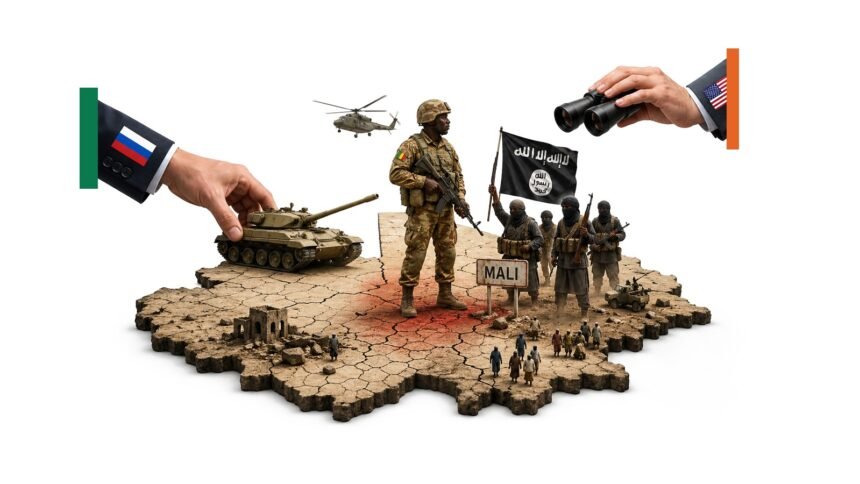
The al-Qaeda-linked group Jama’at Nusrat al-Islam wal-Muslimin (JNIM) remains the most potent and strategically sophisticated insurgent force in the region. In April 2026, JNIM demonstrated a significant expansion in its operational capacity, launching what analysts describe as the largest coordinated offensive in years. These strikes targeted not only the capital, Bamako, specifically the international airport and military training camps, but also four other cities across central and northern Mali. This strategic evolution shows a group capable of simultaneous, multi-front operations, moving beyond rural guerrilla warfare to strike at the heart of the Malian state’s logistical and symbolic power.
Tawaqir in Mali: The Re-emergence of the Separatist Alliance
A defining feature of the current conflict is the re-emergence of the alliance between jihadist elements and northern separatist forces, traditionally led by Tuareg-led groups such as the Azawad Liberation Front. This coordination mirrors the events of 2012, which sparked the region’s original security crisis. The joint nature of the April 2026 attacks suggests a pragmatic, if volatile, “tactical marriage” intended to overwhelm state defenses. For the separatist movements, the alliance provides a force multiplier in their long-standing quest for northern autonomy; for the jihadists, it offers a broader social and geographic base from which to challenge the central government.
Russia & USA Geopolitics: The Multipolar Tug-of-War
The security landscape in Mali has become a focal point for a broader multipolar tug-of-war between Moscow and Washington. Following the ejection of French and U.S. forces, the Malian junta has leaned heavily on Russian military support, including the services of the Africa Corps (the successor to the Wagner Group) and significant donations of tanks, helicopters, and armored vehicles. This shift toward Moscow is viewed as a rejection of Western “conditional” aid in favor of a “security-first” model. Meanwhile, the United States continues to monitor the situation from a distance, focusing on containing the “spillover” of extremism into coastal West African states, creating a geopolitical environment where Malian sovereignty is increasingly negotiated through the interests of extracontinental powers.
Peace Efforts: The Erosion of Mediation
Peace efforts in Mali are currently at their lowest ebb, following the collapse of the 2015 Algiers Agreement and the subsequent withdrawal of traditional mediating parties. The formal split between the Sahelian states and the regional bloc, ECOWAS, has further eroded the institutional channels for dialogue. While the Malian army continues to claim that the situation is “under control” after each major offensive, the lack of a viable political track means that “peace” is often pursued through the total defeat of the enemy, a goal that has remained elusive for over a decade. Without a renewed framework for internal reconciliation, the cycle of strike and counter-strike remains the dominant feature of the national reality.
AU-UN Efforts: Navigating Institutional Displacement
The role of the United Nations and the African Union in Mali has been fundamentally altered by the withdrawal of the MINUSMA peacekeeping mission and the increasing hostility of the central government toward external oversight. AU-UN efforts are now largely restricted to humanitarian support and regional monitoring. The “institutional displacement” of these bodies has left a vacuum in the protection of civilians and the monitoring of human rights, especially as government forces and their international partners face accusations of extrajudicial actions against suspected insurgent collaborators. Reasserting a multilateral presence remains a significant diplomatic challenge in an environment where state sovereignty is used to deflect international scrutiny.
The Way Forward: Toward a Holistic National Contract
The way forward for Mali requires a radical transition from a purely kinetic security strategy toward a holistic national contract that addresses the root causes of dissent. Military force, whether supported by Western or Russian partners, has proven insufficient to suppress the deep-seated grievances of northern populations and the strategic persistence of jihadist movements. Stability in the 21st century depends on the restoration of state services, the inclusion of marginalized communities in the political process, and the professionalization of security forces under civilian oversight. Ultimately, reclaiming the future for Mali starts with the recognition that lasting security cannot be imported from abroad, but must be built on the foundation of an inclusive, transparent, and truly sovereign Malian state.