




Delegates in Fourways, north of Johannesburg, filled the lobby of the Indaba Hotel wearing lanyards and carrying laptops. Their conversations revolved around familiar strategic terms: resilience, risk, and defense.
They were attending the Future of Sustainability Conference 2026, a two‑day forum billed as South Africa’s premier platform for “leading African solutions for global sustainability,” which brought together chief executives, policymakers, investors, and sustainability officers on March 24 and 25.
Across keynote speeches and panel discussions, speakers argued that sustainability, once treated as a corporate add‑on or a narrow environmental issue, is now central to national security and long‑term development.
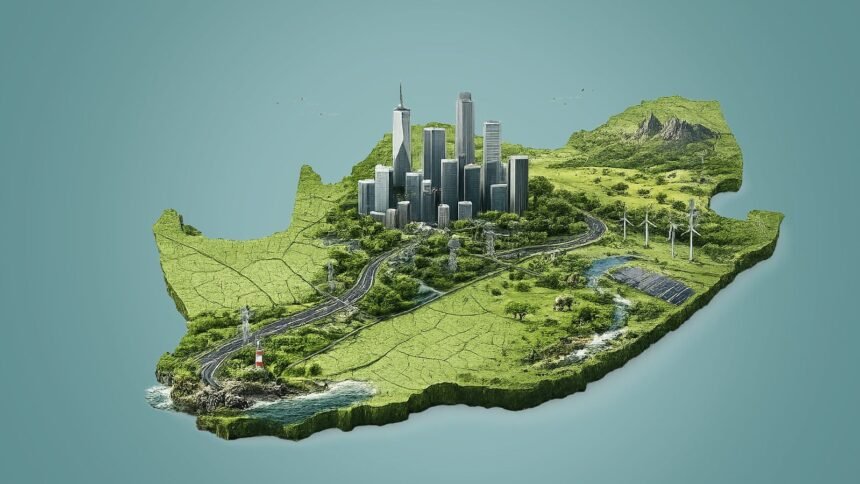
“In a more volatile, multipolar world, sustainability is no longer a ‘nice to have,’” one speaker told the opening session. “It is effectively a form of national defense.” The argument, echoed in different ways across the conference, is that climate resilience, reliable energy, and coherent environmental governance are now as important to a country’s stability as conventional defense spending.
The Johannesburg gathering offers a window into how South African leaders and their counterparts across the continent are trying to reposition sustainability, not as an external constraint, but as the backbone of their economic and security strategies for the next decade.
The Global Backdrop
The Future of Sustainability Conference, hosted by Topco Media in collaboration with partners including the Association of International Certified Professional Accountants and the Chartered Institute of Management Accountants, has quickly become a prominent sustainability forum on the South African calendar.
Promotional material describes it as a platform for C‑suite executives, ESG specialists, and “systems‑change leaders” who see sustainability as a driver of business success and national resilience.
The 2026 program at the Indaba Hotel focuses on “African Solutions for Global Sustainability” and “The Next Decade of Development: What Must Change Now to Secure Africa’s Future.”
Panels and masterclasses promise guidance on resource scarcity, urban resilience, climate adaptation, credible sustainability reporting, and inclusive leadership.
Underlying those themes is a sober reading of the global context. In her keynote address, Deputy Minister of Tourism Bernice Swarts, speaking on behalf of the Minister of Forestry, Fisheries and the Environment, told delegates that the world had shifted in recent years from a relatively rules‑based international order to a “more fragmented, multipolar and confrontational” landscape, complicating multilateral cooperation on climate and development.
She warned that climate and environmental risks, from extreme weather to biodiversity loss, are converging with economic and social pressures, making sustainability “a core pillar of national resilience.”
Ms. Swarts linked that volatility directly to South Africa’s domestic challenges. The environmental and climate agenda, she noted, cuts across most of the United Nations’ Sustainable Development Goals; around 71 percent of the goals are either directly environmental or strongly cross‑cutting.
Yet progress has been uneven, and financing has lagged behind commitments, raising concerns that funds promised for sustainable development could be diverted to other priorities.
Against this backdrop, she framed environmental governance and climate policy as core elements of economic strategy. For South Africa and the wider continent, she argued, industrialization is “not a choice” but essential, and the question is how to pursue it through low‑carbon. These resource‑efficient pathways create jobs and embed countries in future global value chains.
Human Stories and Real-World Examples
On the conference floor, the abstract language of “national defense” and “systems change” translated into more concrete dilemmas. In a panel on climate adaptation and urban resilience, a municipal official from a flood‑prone coastal city described how increasingly frequent storms were damaging roads, homes, and informal settlements, straining already limited budgets.
Insurance premiums were rising or disappearing altogether, she said, as risk models caught up with new climate realities.
For her, resilience is not a metaphor. “If we cannot protect our communities from extreme weather, we risk social unrest and economic collapse,” she told attendees, arguing that investments in drainage, early‑warning systems, and green infrastructure were as protective as any hard security asset.
Conference materials promised “practical strategies to address resource scarcity, urban infrastructure resilience and climate adaptation,” and sessions offered examples of cities integrating climate risk into planning instruments and budgeting.
Energy policy formed another thread, binding national security and sustainability. South Africa’s effort to shift from coal‑dominated power generation toward a cleaner mix, supported in part by a Just Energy Transition Investment Plan with international partners, has been complicated by financing gaps, grid constraints, and socio‑economic impacts.
Ms. Swarts pointed to pilot projects in green hydrogen, low‑carbon steel, and other emerging sectors as examples of how decarbonization can support industrial competitiveness, while stressing the need to ensure that “no South African is left behind in the transition to a low‑carbon economy.”
Corporate participants brought their own perspectives. The Chartered Institute of Management Accountants highlighted a series of ESG‑focused panels, arguing that management accountants are increasingly central to assessing climate and resource risks on company balance sheets and informing strategic decisions.
A bank executive discussed internal stress tests that model the impact of droughts, power outages, or policy shocks on loan portfolios, treating environmental risk as a core credit issue rather than a peripheral concern.
For smaller businesses and civil society organizations, the conversation centered on capacity and inclusion. Several attendees noted that credible sustainability reporting, navigating complex climate‑finance instruments, and responding to new ESG expectations require skills that many African firms and municipalities lack.
Conference organizers emphasized “cross‑sector collaboration” and “inclusive leadership” as ways to share knowledge and avoid widening the gap between large, well‑resourced companies and everyone else.
The Politics and the Path Ahead
The idea of sustainability as a form of national defense is not without critics. Some analysts worry that security‑framing can be used to justify top‑down decisions that sideline communities or to prioritize high‑profile infrastructure over basic services. Others argue that it risks militarising environmental debates at a time when trust between citizens and institutions is fragile.
Speakers in Fourways tried to walk a careful line. Ms. Swarts stressed the importance of “coherent environmental governance” and multi‑level coordination, pointing to intergovernmental forums on climate change and South Africa’s Presidential Climate Commission as mechanisms to guide a just transition.
She highlighted efforts to build capacity in district municipalities on integrating climate adaptation into local development plans and to develop national adaptation pathways that protect vulnerable communities from extreme weather and water stress.
International partners framed the conference as part of a broader effort to center African voices in global sustainability debates. A United Nations note on the event described the Future of Sustainability Conference as a space to explore “what must change now to secure Africa’s future” in the remaining years of the 2030 Agenda, linking climate resilience and environmental protection to peace, equality, and economic inclusion.
What remained contested, in panel discussions and corridor conversations, was how quickly and how far to move. Business leaders spoke of the need to balance long‑term climate goals with short‑term pressures such as load‑shedding, unemployment, and currency volatility. Activists and some academics countered that further delay would only deepen inequalities and make future shocks more destabilizing, especially for communities already living at the edge.
As the conference drew to a close, delegates posed for photos under banners promising a “zero‑carbon, waste‑free, fully sustainable, smart continent.” The gap between aspiration and current reality was obvious; South Africa continues to rely heavily on coal, struggles with air and water pollution, and faces deep socio‑economic divides.
Yet for many participants, the fact that sustainability was being discussed not as a peripheral issue but as central to national security and economic planning was itself a sign of change.
Whether that rhetorical shift translates into more coherent policy, more resilient communities, and more stable livelihoods will be tested far from hotel ballrooms, in townships grappling with floods, in industrial zones navigating new carbon rules, and in rural districts confronting heat and drought.
For now, in a volatile world, the message from Johannesburg is stark: defending the nation may increasingly begin with defending its climate, its ecosystems, and the people most exposed to their loss.