




In the humid heart of Central Africa, an ancient forest exhales the moisture that keeps West Africa’s cocoa trees alive. Every year, billions of leaves in the Congo Basin draw water from deep soils, pump it into the atmosphere, and feed seasonal winds that travel more than 3,000 kilometres westward. There, in the shaded groves of Côte d’Ivoire and Ghana, that distant breath becomes rain—the life-giving downpour on which three-quarters of the planet’s cocoa depends.
But the breath is weakening.
Since the turn of the millennium, the Congo Basin has lost roughly 10 per cent of its tree cover. In 2024 alone, the Democratic Republic of Congo—the forest’s largest custodian—saw 1.2 million hectares vanish under chainsaws, fire, and smallholder clearings. New research now shows that every hectare lost in the basin quietly steals rainfall from the cocoa belt far to the west. If current deforestation rates continue, up to 20 per cent of the rain that falls on West Africa during the critical cocoa flowering and pod-setting months could disappear by mid-century.
The consequences are already being priced into every bar of chocolate.
The Invisible River in the Sky
Rainforests do not merely receive rain; they manufacture it. Through a process called evapotranspiration, a single large tree can release 500–1,000 litres of water vapour into the air each day. Across the 500 million hectares of the Congo Basin, this creates a flying river more powerful, in relative terms, than the Amazon’s. Scientists estimate that 83 per cent of the rain that falls inside the Congo Basin originates from within the forest itself—far higher than the Amazon’s 50–60 per cent. Seasonal winds then carry a fifth of that moisture westward across the continent, drenching the cocoa-producing nations of Côte d’Ivoire, Ghana, Nigeria, and Cameroon.
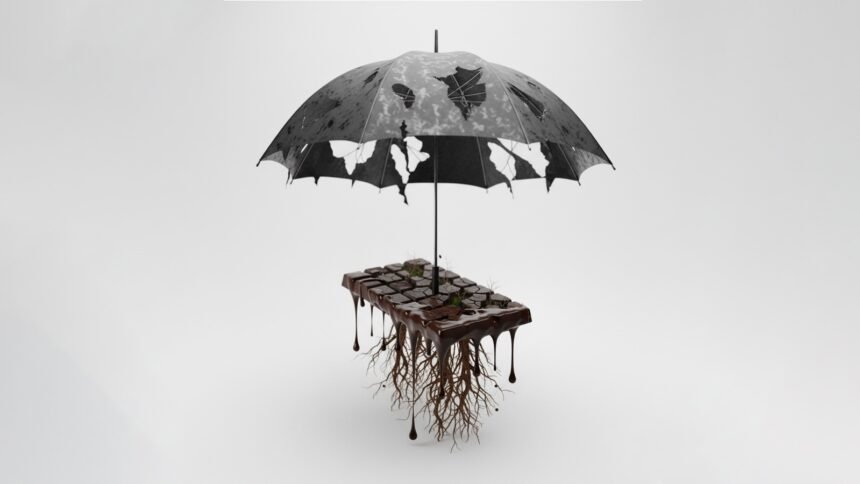
When trees are cut, the moisture pump stalls. Less water vapour rises, fewer clouds form, and the monsoon winds that sweep in from the Atlantic weaken. The result is not merely local drought in Central Africa; it is a slow-motion desiccation that reaches all the way to the Gulf of Guinea.
Joanne Bentley, molecular ecologist and lead author of the Zero Carbon Analytics study, describes it starkly: “This rainfall system has been supporting the global cocoa industry for decades, and now that environmental service is breaking down.”
A Crop on the Edge
Cocoa is one of the most climate-sensitive crops on earth. The Theobroma cacao tree demands year-round warmth, high humidity, and at least 1,500–2,000 mm of well-distributed rainfall. African smallholders rarely irrigate; they rely entirely on the sky. Even modest rainfall reductions trigger flower drop, poor pod fill, and outbreaks of black pod disease and swollen shoot virus—problems that have already slashed harvests in recent years.
The numbers are sobering:
- Côte d’Ivoire could lose up to 1.6 million tonnes of annual production by 2050 (roughly 80 per cent of today’s output).
- Ghana: 866,000 tonnes.
- Nigeria: 377,000 tonnes.
- Cameroon: 205,000 tonnes.
Together, these four countries account for approximately 73 per cent of the global supply. A shock of this magnitude would dwarf the worst El Niño years.
The Price of a Missing Forest
Cocoa futures have already tripled since 2022, driven by a toxic mix of disease, ageing trees, and erratic weather. The new modelling suggests that continued Congo Basin deforestation will add another 40 per cent to the price pressure by 2050. Under a high-deforestation scenario, cocoa could reach US$68 per kilogramme—nearly six times projected 2030 levels. Even under more optimistic forest-protection pathways, prices would still settle above $40/kg.
For European consumers—the world’s largest importers—the extra bill would be staggering. If import volumes remain constant, deforestation-driven scarcity alone would add approximately US$33.8 billion annually to the EU’s cocoa import costs by 2050. The Netherlands, Belgium, and Germany—the traditional hubs of grinding and chocolate-making—would bear the heaviest burden, with cumulative extra costs approaching US$256 billion between now and mid-century, nearly double the entire global cocoa market’s value in 2024.
Beyond the Headlines: Tipping Points and Time Lags
The danger is not evenly spread across decades. The Zero Carbon Analytics team warns that impacts remain relatively modest until the late 2030s. After 2040, however, the degradation accelerates sharply as the Congo Basin’s moisture-generating capacity collapses past a critical threshold. Scientists fear that losing 27 per cent of the remaining forest by 2050 could flip large parts of Central Africa from rainforest to degraded savanna. This self-reinforcing feedback loop would lock in drier conditions for centuries.
Adaptation, Diversification, and the Limits of Resilience
Some experts urge caution against overly deterministic forecasts. Dominic Moran, professor of agricultural economics at the University of Edinburgh, points out that farmers have always migrated crops in response to changing climates. Major processors such as Barry Callebaut are already expanding sourcing in Latin America (Ecuador, Brazil, Colombia) and even Southeast Asia, where rainfall remains more reliable and yields are less volatile.
Yet cocoa is not wheat or maize. It takes five to seven years for a new tree to reach full production, and the fine-flavour varieties prized by premium chocolatiers grow poorly outside narrow equatorial bands. Relocating millions of smallholders or establishing vast new plantations in politically stable, forest-free zones is neither quick nor cheap. And every shift away from West Africa further erodes the livelihoods of 5–6 million farming families who currently depend on cocoa.
A Cheaper Solution: Keep the Trees Standing
The same modelling that predicts catastrophe also calculates the cost of prevention. Halting deforestation and restoring degraded corridors in the Congo Basin would cost a fraction of the economic losses projected for the cocoa sector and its downstream industries. France’s pledge at COP30 to mobilise US$2.5 billion is a start. Still, the basin’s six countries will need tens of billions more in the coming decade—money that could come from carbon credits, debt-for-nature swaps, and redirected agricultural subsidies.
The Final Bean
Chocolate lovers may soon face a future in which a humble 100 g bar costs as much as a bottle of wine. Behind that price tag lies a deeper story: the slow, invisible theft of rain from one of the world’s great forests, and the knowledge that the sweetness we crave is inextricably linked to the survival of a distant green lung most of us will never see.
The Congo Basin is not just Africa’s second lung. It is the hidden breath behind every cocoa pod, every truffle, every childhood Easter egg. If we allow that breath to falter, the world will not run out of chocolate tomorrow—but over the coming decades, the treat that once symbolised affordable joy will become a luxury reserved for the few.
The trees are still standing for now.


