





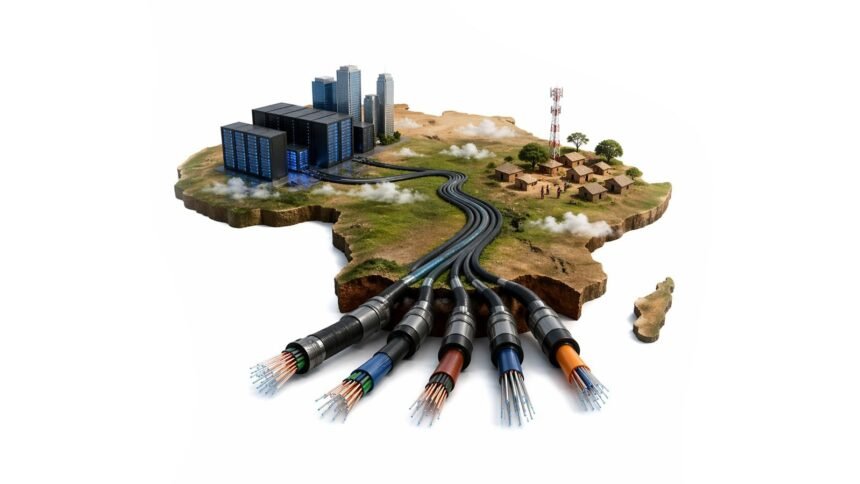
Beyond the ring road that loops through Nairobi’s fast-expanding tech corridor, cranes signal another kind of race. Between the billboards for e‑wallets and solar kits, banners now rise for cable landings and new data facilities. In the halls of the Connected Africa Summit, the hum of screens competes with the low murmur of negotiation.
For a few days this April, the continent’s telecom executives, policymakers, and venture capitalists gather not just to discuss bandwidth, but to decide who will hold the keys to Africa’s digital future, and under what terms.
In the plenary room, the language is diplomatic: inclusion, interoperability, ecosystem growth. In the corridors, it is more direct: spectrum, sovereignty, and cost recovery. At stake is not only digital infrastructure, but the structure of power that accompanies it.
This story matters now because Connected Africa 2026 convenes the actors defining the continent’s digital backbone at a moment when connectivity demand is soaring, geopolitical competition over technology is intensifying, and African states are under pressure to turn digital expansion into tangible public value.
Infrastructure and Influence
The Connected Africa Summit has evolved in step with the continent’s broader digital ambitions. What began as a telecom showcase now brings together subsea cable consortia, national regulators, data‑center developers, fintech founders, and central bankers.
Nairobi’s choice as host is no coincidence. Kenya has long marketed itself as both a connectivity node and an innovation sandbox, home to mobile money’s global success story and the region’s densest cluster of cloud infrastructure.
Across Africa, the signals of uneven progress are clear. Urban hubs from Lagos to Kigali boast near‑universal mobile coverage, yet millions in rural or inland regions rely on patchy 3G links.
Data demand continues to surge, driven by streaming, enterprise cloud adoption, and public digitization campaigns. Governments have unveiled broadband strategies and digital economy blueprints, often with concessional loans or donor backing.
But three questions remain persistent: Will this infrastructure reach everyone? Will it be governed locally? And will it lift African firms into higher-value digital chains or deepen their dependency on external players?
The program in Nairobi mirrors these contradictions. Sessions on fiber rollouts and 5G coexist with discussions on digital public infrastructure and AI policy. Officially, it is a summit about investment; unofficially, it is about control.
For global giants, Africa represents a growth horizon. For governments, digital networks have become strategic infrastructure, no less sensitive than ports or power grids. For entrepreneurs, the same networks are both enablers and constraints, shaping cost structures and market reach.
Ground-Level Realities
Walking through the exhibition hall offers a more grounded view of Africa’s digital awakening. A Ugandan ISP unveils plans to extend fiber along road corridors while offering smart‑metering for utilities; a slide deck promises returns, but the team speaks more about copper theft and cross‑border bureaucracies.
Nearby, a Kenyan start‑up demonstrates a lightweight learning app for schools off the grid, syncing content only when a signal is available. Their engineers optimize for 2G because that is what most students can actually access.
Delegates from West Africa huddle over the economics of cloud hosting. A Lagos fintech founder notes that colocating data in African facilities trims latency but rarely cuts cost. A colleague from Dakar adds that, despite AfCFTA’s political momentum, digital integration still hinges on bilateral taxation and interconnection rules.
Here, the infrastructure debate shifts from megabytes to institutional coordination. The details, permits, pricing, and energy reliability determine who ultimately profits from connectivity.
In smaller policy rooms, regulators listen as engineers outline the weak spots in the backbone: fragile terrestrial backhaul, vulnerable power supply, single‑point dependencies.
A local official from Nakuru admits the city cannot finance its own data center, yet must still police disruptions when cables fail.
The quiet realization shared across delegations is that fiber and concrete alone do not create digital sovereignty. Without commensurate governance and skills, each new investment risks deepening external reliance as it expands coverage.
Beneath The Optimism, Three Policy Fractures Define The Current Debate.
The first is ownership. The capital for undersea cables and hyperscale centers still flows mainly from global syndicates. Governments seek expertise but question the leverage: who decides how traffic is routed when tensions rise, or sanctions are imposed?
Some push for public stakes or tougher oversight; investors warn such moves could chill capital inflows. The battle over “digital sovereignty,” once theoretical, now lives in clauses about landing stations and license rights.
The second fracture concerns data. As African economies digitize, questions about where information is stored and under whose jurisdiction it falls intensify. Protection laws multiply, but enforcement often lags. Start‑ups face a maze of national regimes, while civil society fears that tighter state control could slide into surveillance.
The African Union’s push for harmonized frameworks signals progress, yet implementation remains uneven across blocs like ECOWAS and SADC.
The third is inclusion. Market players focus on rollout economics, spectrum fees, tower sharing, and return on fiber investment, while communities confront affordability. Civil society insists on transparency in universal service funds; some governments eye new digital taxes to fill fiscal gaps.
Each policy choice redraws the map of who can participate in the online economy—and who remains offline.
Across these divides, African agency is asserting itself in quieter ways. The African Development Bank co‑funds open‑access terrestrial links. Regional ICT bodies promote shared spectrum frameworks. Local consortia from Ghana to South Africa experiment with community data centers and cooperative cloud models.
Their collective efforts suggest that digital sovereignty will not emerge from a single declaration but from a mosaic of national and regional experiments.
As the summit closes, the polite applause masks a deeper unease. More memorandums will be signed, new cables laid, new partnerships announced.
Yet the essential question endures: can Africa design a digital continent that is both interconnected and independent, open to the world’s networks, but answerable first to its own citizens?