



Pan-African Borders: The Crises of Transnational Enclaves
Across the African landscape, the contemporary configuration of demographic mobility serves as a primary baseline for evaluating continental integration and sovereign dignity. The Pan-African ideal of a unified, borderless continent faces a structural challenge posed by the creation of localized transit enclaves that indefinitely contain vulnerable migrant populations. Rather than serving as cooperative corridors for regional development, North African transit zones have been transformed into arenas of intense friction. Reclaiming the continent’s shared future requires a comprehensive shift away from fragmented, security-led border regimes toward a human-centric model of migration governance, ensuring that the protection of African workers across historical frontiers takes precedence over localized political calculations.
Libya’s Emerging Migration Landscape: A Crucible of Conflict and Commerce
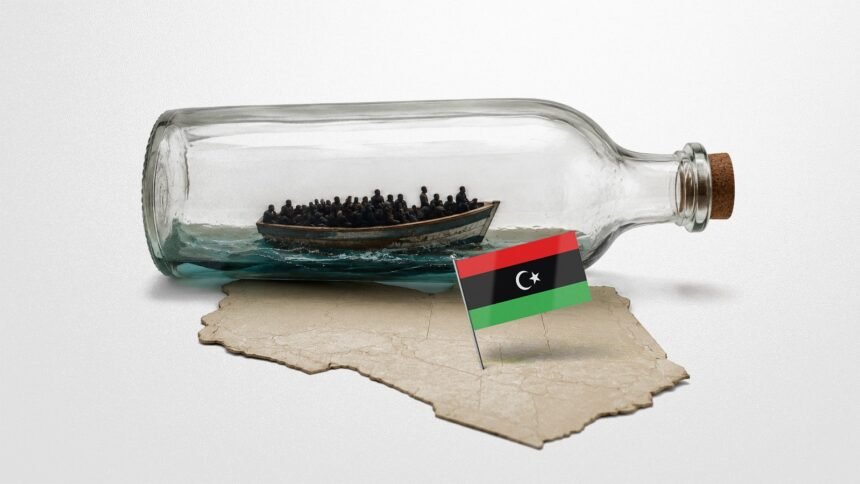
A volatile intersection of prolonged political division, oil dependency, and geographic inevitability fundamentally defines the contemporary migration landscape in Libya. Since the NATO-backed uprising in 2011, the North African country has operated as a major transit route for hundreds of thousands of migrants fleeing conflict and poverty, primarily from sub-Saharan Africa, with many risking dangerous journeys across the desert or the Mediterranean Sea. Paradoxically, the oil-dependent Libyan economy also serves as a powerful draw for migrants seeking work; the domestic market relies heavily on foreign labor to fill essential, low-wage jobs in sectors like cleaning and construction that locals are reluctant to take. Out of an estimated total population of about 7 million, the country hosts well over 900,000 migrants, making it a high-density hub of human transit and informal labor.
The Politics of Resettlement: Xenophobic Mobilization in the Sarraj Quarter
The underlying social fabric in urban centers has been destabilized by an accumulation of nativist anxieties, culminating in unprecedented anti-migrant protests. On June 4, 2026, hundreds of Libyan demonstrators executed a coordinated blockade of the United Nations refugee agency’s headquarters in Tripoli’s Sarraj neighborhood, marking the largest in a wave of recent anti-migrant demonstrations. Protesters erected tents, brought a truck full of sand to close off the main gate of the building with a physical barrier, and chanted exclusionary slogans such as “No, No to settlement, Libya only for Libyans” and “Get out of Libya”. This mobilization reflects a systemic scapegoating matrix where foreign nationals are blamed for social and economic problems, including street homelessness and rising crime rates, that are actually the direct consequence of 15 years of internal conflict and political polarization.
Multilateral Friction: The Stand-Off Between the UNHCR and the Ministry of Interior
The blockade of the Sarraj facility highlights deepening operational friction between international humanitarian bodies and the state’s administrative organs. Demonstrators targeted the United Nations High Commissioner for Refugees (UNHCR) under the assumption that the organization was facilitating the permanent settlement of refugees within Libyan territory. In response, the United Nations Support Mission in Libya (UNSMIL) condemned any incitement to violence against its staff, explicitly clarifying that there is no active UN resettlement program inside the country. Instead, the UNHCR’s mandate is restricted to organizing emergency evacuations to third countries and facilitating voluntary returns when conditions allow. This position was echoed by Taher al-Baour, the acting foreign minister of the internationally recognized government, who stated that while Libya is not capable of handling these high numbers, citizens must stop blaming external populations for structural security deficiencies.
Shadow Infrastructures: Exploitation and the Illicit Economy
The protracted division of the Libyan state between competing administrative regimes has allowed a highly lucrative, shadow economy to entrench itself within the migration corridor. In the absence of a centralized law enforcement apparatus, transnational criminal networks have systematically industrialized human smuggling and exploitation across the desert and maritime frontiers. For these organizations, the hundreds of thousands of trapped migrants serve as primary economic commodities, subjected to arbitrary detentions, forced labor, and extortion. The massive financial flows generated by this informal market fuel local militias and undermine state-building efforts, demonstrating that the migration crisis cannot be resolved without addressing the criminal economies that profit from the diaspora’s vulnerability.
Externalized Enforcement: The Geopolitical Legacy of European Agreements
The structural bottlenecks defining contemporary Libya are deeply linked to the geopolitical legacy of anti-immigration agreements orchestrated by the European Union. Under the guise of externalized border management, European funding and technical equipment have been systematically funneled to various Libyan coastguard and security factions to intercept migrant vessels in the Mediterranean. This policy of containment effectively transforms Libya into a southern border guard for Europe, forcing hundreds of thousands of individuals back into a territory characterized by active conflict and institutional collapse. By externalizing its border enforcement without providing legal, safe pathways for asylum or migration, the international community has directly contributed to the hyper-concentration of migrants inside Tripoli, worsening the domestic social pressures that spark nativist backlashes.
Protecting the Displaced: Upholding Basic Human Rights in Legal Limbo
The ultimate survival and dignity of the sub-Saharan diaspora depend on a complete re-engineering of the national protection framework away from criminalization toward the rule of law. Currently, the hundreds of thousands of migrants residing in Libya exist in a state of absolute legal limbo, stripped of constitutional protections and exposed to arbitrary violence from both vigilante groups and informal state actors. Protecting fundamental human rights requires the immediate closure of abusive detention centers and the institutionalization of transparent labor protections for foreign workers in the construction and service sectors. True regional stability cannot be achieved by constructing sand barriers outside UN offices; it requires building an inclusive governance architecture that respects international humanitarian conventions and protects the inherent dignity of every person within its borders.