



Africalix Exclusive Interview
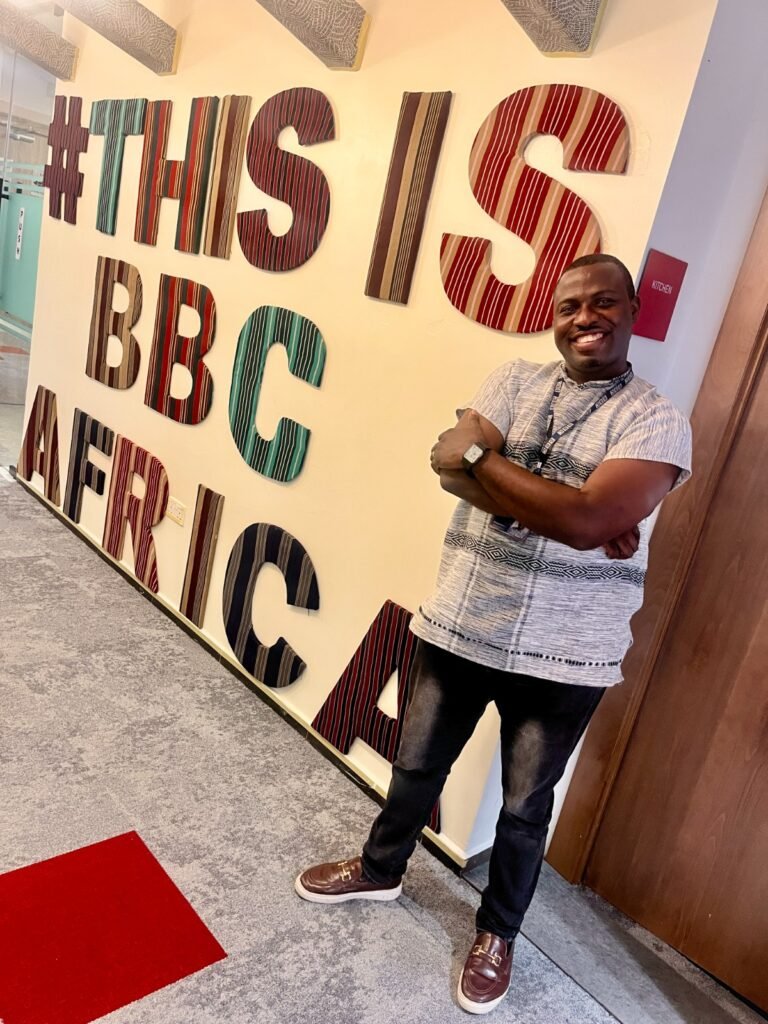
Emmanuel, Senior Journalist & Digital Sports Producer, BBC World Service Africa
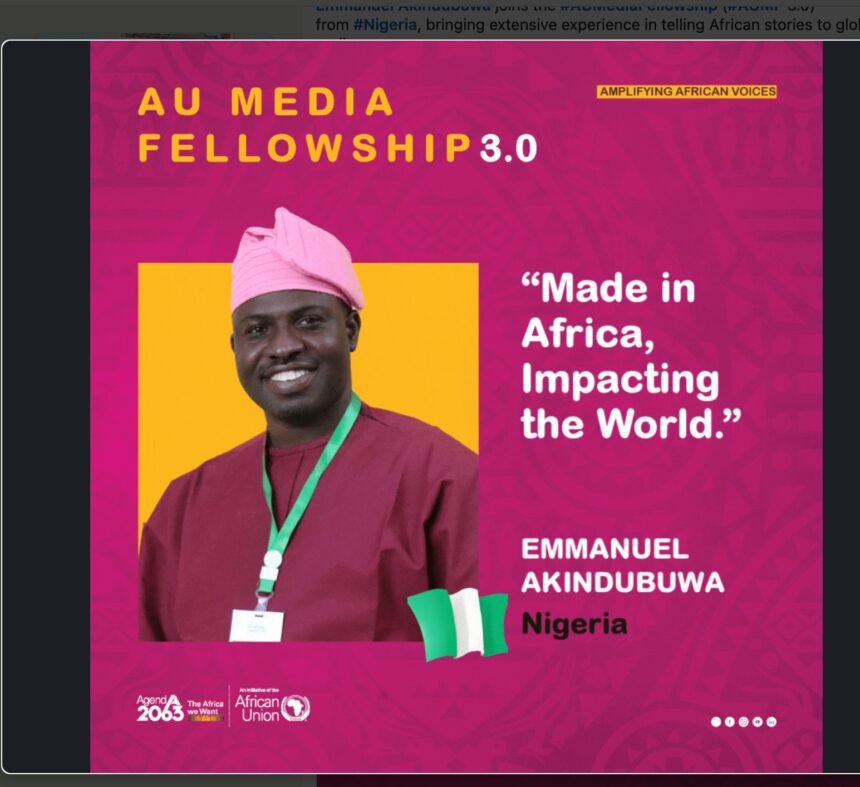
In an era where African stories are too often framed through deficit narratives, corruption, conflict, and crisis, a new generation of journalists is deliberately choosing different entry points into the continent’s realities. Emmanuel, a Senior Journalist and Digital Sports Producer for BBC World Service Africa and African Union Media Fellow, has spent nineteen years building a practice centered on what he calls “triumph over adversity.”
Growing up in Nigeria during the turbulent late 1980s and early 1990s, listening to freedom fighters and human rights activists on state-controlled radio, he developed an early commitment to people-centered storytelling.
His journey from banking to newsrooms, from TVC News to the BBC African Service, reflects a deliberate choice to amplify small wins, highlight structural solutions, and position African athletes and communities as agents rather than subjects.
In this exclusive interview with Africalix, Emmanuel discusses why journalism is more of a calling than a profession, how sports can be a unifying factor that diplomacy cannot achieve, and his vision for using the AU Media Fellowship to advocate for policies that keep Africa’s youth on the continent rather than watching them disappear into the Mediterranean Sea.
From Radio Activism to Narrative Making
Emmanuel’s journey into journalism began in a way he describes as both very interesting and circumstantial. Growing up in Nigeria in the late 1980s to early 1990s, during a turbulent time in the country’s political history, only state-owned media were prominent alongside a couple of private outlets.
“That period really molded my approach to journalism and storytelling,” Emmanuel recalls. “I mean, growing up listening to lots of freedom fighters and human rights activists talking on the radio, it drew my heart to nationalism and to people-centered development. Initially, I had wanted to be a lawyer because I developed this pan-nationalism, which love really drove my enthusiasm.”
Since 2005, he has been involved in storytelling, advocacy, and the promotion of narratives that inspire change, equity, justice, and institutional reform for the greater good of the people. He started as a production intern, moved into business reporting, then entertainment reporting, but recognized that journalism is not a high-paying profession.
“It’s more of a calling than a profession,” he explains. “And that’s why you see that even people who are not naturally trained or would not even have the privilege of studying journalism in classrooms can still become exceptional story writers and journalists because it’s more of a calling. It’s more of a natural makeup than acquired.”
At some point, Emmanuel delved into banking, working with a couple of banks and doing marketing work. Those periods shaped him to become what he calls a broad personality, allowing him to be a good storyteller while developing a strategic mindset to achieve the most with minimal effort or cost. This combination of journalistic calling and business acumen has defined his approach to resource-constrained storytelling.
More Than a Pen Pusher
Joining the BBC World Service was a major shift that shaped Emmanuel’s outlook and interest in pan-African stories. He believes this contributed to his selection for the African Union Media Fellowship as a fellow in cohort 3.0.
“It’s been a journey of steady development, steady growth, giving opportunity to explore from different angles, and I would say I am a well-rounded figure,” he notes. “I really do not even want to call myself a journalist most times because that may limit what I have to offer.
I think I am much more than just a pen pusher. I am more of a narrative maker or a change advocate in the field of journalism.”
He learned about the African Media Fellowship through a LinkedIn conversation with a friend who told him the African Union was seeking to provide a platform for storytellers across the continent to develop projects and content that would further enhance the journey toward the Africa We Want Agenda 2063.
Emmanuel was initially skeptical that his role as a sports journalist and content creator would stand a chance, but what interested him was the opportunity to tell stories that could shape the continent. Having worked at the BBC African Service for about 3 years, he wanted a bigger opportunity to contribute to Africa’s growth.
Empowering Youth, Stopping the Exodus
The fellowship selected 22 fellows across six thematic areas: policy and governance, digital innovations, economic integration, public health, emerging economies and youth inclusion, and agriculture. Emmanuel identifies himself as a critical voice in the emerging economy and creative industries.
“I believe that the future of Africa’s development is not the resources buried within the ground, but our people,” Emmanuel argues. “We have the youngest and most vibrant youth population in the world, which needs empowerment toward developing the continent.
We’re seeing a lot of youth migrating to other parts of the world to take up opportunities that are often derogatory, and these opportunities, if they are available here on the continent, will drive our goals.”
He expresses deep concern about what he sees as the biggest threat to Africa’s survival: the fact that African youth are not empowered, and many are leaving in droves.
“Many of them will go through the ocean, get into the boats, with lots of them buried in the belly of the Mediterranean Sea,” he observes. “We cannot continue, we cannot hope for a prosperous Africa, and our biggest assets are allowed to slip out of our hands for no reason. My projects will be focused on advocating for policies that will empower young people to create viable opportunities for them to thrive on the continent.”
Do Less, Do It Better, Make More Impact
In an era of mass digital content production, Emmanuel emphasizes that one key attribute should determine what story to tell: impact. What is the impact I hope to make with this story? That question has been at the core of everything he does as a journalist.
“We have a guiding principle at the BBC, which is do less, do it better, and make more impact,” he explains. “So that’s why you see that we’re not in the race for numbers. I mean, right now, everyone is just doing content for the numbers or clicks.
We, as core journalists, are not driven by clicks. Yes, the numbers are good. It shows that you’re getting the audience, but sometimes the numbers should not just be the sole reason why you’re producing, because that could water down the story you’re really telling, or you could even end up fabricating facts, which could play down the trust level.”
This focus on impact over metrics shapes his editorial decisions. Whether advocating for better healthcare for women, proper education support for young people in rural areas, or investment in sports infrastructure and digital innovation hubs, the question remains: how do we tell that story in a way that drives change?
When Sport Silences the Guns
Sports in Africa are often regarded as recreation, but Emmanuel argues they have played much more significant roles across the continent. He points to the Ivorian Civil War in 2003-2005, when the country’s qualification for the 2006 World Cup in Germany helped silence the guns and bring peace back.
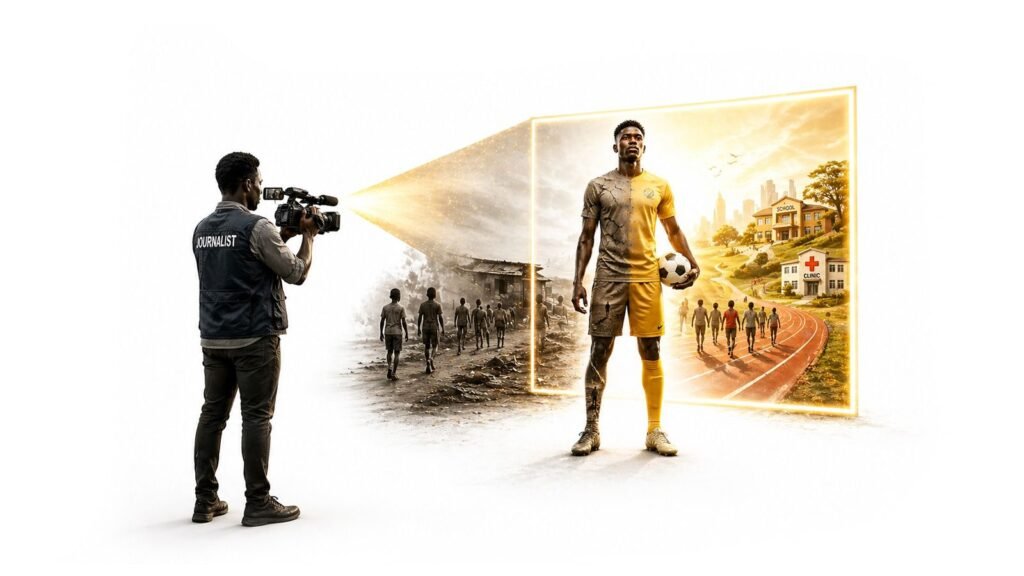
“It was Didier Drogba who appealed to the warring parties to embrace peace, a feat that could not be achieved through diplomats,” Emmanuel notes. “A sports athlete achieved that because sport is a unifying factor. So if sports could play such an integral role, it means that if there are proper structures and investment, athletes can become a voice and a change maker in their communities.”
He highlights athletes like Sadio Mané, Mohamed Salah, Eliud Kipchoge, and Victor Osimhen, people who came from nothing to something and are making an impact in their communities by building schools and hospitals and supporting local businesses.
For the continent, Emmanuel advocates for the establishment of structures, pointing to Egypt, Morocco, Ethiopia, Rwanda, and Senegal as countries setting standards by investing in sports infrastructure and creating opportunities for athletes to thrive.
Character-Led, Impact-Driven Stories
Emmanuel’s portfolio demonstrates his commitment to stories that highlight dignity and agency. He has covered Langa, a cultural sport from northern Nigeria where warriors hop on one leg and battle each other in tests of stamina and endurance. He produced a story about a Paralympian couple aiming to make history in Paris, two Nigerian athletes with physical disabilities who made it to the Olympics.
He has told stories about women in arm wrestling, about skate soccer, where people with polio or other physical challenges found solace in sports, and about a young female referee who went from being a hawker selling soft drinks with her mother at the stadium to becoming one of Nigeria’s youngest top professional referees.
“These are stories to highlight youth inclusion. These are stories that I’ve done in the past to bring about the triumph in adversity,” Emmanuel explains. “Telling the story of success is possible in Africa. I advocate the need for the right system and the right structure for people to thrive on the continent.”
Recently, as part of the African Union Media Fellowship, he visited Ethiopia and produced a story about the future of African public health systems, following a visit to the Africa CDC headquarters in Addis Ababa.
Structural Barriers to Athletic Development
Emmanuel identifies serious infrastructural challenges affecting African sports talent. Facilities that cost billions to build are not accessible to young people. They are often used as venues for political rallies, campaigns, and religious crusades. Many have been turned into commercial ventures rather than tools for giving young people opportunities to nurture their talents.
Second, he notes the absence of policies that support active participation in sports while combining it with education. Young athletes struggle to handle both and eventually drop out, which creates challenges for their future, especially after they finish their active sports careers.
Amplifying Small Wins
After nineteen years in journalism, Emmanuel observes that technology is changing how stories are told, how fast they are shared, and how truth can be manipulated to suit certain narratives. The attention span of audiences has shortened significantly, creating pressure for attention-grabbing content that can border on sensationalism.
“As journalists on the continent, the challenge before us is to see how we can use our skills, our talents to push the right narrative about what we are facing,” he argues. “The challenges will always be there, but we cannot continue to put those challenges at the forefront of everything we do. Corruption, war, famine, pandemic. That’s not everything that is about our continent.”
Instead, he advocates for bringing about how people are surviving amidst these challenges. What are people doing? Are they walking thousands of kilometers to get access to potable water? How does their daily life get affected by this? And how are they adjusting to that reality?
“This triumph over adversity is what we should be amplifying as journalists,” Emmanuel emphasizes. “Not just the issues, not just the challenges, but we must see ourselves as a voice amplifying those small wins to inspire, to educate, to enlighten, and to offer solutions to the number of challenges that we face.”
As Emmanuel continues his work through the African Union Media Fellowship and BBC World Service Africa, his commitment to reframing African narratives through dignity rather than deficit offers a model for sports journalism that sees athletes not as exotic subjects but as change-makers whose impact extends far beyond the playing field.
By focusing on structural solutions, accessible sports facilities, policies that combine athletics with education, and investment in youth empowerment, he positions journalism not merely as documentation but as advocacy for the systems that allow talent to thrive. Whether this approach can shift the dominant narratives about African sports and youth on a continental scale remains to be seen.
Still, his insistence that Africa’s biggest asset is its people, and that journalism’s role is to amplify their triumphs rather than catalog their tragedies, represents a necessary counterweight to coverage that too often frames the continent primarily through crisis. For young African storytellers navigating similar paths, Emmanuel’s journey from state radio activism to international platforms demonstrates that journalism, as a calling rather than a profession, can cultivate the broad perspective needed to tell impact-driven stories that inspire change.
• • •
Emmanuel is a Senior Journalist and Digital Sports Producer (West Africa) for the BBC World Service, where he produces award-winning content that spotlights African talent on global stages through frameworks of dignity and agency rather than deficit.
He is a member of the African Union Media Fellowship Cohort 3.0, focusing on emerging economies and creative industries within the Africa We Want Agenda 2063. His nineteen-year journalism career spans production, business reporting, entertainment journalism, and banking, with work that emphasizes “triumph over adversity” storytelling, from Paralympian couples making history to young referees rising from poverty, from traditional cultural sports to skate soccer communities finding solace through athletics.