




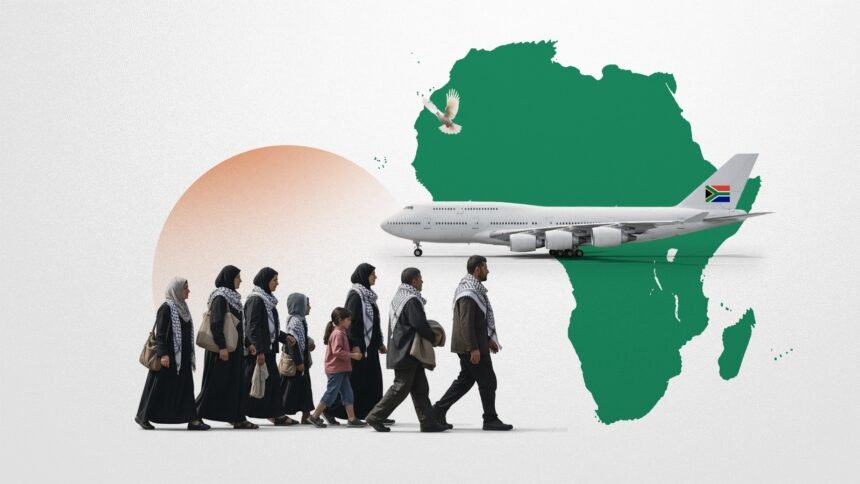
Amid the escalating vortex of conflict in Gaza and the entrenched occupation of the West Bank, Palestinian families are forging perilous routes southward, converging upon Africa’s diverse terrains as both transient halts and enduring havens. Charters departing from shadowed airstrips in Cairo or Amman—laden with the desperate and the documentless—touch down in Johannesburg, Nairobi, or Addis Ababa, only to confront bureaucratic barricades and humanitarian impasses. The mid-November 2025 incident at OR Tambo International Airport, where 153 Palestinians endured a sweltering 12-hour confinement aboard a mysterious flight, exemplifies this emergent corridor. Far from isolated anomalies, these journeys intertwine with broader deportation architectures from the Global North, where rejected asylum seekers are rerouted to African soil. This expansive analysis probes the historical resonances, geopolitical entanglements, and grassroots integrations that define Africa’s role in Palestinian exile, illuminating a continent’s compassionate recalibration amid global indifference.
Continental Bonds: Pan-African Solidarity Echoing Palestinian Plight
Pan-African solidarity, a resilient ideology born in the crucible of colonial resistance and refined through decades of mutual aid, finds profound expression in the reception of Palestinian refugees. South Africa’s unwavering advocacy—manifest in its 2023 International Court of Justice filing accusing Israel of genocide and its historical parallels between apartheid’s bantustans and Gaza’s open-air prison—positions the nation as a symbolic lodestar. This bond traces to the 1970s, when ANC exiles trained alongside PLO fighters in Algerian camps, forging a lexicon of shared liberation that persists in contemporary policy. The November 2025 tarmac crisis, the second such arrival in mere weeks, activated this legacy: civil society mobilized swiftly, with organizations like Gift of the Givers deploying water tankers, medical teams, and blankets to the aircraft’s stifling cabin, where temperatures soared and children’s cries pierced the night.
Extending beyond South Africa, this solidarity permeates the continent’s refugee ecosystem. Uganda, hosting over 1.5 million displaced from Congo, South Sudan, and beyond, has quietly absorbed Palestinian professionals—engineers and educators—who transit through Entebbe en route to resettlement. Rwanda’s Kigali hubs, designed for Libyan and Afghan evacuees, incorporate Arabic-language modules, anticipating Middle Eastern inflows. Even in North Africa, Morocco’s Casablanca serves as a discreet gateway, with visa-on-arrival policies facilitating onward travel. These acts are not mere hospitality; they embody a Pan-African recalibration—transforming Africa’s own histories of displacement into empathetic infrastructure. Community forums in Cape Town link Palestinian narratives with Khoisan land struggles, while Dakar conferences invoke Senghor’s pan-continental visions to advocate for Palestinian statehood. In this tapestry, solidarity weaves political defiance with practical refuge, challenging the isolation imposed by blockade and bombardment.
Flight from Fragmentation: Palestinian Refugees Navigating African Routes
The refugee odyssey from Palestine to Africa is a saga of fragmentation and fortitude, propelled by the unrelenting siege that has rendered Gaza uninhabitable and the West Bank a labyrinth of checkpoints. Families, often intergenerational clusters pooling remittances from diaspora kin, embark on clandestine charters orchestrated by opaque syndicates. These flights—departing under cover of darkness to evade Israeli exit permits—carry the vulnerable: pregnant women clutching ultrasound prints, elders with chronic ailments, and youths whose education halted amid rubble. The Johannesburg episode unfolded thus: 153 souls, including infants swaddled in sweat-soaked blankets, arrived without manifests, passports stamped irregularly, or onward tickets, victims of brokers who vanished after collecting exorbitant fees promising Canadian or Australian asylum.
This trajectory mirrors evolving displacement patterns. Post-2023 escalation, over 2 million Gazans displaced internally sought external exits, with Africa emerging as a viable bridge due to geographic proximity, laxer visa regimes, and established smuggling networks from the Horn. Nairobi’s Wilson Airport and Addis Ababa’s Bole International have seen surges in Middle Eastern transits, with Palestinians blending into Somali or Yemeni cohorts. Upon African soil, refugees confront layered liminality: initial entry denials citing “irregular facilitation” yield to humanitarian paroles, as in South Africa’s granting of 90-day visas to 130 passengers while rerouting 23 to Malaysia. Yet, resilience shines through—mothers improvising diapers from aircraft blankets, fathers reciting Quranic verses to calm the chaos. Africa’s refugee continuum, encompassing Eritrean treks across the Sinai and Sudanese crossings of the Sahel, absorbs these newcomers, enriching its demographic mosaic while exposing the inadequacies of global protection regimes amid protracted conflicts.
Rejection’s Ripple: Deportations Fueling Palestinian African Sojourns
Deportation policies in the Global North exert a centrifugal force on Palestinian migrations, propelling the rejected toward Africa’s embrace as inadvertent sanctuaries. The Netherlands’ Uganda transit hub—poised to relocate dozens of failed asylum seekers by mid-2026—intersects obliquely with Palestinian paths: Syrians and Iraqis denied in Amsterdam eye Kampala as a pivot, their journeys inspiring Gazan networks. Similarly, U.S. third-country removals to Eswatini and Equatorial Guinea, targeting sentence-served migrants, amplify Africa’s role in absorption, with Palestinians ineligible for direct repatriation funneled southward via failed European bids.
The Johannesburg impasse evokes deportation’s spectral variant: enforced stasis on foreign tarmacs, where border officials, invoking security protocols, prolong agony under humanitarian pretexts. Lacking origin cooperation—Israel’s refusal to accept returns from Gaza’s devastation parallels EU frustrations with uncooperative homelands—these exiles embody non-refoulement’s breach in practice. Syndicates exploit this vacuum, bundling families onto unlisted flights, echoing the “ghost planes” of earlier renditions. South African authorities’ pivot from rejection to exemption underscores deportation’s ripple: President Ramaphosa’s probe into the flight’s “mysterious” orchestration reveals layered complicity, from Middle Eastern facilitators to African ground handlers. This ripple extends continentally—Uganda’s hubs, designed for regional returns, adapt to Middle Eastern inflows, while Morocco’s ports facilitate Mediterranean crossings. Deportation thus morphs into deflected exile, compelling African improvisation: from runway interventions to urban absorptions, transforming rejection’s debris into reluctant refuge.
Triadic Tensions: US-EU Africa Dynamics in Palestinian Transits
The governance of Palestinian migrations entwines US-EU policies with African agency in a triadic tension of incentives, impositions, and innovations. Washington’s deportation blitz—securing pacts with over 50 nations, including multimillion-dollar deals with Equatorial Guinea—sets precedents that Europe emulates, with the EU’s 2026 Migration Pact legitimizing external hubs like Italy’s Albanian facilities. For Palestinians, this dynamic constricts Northern avenues: Dublin Regulation rejections in Ireland or Berlin push claimants toward African waystations, leveraging South Africa’s 90-day visa-free access or Ethiopia’s open-door for Arabs.
Financial levers amplify these tensions—U.S. aid packages dwarfing UNHCR budgets, EU development funds tied to return cooperation—yet African counterparts assert counterweights. South Africa’s exemption grants, aligned with its BDS commitments, defy external pressures, while Uganda’s UN oversight in Dutch pacts ensures rights compliance absent in American models. Palestinian diplomats decry “irregular” transits as exploitation’s byproduct, yet African Union summits advocate for dedicated corridors: harmonized visas for conflict evacuees, joint task forces with UNRWA. This triad reveals Africa’s pivot from periphery to pivot—hosting ICJ hearings, amplifying Gaza testimonies in Addis Ababa—challenging US-EU outsourcing while demanding reciprocal accountability. In Johannesburg’s resolution, where 130 dispersed into townships, the tension resolves temporarily in compassion, but structurally in calls for equitable global compacts.
Kinship’s Kindling: African Solidarity Sustaining Palestinian Exiles
African solidarity kindles as a steadfast flame, sustaining Palestinian exiles through institutional ingenuity and communal warmth. The tarmac intervention—paramedics treating dehydration, social workers documenting trauma—exemplifies this: Gift of the Givers, born of post-apartheid altruism, coordinates with mosques and churches for immediate relief, echoing Uganda’s refugee-village models, where newcomers receive plots and seeds. President Ramaphosa’s condemnation of the “excruciating” ordeal, vowing investigations, channels solidarity into policy: expanded humanitarian visas, probes into syndicates.
This kindling burns brighter in civil spheres—Cape Town vigils linking keffiyehs with ANC colors, Johannesburg soup kitchens serving falafel alongside pap. Echoing Fanon’s anti-colonial fraternity, African intellectuals host webinars framing Palestine as the continent’s “unfinished liberation.” Solidarity manifests materially: Rwanda’s tech incubators onboarding Palestinian coders, Morocco’s artisan guilds teaching embroidery to Gazan women. In this warmth, exiles find not pity but partnership—shared iftars during Ramadan, joint protests against arms sales. Solidarity’s flame, fanned by historical affinities, illuminates Africa’s moral compass, countering global complicity with unyielding embrace.
Belonging’s Symphony: Social Integration Harmonizing Palestinian Lives
Social integration composes a symphony of belonging for Palestinian newcomers, orchestrating exilic discord into communal harmony across Africa’s urban and rural canvases. In Johannesburg’s Fordsburg, where 130 arrivals settled into 90-day respites, integration unfolds symphonically: language exchanges pairing Arabic with isiZulu, vocational programs repurposing West Bank carpentry for township furniture markets, and schools integrating Palestinian curricula with South African history modules on resilience. Metrics from similar cohorts—70% employment within 18 months via mentorship networks—attest to the efficacy.
Harmonies resonate continent-wide: Kampala’s markets welcome Gazan spice traders, blending sumac into ugali; Kigali’s cooperatives employ engineers on renewable energy projects. Challenges—xenophobic whispers amid economic strains, trauma’s lingering echoes—are met with ubuntu circles: group therapies invoking shared displacement narratives. Triumphs abound—a Gazan chef launching a hummus eatery in Durban, children’s murals depicting olive trees alongside baobabs. Policy symphonies evolve: work permits during transit, mental health subsidies funded by the AU. In this belonging’s crescendo, Palestinians transcend refugee labels, becoming Pal-African bridge-builders—enriching hosts with cultural infusions while reclaiming agency. Africa’s symphony not only shelters but elevates, transmuting flight’s cacophony into a melody of mutual flourishing.