


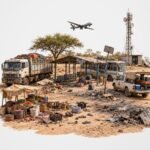



Pan-African Vortex: Continental Currents of Conflict and Kinship
Africa’s expansive terrain, from the Sahara’s nomadic skirmishes to the Congo’s mineral-fueled insurgencies, forms a vortex where armed violence swirls as a persistent undercurrent, binding nations in a kinship of shared scars and collective resolve. The December 6, 2025, massacre in South Africa’s Atteridgeville township—where gunmen ravaged an illegal shebeen in a Saulsville hostel, killing 12 patrons, including a three-year-old boy, a 12-year-old boy, and a 16-year-old girl, while wounding 25 others—ripples outward, mirroring pan-African patterns of illicit arms flows and socioeconomic strife. Across the continent, over 200,000 small arms deaths annually underscore this vortex: Nigeria’s banditry claiming thousands in the northwest, Kenya’s urban gangs terrorizing informal settlements, and the Sahel’s jihadist incursions displacing millions. South Africa’s incident, with its indiscriminate barrage in a space of communal solace, highlights how colonial-era migrations and postcolonial disparities—exacerbated by global arms trade—fuel such eruptions. The African Union’s Silencing the Guns initiative, embedded in Agenda 2063, seeks to disrupt this cycle through border harmonization and AfCFTA-driven economic uplift. Yet the vortex persists, demanding kinship in action: regional pacts like ECOWAS’ small arms conventions, adapted continent-wide. In this pan-African swirl, South Africa’s gunfire serves as a sentinel, urging a unified front where ubuntu’s interconnectedness counters the isolation of violence, transforming continental currents from conflict to collaborative calm.
Rainbow Fractures: South Africa’s Socioeconomic Scars and Strife
Beneath South Africa’s rainbow facade of democratic triumph lies a fractured core, where armed violence thrives amid entrenched socioeconomic scars from apartheid’s divide-and-rule blueprint. The Atteridgeville shooting—unfolding in the dim hours after 4 a.m. in a Saulsville hostel, those apartheid-era barracks built to confine Black migrant laborers far from white urban privileges—exposes these fractures: 12 lives extinguished, including three minors whose innocence clashed with the chaos of an unlicensed shebeen, a humble home-based bar offering cheap brews in Gauteng’s impoverished peripheries. With unemployment at 32% nationally and 68% among youth, these hostels—once symbols of segregation, now hubs of desperation—harbor over 1 million residents in substandard conditions, where economic exclusion breeds illicit enterprises. The nation’s 76% debt-to-GDP burden, compounded by global tensions such as the U.S. G20 boycott and the lapse of AGOA, strains public coffers, limiting investments in township revitalization. Gold’s decline to 95 tonnes in 2025 further erodes job bases, pushing communities toward informal economies vulnerable to gang predation. This strife’s toll: 27,000 homicides yearly, a rate eclipsing war zones, with Gauteng alone logging 7,000 assaults daily. In rainbow fractures, violence is the symptom of unaddressed wounds—land inequities persisting since 1994, racial wealth gaps widening the Gini to 63—demanding reforms that mend scars through inclusive growth, lest strife’s shadows eclipse the nation’s hard-won hues.
Triggers’ Tragic Cadence: Armed Violence in Informal Enclaves
Triggers pull in tragic cadence across South Africa’s informal enclaves, where shebeens like the one in Atteridgeville become stages for armed violence’s lethal dance. Three assailants, cloaked in dawn’s obscurity, stormed the Saulsville hostel bar, firing indiscriminately into a crowd of drinkers, felling 12—including a toddler possibly kin to the owner—and injuring 25, their bullets weaving a web of random ruin. Police, summoned two hours later, launched a chase amid ballistic probes, yet motives remain elusive: perhaps a turf dispute over liquor sales, or a spillover from organized crime syndicates that infiltrate these spaces. Shebeens, numbering tens of thousands despite 12,000 closures from April to September 2025, pulse as lifelines in poor settlements—offering affordable home-brewed umqombothi amid formal bars’ inaccessibility—but their unregulated nature amplifies risks: alcohol ignites brawls, escalating to gunfire in a land awash with 4.2 million legal firearms and countless smuggled ones. This cadence echoes nationally: 60% of murders are alcohol-linked, with triggers claiming over 60 lives daily. Rural variants amplify the rhythm—17 family members slain in homestead raids last year, 19 in bar shootings three years prior, eight at a birthday gathering, ten in another clan assault—painting a portrait of violence as both urban epidemic and rural retribution. In informal enclaves, armed cadence demands disruption: licensing reforms, community mediation, and arms amnesties to mute the triggers’ tragic toll.
Cleavages’ Cruel Inheritance: Discrimination’s Enduring Divide in Deadly Dynamics
Discrimination’s cruel inheritance carves enduring cleavages in South Africa’s deadly dynamics, consigning Black and marginalized communities to the forefront of armed violence’s fury. The Atteridgeville shebeen, embedded in a Saulsville hostel—a vestige of apartheid’s spatial engineering that isolated Black laborers in barren blocks—exemplifies this divide: its victims, predominantly from disenfranchised strata, felled in a space where economic discrimination denies formal leisure alternatives. With 80% of homicides clustered in townships housing 40% of the population, the inheritance is stark: Black South Africans, comprising 81% of the populace, bear 90% of violence’s burden, their Gini-driven poverty—exacerbated by 60% Black youth unemployment—fueling vulnerability to gang incursions and shebeen skirmishes. The three-year-old’s death, alongside preteens caught in crossfire, underscores discrimination’s intergenerational cruelty: minors, 20% of victims, ensnared in adult worlds warped by historical dispossession. Broader cleavages manifest in rural-urban rifts, where land reform’s sluggish pace—only 10% redistributed since 1994—sparks homestead massacres rooted in resource rivalries. This inheritance, compounded by affirmative action backlashes that inflame racial tensions, demands erasure through equitable policies: vocational training in townships, restorative justice circles, and AfCFTA integrations that bridge divides, transforming cruel cleavages into cohesive communal bonds.
Safeguards’ Fragile Fabric: Protection’s Perilous Path in Vulnerable Vistas
Safeguards in South Africa weave a fragile fabric, their perilous path leaving vulnerable vistas exposed to armed violence’s onslaught, as Atteridgeville’s delayed response reveals. Brigadier Athlenda Mathe’s force, grappling with 150,000 officers for 63 million citizens, arrived post-dawn to a scene of carnage—12 dead at the Saulsville shebeen, 25 wounded—launching forensic sweeps and manhunts for the trio of gunmen. Yet protection’s fabric frays: clearance rates at 12% for murders, dockets overwhelmed by 7,000 daily assaults, and township patrols thinned by budget cuts amid 76% debt loads. Hostels like Saulsville, with their apartheid-inherited overcrowding, evade robust safeguards, their residents—migrants’ heirs in economic limbo—left to makeshift defenses against syndicates wielding smuggled AK-47s. The minors’ fates—a toddler’s relation to the owner amplifying familial peril—highlight safeguards’ gaps for the young, who comprise a fifth of casualties without dedicated patrols. Nationally, the path perils further: rural homesteads undefended against raids, urban shebeens shuttered reactively rather than regulated preventively. Mending this fabric requires fortified threads: expanding the Independent Police Investigative Directorate, adopting AU peacekeeping models for hotspot interventions, and channeling G20 debt relief into community shields like neighborhood watch tech. In vulnerable vistas, protection’s path must solidify, weaving safeguards that shield the fragile from violence’s fraying force.
Myths’ Malignant Mirage: Racism’s Reverberating Role in Violence Narratives
Racism’s reverberating role crafts a malignant mirage in South Africa’s violence narratives, where myths of “white genocide”—echoed in Trump’s G20 boycott rhetoric—distort the grim reality of Black township bloodshed. The Atteridgeville massacre, with its Black victims in a Saulsville shebeen, counters these mirages: farm killings, at 50-60 annually, pale against 27,000 urban homicides, yet amplify global distortions that veil the 90% Black casualty rate. Trump’s disinvitation of South Africa from Miami’s 2026 summit, rooted in Afrikaner “slaughter” fables, not only severed AGOA’s $10 billion aid but perpetuated a racist resonance, prioritizing minority myths over majority mourning. This mirage reverberates domestically: media sensationalism of white vulnerabilities eclipses shebeen shootings’ toll, entrenching policies that underfund Black peripheries while bolstering elite securities. The three-year-old’s death, emblematic of innocent Black lives lost, demands myth-busting: data revealing violence’s class-racial skew, AU dialogues amplifying marginalized voices, and international engagements sans punitive prejudice. In myths’ malignant haze, racism’s role must dissolve, yielding to narratives that honor the reverberating truths of equitable reckoning.
Reckoning’s Rugged Ridge: Accountability’s Uphill Battle Against Impunity
Accountability climbs a rugged ridge in South Africa’s battle against armed impunity, where Atteridgeville’s elusive gunmen test the resolve of those who ascend. Police pursuits, bolstered by ballistics and witness appeals, confront jagged obstacles: 12% murder solvency rates, corruption eroding trust, and forensic lags stretching months. The Saulsville shebeen’s aftermath—12 slain, motives murky amid organized crime suspicions—mirrors national ridges: unsolved bar rampages from 2022 claiming 19, family annihilations in 2024 totaling 17, birthday slaughters of eight, homestead purges of ten—all evading complete reckoning. This uphill path stumbles on institutional crags: understaffed courts, intimidated testimonies in township vendettas, and syndicates’ sway over evidence. Accountability demands surmounting: empowering the National Prosecuting Authority with tech forensics, integrating restorative ubuntu circles for non-lethal disputes, and leveraging G20 frameworks for international arms tracing. Along reckoning’s ridge, the battle sharpens—transforming impunity’s peaks into plateaus of justice, where rugged pursuits yield resolute resolutions.
Clarity’s Clouded Canvas: Transparency’s Tentative Trail Through Turmoil
Transparency traces a tentative trail across South Africa’s turmoil-clouded canvas, where ledgers of violence often blur under institutional veils and incomplete disclosures. In Atteridgeville, police updates—25 shot, 12 dead, including specified minors, chase ongoing—emerge fragmented, with motive details withheld and shebeen statistics (12,000 closures quarterly) masking resurgence patterns. This clouded canvas obscures broader strokes: homicide data delayed by fiscal constraints, gun registries riddled with 500,000 illicit entries, and socioeconomic links—80% violence in poverty pockets—buried in opaque reports. Nationally, the trail tents further: underreported rural raids, media biases amplifying myths over metrics, and global perceptions skewed by boycott distortions. Clearing the canvas requires bolder trails: public crime dashboards for real-time tracking, AU-standardized reporting to illuminate continental flows, and civil audits piercing institutional fogs. In clarity’s pursuit, transparency’s tentative steps must solidify, painting turmoil’s canvas with unclouded truths that foster informed interventions and communal trust.