



From the timeless shadow of Giza’s pyramids to the vibrant, twisting alleys of Al-Darb al-Ahmar, Cairo stands as Africa’s unparalleled urban manuscript—a metropolis of over twenty-five million inhabitants where the dust of pharaonic eras still clings to Mamluk domes, and pigeon towers perch precariously on modern concrete rooftops. The rhythms of craft, memory, and daily existence intertwine in defiant refusal of separation or stasis. This is a city that defies easy categorization, its essence captured through the eyes of those who immerse themselves in its layers, like the Egyptian-Danish architect and designer Salem Charabi, who traded Copenhagen’s orderly grids for Cairo’s generous chaos. Born to an Egyptian father and Danish mother, both physicians who met in 1990s Copenhagen, Charabi grew up shuttling between the sanitized precision of Scandinavia and the expansive, story-rich streets of Egypt, where holidays with extended family—driving Downtown with a fighter-pilot cousin or watching his grandmother Oufa iron in her hallway—expanded his world beyond borders. Now relocated full-time to Cairo since summer 2025, he navigates its unfathomable vastness, a palimpsest founded in 969 CE as Al-Qāhirah, “the Victorious,” under the Fatimid dynasty, and reshaped through Ayyubid, Mamluk, and Ottoman epochs. In this living archive, architecture emerges not as a frozen form but as a dynamic practice, communal heritage, and improvised performance, teaching that true urban vitality blooms from embracing disorder rather than conquering it.
Nile’s Timeless Layers: Urban Design Through Accretion
Cairo’s urban fabric is a testament to millennia of layered reinvention, where the Nile’s ancient flood cycles once orchestrated settlement patterns, depositing fertile silt that birthed mud-brick homes and vernacular structures still echoed in contemporary compounds. From pharaonic Memphis’s ruins to Coptic Babylon’s fortified enclaves, the city has accumulated histories without erasure: Fatimid gates pierce Ayyubid walls, Mamluk madrasas nestle beside Ottoman fountains, and Belle Époque balconies overlook streets thrumming with microbuses and street vendors. This accretive urban design rejects the top-down impositions of modernist planning, favoring instead an organic evolution in which new constructions lean into the old, creating a dense, adaptive ecosystem. Charabi’s own journey reflects this: trained in architecture and building a furniture practice since 2017 just outside Copenhagen with limited resources, he found Cairo’s abundance of craftspeople, domestic techniques, and materials transformative. Influenced by local architect Malak Abdelhady, he advocates leaning into the city’s chaos—planning loosely from point A to B, then surrendering to serendipity—as the key to unlocking its generosity, a philosophy that mirrors how Cairo’s design has always accommodated the unexpected, from medieval caravanserais to informal rooftop farms.
Eternal Necropolis: Inclusive Living Among Tombs
The Southern Cemetery, or City of the Dead, sprawls across six kilometers along the Mokattam hills, embodying one of Africa’s most audacious models of inclusive urbanism by blurring the boundaries between mortality and vitality. Dating back to the seventh century, this vast necropolis is no desolate graveyard but a thriving quarter where over half a million Cairenes reside amid tombs, mosques, and workshops. Families have dwelled here for generations, turning mausolea into homes, while artisans like glassblowers at Khaled Ali’s workshop recycle bottles into luminous globes, blacksmiths forge tools in open forges, and silk-rope makers utilize entire street lengths for their weaving. At its eastern edge rises the fifteenth-century funerary complex of Sultan al-Nasir Faraj ibn Barquq, a Mamluk masterpiece integrating mosque, madrasa, and khanqah around a serene courtyard that still echoes with children’s games and communal tea sessions. Climb to its rooftop for panoramic views that encompass minarets piercing the skyline alongside satellite dishes, illustrating how death here is integrated into life’s continuum. This radical coexistence challenges conventional urban segregation, offering lessons for African cities grappling with housing shortages and heritage preservation, where memory thrives precisely because it remains inhabited and productive.
Artisanal Commons: Cultures of Shared Mastery
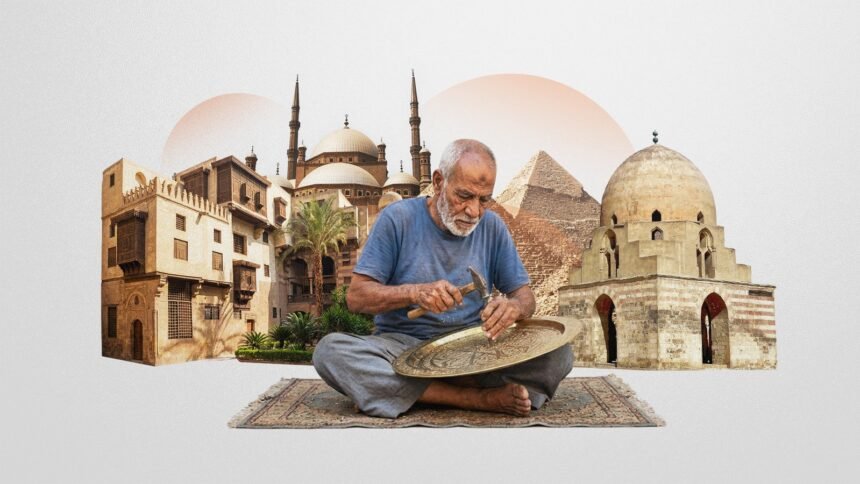
Deep within Al-Darb al-Ahmar—”the Red Path”—a historic district in Islamic Cairo, over a thousand artisans sustain guild traditions that trace back to medieval times, forming a vibrant commons of knowledge exchange amid narrow lanes free from heavy traffic. Here, tent-makers stitch elaborate khayameya appliqués for festivals, furniture carvers shape wood with techniques passed down orally, and bronze casters pour molten figures in courtyards that double as social hubs. Official guided tours navigate this maze, but the true magic lies in unplanned detours: pause to observe an artisan at work, and you’re likely invited for mint tea, then instruction, then hours of dialogue spanning skill, history, and philosophy. Charabi highlights this value system of open sharing, where expertise circulates freely without proprietary barriers, in contrast to the individualized practices he encountered in Europe. This communal ethos not only preserves endangered crafts but fosters innovation, as seen in how young designers collaborate with elders, blending ancient motifs like lotus patterns with contemporary forms. In an African context, it parallels oral knowledge traditions from West African griots to East African beadworkers, positioning Cairo as a beacon for inclusive cultural economies that empower communities through collective creativity.
Vernacular Visions: Reviving Mud-Brick Legacies
The pioneering work of Hassan Fathy endures as a cornerstone of Egypt’s vernacular modernism, demonstrating how indigenous materials and techniques can yield sustainable, elegant designs attuned to climate and culture. In the 1940s, Fathy constructed New Gourna near Luxor using mud brick—traditionally reserved for everyday homes rather than eternal stone temples—employing Nubian vaulting and natural ventilation to create affordable housing that harmonized with the environment. His former Cairo residence, now the Egyptian Architecture House, showcases intricate models fusing Ottoman lattices with Mamluk influences. At the same time, the American University in Cairo’s Rare Books Library holds his technical drawings, revealing his holistic approach encompassing craft, engineering, politics, and even playwriting. Fathy’s collaborator and friend Ramses Wissa Wassef extended this vision in the 1950s by establishing the adobe arts center in Harrania, where village children learned tapestry weaving without formal curricula, producing internationally acclaimed works. Charabi, now residing on this compound, is setting up an atelier for stone chairs carved by Luxor sculptors, continuing the tradition. Nearby, the Adam Henein Museum’s palm-shaded gardens display modernist bronzes, including a monumental Noah’s Ark, evoking the Noguchi Museum in New York for its blend of abstraction and nature. These sites illustrate vernacular architecture’s forward-looking potential, inspiring Pan-African movements toward eco-conscious building that draws on local wisdom to address global challenges such as urbanization and climate change.
Sacred Inclusivity: Mosques as Urban Anchors
Cairo’s sacred spaces exemplify an urban design that embraces the profane, none more profoundly than the ninth-century Mosque of Ahmad ibn Tulun, Africa’s oldest surviving large-scale mosque and a masterclass in spatial poetry. Built from red brick in 879 AD with a vast open courtyard capable of encompassing entire communities, its tulip-shaped spiral minaret soars monumentally yet minimally, absorbing the surrounding city’s clamor rather than isolating from it. Apartment blocks press against its walls, laundry lines drape over arcades, and the adhan resonates amid traffic horns, creating a lived sanctity where worship intermingles with daily routines. Charabi recalls his first visit a decade ago, struck by its timeless quality—climbing the minaret at sunset to catch the prayer call feels transcendent, the structure’s isolation in photos belies its embeddedness in the urban fabric. This inclusive model extends to other sites, like the Masjid al-Amir Qurqumas al-Sayfi in the City of the Dead, where historic elements coexist with modern adaptations. Across Africa, such approaches resonate with communal worship spaces from Timbuktu’s mud mosques to Addis Ababa’s rock-hewn churches, emphasizing architecture’s role in fostering social cohesion and cultural continuity.
Pan-African Tapestry: Cairo’s Continental Echoes
Despite its northern perch, Cairo’s creative pulse reaffirms Egypt’s deep African roots, serving as a crucible where continental aesthetics converge and evolve. The open pedagogy of Al-Darb al-Ahmar’s workshops mirrors Malian manuscript traditions and Ethiopian cooperative weaving; Fathy’s mud-brick innovations echo Great Zimbabwe’s stone enclosures and Nubian domes; Harrania’s tapestries carry motifs shared with Khoisan rock art and Bantu riverine patterns. When designers like Charabi, with his dual heritage, choose Cairo over Copenhagen, or when Sudanese carvers partner with Egyptian ateliers, the city facilitates cross-border dialogues that counter historical divisions. This Pan-African resonance is evident in collaborative projects, such as joint restorations drawing from Tunisian tilework or Zimbabwean metallurgy, fostering a shared aesthetic vocabulary that honors ancestral ingenuity while addressing contemporary needs. In Cairo, these threads weave a broader continental narrative in which art and urbanism become tools for unity, empowering African nations to reclaim and reinvent their intertwined legacies.
In essence, Cairo’s architecture transcends its built form to embody a profound social ethos, an educational framework, an economic catalyst, and artistic expression. Through voices like Charabi’s, the city imparts an enduring African wisdom: authentic place-making cultivates generosity amid layers of history, trusting street-level knowledge to sustain collective renewal. As the continent asserts control over its urban stories, Cairo—vast, resilient, eternally evolving—serves not as a blueprint to replicate but as an invitation to dwell: embrace the palimpsest, honor the shared crafts, and allow the metropolis to inscribe its ongoing saga through every committed resident.