


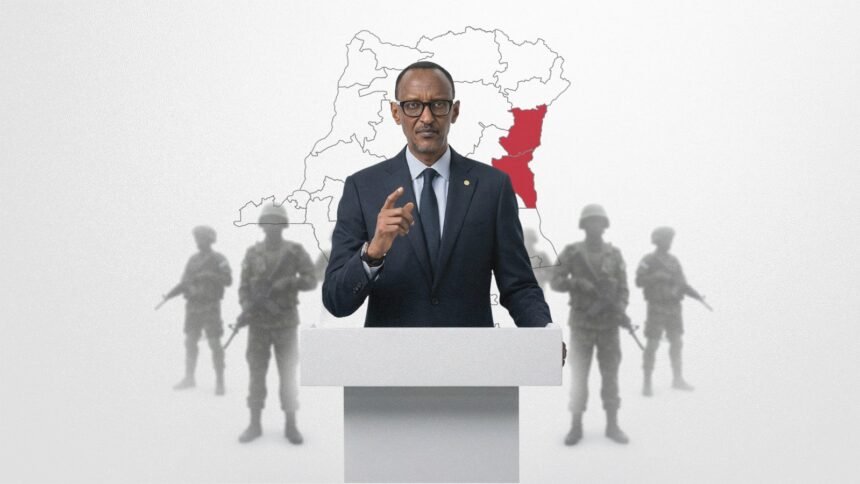
President Paul Kagame of Rwanda has accused Burundi of playing a central role in the worsening insecurity in eastern DR Congo, saying the country has deployed more than 20,000 soldiers across North and South Kivu who are actively involved in attacks against civilians.
Addressing newly sworn-in government officials on Wednesday, December 11, Kagame said that Burundi’s military presence has become a significant source of instability in the region, even as Rwanda continues to face international criticism over developments it does not control.
According to him, Burundian forces have entrenched themselves in strategic locations, including Uvira, Kalimi, Kindu, Walikale, and Kisangani. They are engaged in what he described as coordinated combat operations targeting the Banyamulenge community.
“You really have to ask yourself what these Burundian forces are doing in places like Minembwe, bombing and killing residents,” Kagame said.
Despite this heavy deployment, Kagame noted, the international community quickly blamed Rwanda following the recent fall of Uvira to the AFC/M23 coalition.
“After Uvira was captured, everyone rushed to point fingers at Rwanda. We are now carrying those accusations again,” he said, adding that Kigali continues to face threats and punitive measures “for a problem everyone understands but refuses to confront honestly.”
He added: “We have accepted being blamed for many things, but we also want the right to choose what we are blamed for.”
Kagame revealed that he confronted Burundi’s President Évariste Ndayishimiye about the scale of the deployment soon after Burundian forces remained in DR Congo following the exit of the East African Community Regional Force (EACRF) in 2023.
According to Kagame, Ndayishimiye denied sending troops to northern areas such as Goma and Rutshuru—positions far from the South Kivu zones where Bujumbura claims to face security threats. Kagame said evidence later contradicted the denial.
Kagame accused Burundi of fighting alongside the Congolese army (FARDC) and the FDLR, the militia composed of remnants of the perpetrators of the 1994 Genocide against the Tutsi.
He said Rwanda facilitated the withdrawal of AFC/M23 fighters from Walikale based on an understanding that it would create space for political dialogue. Instead, he said, FARDC and its allies moved into the area immediately after the withdrawal and launched attacks on M23.
The Rwandan leader also dismissed claims that recent fighting was sparked by the signing of the Washington Accords on December 4.
“The escalation did not start after the agreement. It was already happening long before. But I keep seeing claims that the signing triggered the violence,” Kagame said.
Kagame emphasised that while Rwanda remains committed to the peace deal, responsibility must be shared by all actors.
“Everyone contributes to this crisis, and everyone should be accountable, whether it is DR Congo, Burundi, or ourselves. We will not carry the responsibility for actions taken by others,” he said.
On December 10, the AFC/M23 movement announced it had taken control of Uvira, South Kivu’s second-largest city, after days of clashes that began in early December. Bukavu, the provincial capital, has been under the group’s control since February.