





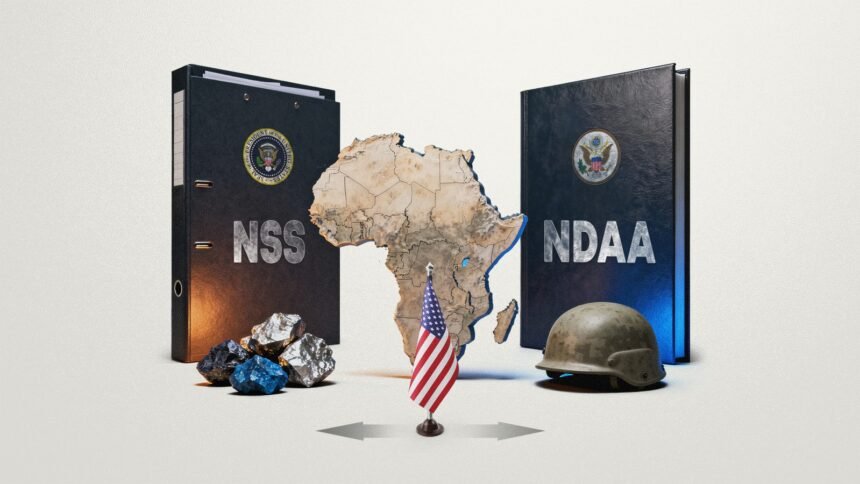
As 2025 draws to a close, the United States has articulated its global posture through two pivotal instruments: the National Security Strategy (NSS) released in early December, embodying the Trump administration’s executive vision, and the National Defense Authorization Act (NDAA), a $901 billion defense policy framework passed by Congress just days later on December 17. These documents reveal divergent impulses within American statecraft—executive pragmatism tempered by legislative safeguards—that carry profound implications for Africa. The NSS adopts a starkly transactional lens, prioritizing economic reciprocity and resource access while de-emphasizing ideological commitments. In contrast, the NDAA, amid controversies over domestic aviation safety and European troop levels, includes provisions that preserve and extend security cooperation across the continent, particularly in counterterrorism and command structures. This comparative divergence offers Africa a nuanced landscape: one of constrained yet opportunistic engagement, in which congressional inertia counters executive retrenchment, compelling the continent to enhance its strategic autonomy.
Pan-African Imperatives: Navigating Multipolar Currents
Africa enters this era amid enduring vulnerabilities and emerging leverage. Historical US engagement has fluctuated—from Cold War proxies to post-9/11 counter-terrorism surges via AFRICOM’s establishment in 2007—often subordinating developmental goals to great-power containment. The Russia-Ukraine war’s lingering effects, now compounded by Middle Eastern instabilities, continue to disrupt food and energy flows. At the same time, China’s entrenched infrastructure investments and Russia’s mercenary networks exploit security vacuums in the Sahel and beyond. The African Union’s Agenda 2063, with its emphasis on integration and self-reliance, faces renewed tests as external partners recalibrate. Both the NSS and the NDAA reflect the United States’ inward turn. Yet, their differences highlight Africa’s potential to exploit institutional fractures in Washington: the executive’s austerity versus Congress’s institutional safeguards for ongoing partnerships.
Africa-US Ties: From Transactionalism to Institutional Anchorage
The NSS frames Africa peripherally, allocating minimal space to the continent within a broader pivot toward economic preeminence and selective alliances. It advocates “increased economic engagement” in Africa, positioning the region alongside the Western Hemisphere as a frontier for reciprocal trade, particularly in high-growth sectors. This aligns with a broader disavowal of expansive liberalism, favoring “trade not aid” and reforms to multilateral institutions that serve American interests. Democracy promotion is explicitly eschewed, marking a departure from prior strategies that, however inconsistently, tied assistance to governance reforms.
The NDAA, however, introduces congressional counterweights that subtly bolster security dimensions absent in the NSS. While silent on explicit economic pacts, it restricts unilateral executive actions that could diminish US military footprints, including safeguards for geographic combatant commands like AFRICOM. This mirrors provisions limiting troop reductions in Europe to fewer than 76,000 without rigorous assessments and allied consultations—extending a pattern of legislative restraint on potential drawdowns. For Africa, such measures protect established frameworks, ensuring continuity in training, intelligence-sharing, and operational support that the NSS’s transactional ethos might otherwise erode.
National Security Realignments: Priorities and Omissions
At its core, the NSS reaffirms American military dominance while critiquing post-Cold War overextensions, framing rivals through an “axis of aggressors” lens that prioritizes China, with secondary nods to Russia, Iran, and North Korea. Africa is implicitly cast as a theater of economic competition rather than kinetic rivalry, with scant reference to jihadist threats or regional instability. This deprioritization risks sidelining the continent in strategic planning, treating it as a resource appendage rather than a security partner.
The NDAA, conversely, codifies broader authorizations for international security assistance, missile defense enhancements, and cybersecurity—elements that indirectly sustain global postures, including in Africa. Its pushback against administration policies, evident in Europe-focused restrictions, signals bipartisan wariness of abrupt withdrawals. By withholding funds pending transparency regarding certain operations and reinforcing procurement restrictions against adversaries, the bill maintains a defensive ecosystem encompassing African theaters, albeit without the NSS’s explicit economic framing.
Counter-Terrorism Synergies: Sustained yet Subordinated Efforts
Counter-terrorism represents a key fault line. The NSS largely omits detailed discussion of violent extremism in Africa, subsuming it under broader great-power competition and homeland-focused defenses like advanced missile systems. This reflects a shift from post-9/11 expansiveness toward selective interventions, potentially diminishing joint operations in the Sahel, Horn of Africa, and Lake Chad Basin.
The NDAA, however, extends and protects counterterrorism authorities, including programs for partner capacity-building that have long anchored U.S.- Africa military ties. Provisions broaden support for allied forces in volatile borders, ensuring funding streams for training and equipment that target groups like al-Shabaab, Boko Haram, and Islamic State affiliates. Congressional insistence on preserving command structures helps guard against executive impulses to scale back AFRICOM, thereby fostering continuity in joint task forces and exercises. This legislative bulwark offers Africa reliable channels for collaboration, even as the NSS signals a narrower strategic aperture.
Mineral Wealth and Strategic Leverage: Pathways to Equitable Partnerships
Critical minerals emerge as a convergent theme, albeit approached in different ways. The NSS celebrates America’s technological edge while advocating reshoring and supply-chain security, implicitly eyeing Africa’s vast reserves of cobalt, lithium, manganese, and rare earths—essential for batteries, renewables, and defense technologies. This positions the continent as a key node in countering Chinese dominance, with calls for standards-setting and collaborative investments.
The NDAA complements this by directing domestic production of critical materials sourced from adversaries and prioritizing diversified, reliable supplies. Restrictions on foreign-adversary components incentivize alternatives, thereby opening opportunities for African exporters. Yet, without explicit mandates for African partnerships, the risk persists of extractive deals favoring American firms. Africa’s agency lies in conditioning access on value addition, technology transfers, and infrastructure co-ownership, leveraging Washington’s diversification imperative against Beijing’s entrenched positions.
Developmental Horizons: Forging Resilient Futures
Ultimately, the NSS and NDAA converge on a restrained American footprint but diverge in execution: executive strategy leans toward economic pragmatism and security minimalism, whereas congressional authorization embeds safeguards for enduring military ties. This duality presents Africa with strategic openings—to harness NDAA-protected counter-terrorism frameworks for stability, while negotiating NSS-driven economic engagements for inclusive growth.
The path forward demands Pan-African cohesion: accelerating the African Continental Free Trade Area to amplify bargaining power, operationalizing AU peace architectures with domestic funding, and diversifying partnerships beyond binary US-China choices. Initiatives like regional anchor states coordinating mineral strategies or community-driven counter-extremism can transform external shifts into internal strengths. In an era of American recalibration, Africa’s development as the bedrock of security—through education, climate-resilient agriculture, and digital infrastructure—will determine whether 2025 marks marginalization or maturation. By asserting unified agency, the continent can pivot from peripheral player to pivotal partner in a reordered global order.