



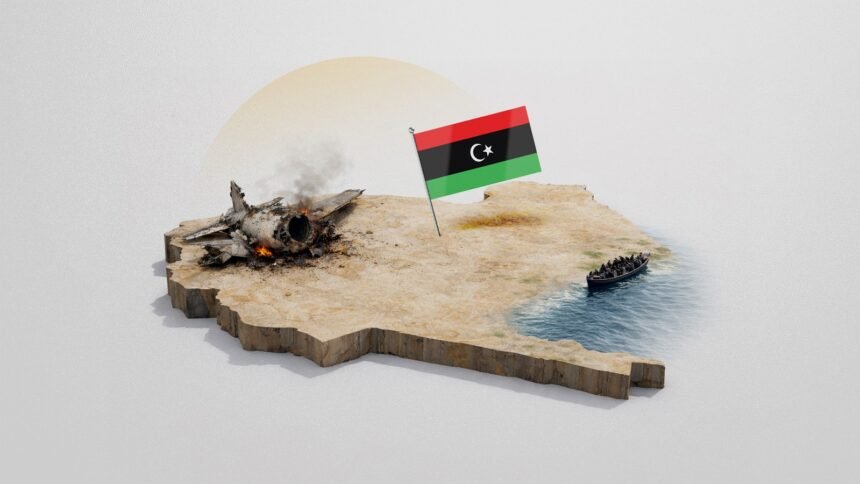
The devastating plane crash on December 23, 2025, which obliterated a Dassault Falcon 50 private jet mere minutes after departing Ankara’s Esenboğa Airport, has eradicated pivotal figures in Libya’s western military hierarchy, sending shockwaves through the nation’s precarious equilibrium and amplifying risks to its entrenched immigration crisis. Claiming the lives of eight individuals—including Lieutenant General Mohamed Ali Ahmed al-Haddad, the Chief of General Staff; Lieutenant General al-Fitouri Ghraibil, Commander of Ground Forces; Brigadier General Mahmoud al-Qattouwi, Director of Military Manufacturing; Brigadier General Idris al-Zaghdani, Advisor to the Chief of Staff; and Colonel Ramadan al-Mansouri, Media Officer, alongside three crew members—this incident unfolded amid dense fog and potential technical failures, as preliminary probes suggest. The aircraft, en route to Tripoli following strategic consultations with Turkish allies on bolstering defense ties, plummeted near a rural village southwest of the capital, prompting immediate Turkish-led search operations that recovered the black boxes for forensic scrutiny in a neutral third-party facility. As Libya declares three days of national mourning and Prime Minister Abdul Hamid Dbeibah vows resilience, this decapitation of command structures threatens to unravel fragile ceasefires, embolden rival factions, and exacerbate the chaos fueling sub-Saharan migration routes. In a year witnessing a reported decline in overall irregular departures from Libyan shores—per international monitoring—yet punctuated by lethal surges and over 1,300 Mediterranean drownings, such a void could reverse containment gains, intensifying smuggling operations and human vulnerabilities in a transit hub harboring nearly 850,000 migrants amid intertwined oil graft, militia economies, and geopolitical meddling.
Pan-African Echoes: Continental Stability Unraveled by Elite Loss
In the expansive Pan-African context, the annihilation of Libya’s western military elite resonates as a profound rupture in efforts to foster regional cohesion, where Libya’s role as a migratory fulcrum intersects with broader continental displacement patterns driven by Sahelian insurgencies, Sudanese civil strife, and economic disparities. Historically, Libya’s post-colonial hydrocarbon prowess positioned it as a magnet for African labor mobility, aligning with African Union ideals of integrated economies and free movement protocols that aimed to channel human capital productively across borders. However, the 2011 overthrow of Muammar Gaddafi fractured this vision, birthing a bifurcated state where western Tripoli’s alliances with Turkey contrast eastern Benghazi’s Russian-UAE backing, perpetuating divisions that spill into neighboring realms. Al-Haddad’s elimination, as an architect of coordinated defenses against eastern encroachments, undermines Pan-African stabilization initiatives: his oversight of joint operations had buffered against conflict spillovers from Mali’s jihadist fronts or Burkina Faso’s coups, which displace millions northward through porous Saharan corridors. This elite void may catalyze secondary migrations, as weakened Western patrols invite unchecked influxes from Chad or Niger, thereby overwhelming coastal waypoints already strained by climate-induced pastoral flight from the Horn. Pan-African echoes thus frame the crash not as an isolated tragedy but as a multiplier of continental flux: stalled unification dialogues risk amplifying origin-zone push factors, binding Africa’s youth bulges and resource inequities into heightened exoduses that challenge collective security frameworks and demand urgent AU-led interventions to fortify migration governance amid Libya’s unraveling.
Libyan Schisms: Command Vacuum and Factional Realignments
Libya’s inherent schisms, etched by over a decade of civil conflict, now widen with this aerial catastrophe, precipitating command vacuums that could ignite factional realignments and erode the tenuous 2020 truce. Al-Haddad, a seasoned strategist pivotal in repelling Khalifa Haftar’s 2019 assault on Tripoli with Turkish drone support, embodied the Government of National Unity’s military backbone, coordinating ground tactics alongside Ghraibil’s infantry deployments in volatile western enclaves such as Misrata and Zawiya. Their cohorts—al-Qattouwi’s manufacturing expertise, al-Zaghdani’s advisory acumen, and al-Mansouri’s media coordination—bolstered institutional resilience amid Dbeibah’s extended mandate, recently fortified by parliamentary nods to prolonged Turkish military presence. This collective loss hollows Tripoli’s apparatus at a critical inflection: interim successors, potentially drawn from fragmented alliances, may struggle to quell opportunistic militia surges, as evidenced by earlier 2025 clashes in Tripoli triggered by a commander’s assassination, which displaced thousands and disrupted coastal controls. Eastern potentate Haftar, commanding the Libyan Arab Armed Forces with Russian mercenary infusions, stands poised to exploit the imbalance, possibly probing western frontiers or intensifying oil smuggling rackets that siphon billions annually. Libyan schisms thus evolve into a tinderbox: where command cohesion fractures, governance voids proliferate, and corruption scandals—such as the $20 billion fuel diversion exposé—intertwine to sustain militia economies that dominate migration pathways, heightening the nation’s volatility as a perilous crossroads for continental aspirations.
Immigration Vortex: Surge Risks in Disrupted Oversight
Libya’s immigration vortex, a maelstrom of irregular flows propelled by sub-Saharan desperation, risks spiraling amid disrupted military oversight, as the crash’s fallout loosens reins on smuggling syndicates that commodify human transit. Tripoli’s forces, under al-Haddad’s purview, had nominally patrolled launch sites along the western littoral—Sabratha, Zuwara—intercepting vessels under EU-funded accords, though their effectiveness waned amid graft ties that bound officials to multibillion-dollar fuel heists. With this cadre erased, transitional leadership may falter in synchronizing with international partners, potentially inflating departure tallies that, despite a 2025 IOM-noted decline linked to enhanced eastern crackdowns, remain lethal with persistent capsizings. Economic underpinnings, ravaged by oil corruption that devours 15 percent of public spending, already compel locals and migrants alike to hazard crossings; the vacuum could accelerate this by diminishing deterrence against networks blending hydrocarbon and human trades, as seen in Zawiya’s warlord domains, where ransoms fund illicit fleets. Immigration’s vortex thus intensifies: hardships of origin, stemming from Ethiopian famines or Nigerian joblessness, converge with Libyan anarchy, priming overloaded crafts for Mediterranean perils and underscoring how elite disruptions cascade into humanitarian surges that test Pan-African resilience.
Refugee Perils: Heightened Vulnerabilities in Fractured Havens
At Libya’s refugee perils, the officers’ demise augurs heightened vulnerabilities for sub-Saharan sojourners ensnared in fractured havens, where militia ascendancy exploits governance lapses to perpetuate cycles of predation. Migrants, navigating Saharan gauntlets from Sudanese Darfur atrocities or Burkinabe insurgencies, often land in unofficial detention dens rife with torture, extortion, and forced conscription—abuses amplified in western territories under Tripoli’s sway. Al-Haddad’s command, albeit imperfect, offered sporadic raids on such facilities; its dissolution invites unchecked escalations, potentially recycling refugees into exploitative loops as eastern alignments test boundaries. Recent 2025 influxes, including 150,000 Sudanese in Kufra with minimal onward sea crossings, highlight the scale of perils: a leadership hiatus risks spiking terrestrial abuses, transforming transit camps into auction blocks where women endure gender-based horrors, and youth face militant recruitment. These perils underscore Libya’s role as a displacement amplifier: Pan-African refugees, seeking European Eldorado, confront compounded threats in power interstices, necessitating strengthened UN-AU repatriation mechanisms to avert escalations into broader humanitarian catastrophes.
Human Rights Abyss: Exploitation Thrives in Authority Gaps
The human rights abyss engulfing Libya’s migratory underbelly deepens inexorably post-crash, as authority gaps foster exploitation ecosystems that defy international covenants and erode dignity. In militia-run enclaves, violations—arbitrary detentions, commodified labor, and systemic assaults—flourish sans oversight; the lost officers’ tactical roles in curbing such impunity now leave a chasm, allowing overlords linked to Dbeibah or Haftar’s kin to intensify predations fueled by oil graft proceeds. Vulnerable cohorts, from Eritrean minors to Malian families, bear the brunt: rights erosions manifest in denied medical aid amid dinar devaluations or forced returns to conflict origins, mocking AU human rights charters. This abyss critiques Libya’s transitional farce: where military integrity crumbles, abuses metastasize, intertwining with smuggling synergies that treat humans as cargo, compelling global advocacy to enforce protections and dismantle the impunity scaffolding sustaining continental indignities.
Security Breaches: Frontier Fragility and Militia Empowerment
Libya’s security breaches, riddling its expansive frontiers, threaten to fracture further, empowering militias in a cascade that undermines border integrity and swells migration insecurities. Al-Haddad’s doctrines fortified southern perimeters against Sahelian inflows, yet his void invites breaches through which dual trades—subsidized fuel southward, migrants northward—evade reprisals in ungoverned swathes. Turkish patronage, instrumental since thwarting Haftar’s 2019 siege, now grapples with an enfeebled ally, straining collaborative patrols that intercept coastal ventures. These breaches encapsulate a security conundrum: augmented external aids falter in internal hollows, sustaining regional destabilizers such as Sudan’s Rapid Support Forces through diverted resources. At the same time, militia empowerment perpetuates the chaos that primes irregular surges. Libya’s security tapestry, already tainted by corruption, risks unraveling into fiefdom sprawls, where frontier fragility amplifies Pan-African threats and demands recalibrated alliances for cohesive guardianship.
Pan-African Pathways: Renewal Through Crisis Catalysts
Charting Pan-African pathways forward necessitates viewing this crisis as a catalyst for renewal, in which Libya’s fatal flight propels reforms to quell the shadow of migration through unified security and rights architectures. Mandating anti-graft interim measures could redirect hydrocarbon revenues toward Sahelian peacebuilding, thereby alleviating push factors that funnel individuals into Libyan traps. Continental synergies, expanding AU visa regimes, and reintegration aid might decompress transit burdens, nurturing legal mobility across lethal seas. Global actors, leveraging investigative mechanisms into the crash, hold sway to mandate transparency, thereby severing exploitation nexuses. Ultimately, these pathways envision Libya’s resurgence as a stabilized conduit within the Pan-African mosaic, where leadership losses forge resilient solidarities, curbing human hemorrhages and channeling continental dynamism toward futures of equity and unhindered progress.