



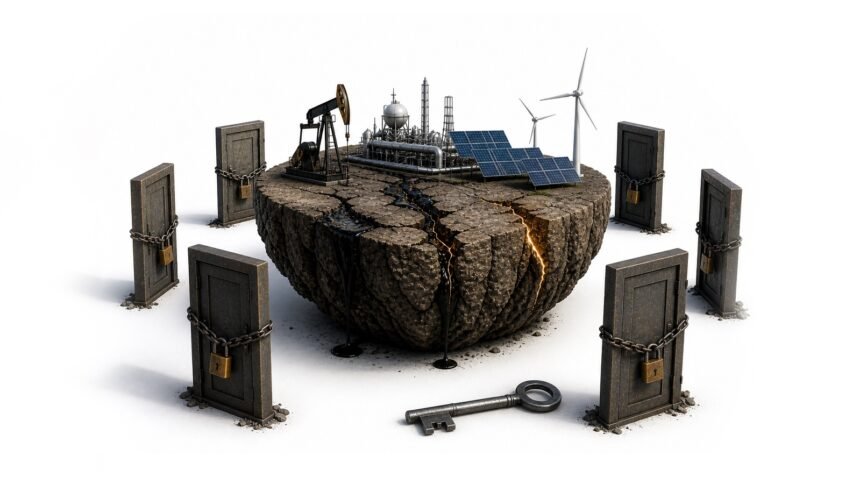
A lack of resources may not block Africa’s path to energy independence, but by deeper governance challenges that continue to undermine investment, planning, and long-term resilience, according to experts, as countries struggle with the ripple effects of the United States–Iran tensions.
The issue was highlighted during a panel on energy security, where weak policies and poor coordination were cited as major obstacles, despite the continent’s vast energy potential. Given this intro, how can I recite the headline and the intro to make it solution-oriented
The issue was highlighted during a panel on energy security, where governance gaps were identified as key barriers to unlocking the continent’s energy potential, with a recurring concern being the lack of stable, predictable policy environments that continue to discourage sustained investment.
“In Africa, the private sector is heavily dependent on government policy; if I design a ten-year strategy and the policy changes midway, it affects everything. This unpredictability makes it difficult for investors to commit capital to large-scale energy projects, including oil exploration, refining, and infrastructure development,” said Tunde Oni Nosakhare, the Pan African Energy Strategist.
“The result is a cycle where countries remain dependent on imports, even when they possess significant natural resources.”
Beyond policy instability, governance gaps, particularly corruption and a lack of transparency, were highlighted as major barriers to Africa’s energy progress.
Using Nigeria as an example, Tunde pointed to persistent opacity across the oil value chain, arguing that while production and trade continue, accountability remains weak.
“In Nigeria, oil is being exported, yet there’s no transparency in what’s happening in government. You have traders making profits, different actors involved, and decisions being made, but it’s hard to track who did what, why, and whether it benefits the country,” he said
He added that such opacity not only distorts markets but also undermines public trust and limits governments’ ability to channel resource wealth into long-term development.
Teddy Kaberuka, an Economic Policy Analyst, pointed to long-term contracts and opaque agreements with foreign investors as another challenge, warning that such deals often limit countries’ ability to benefit from their own resources fully.
“What we are facing today is a new form of control; contracts are signed for decades, and when governments cannot repay loans, resources are exploited. These practices, they argued, weaken national control over strategic sectors and reduce the potential for domestic value creation,” he said.
Kaberuka also highlighted the absence of strong regional coordination, arguing that African countries could benefit more from joint investment in extraction, refining, and energy infrastructure.
“Trust between states remains limited, making co-investment difficult despite shared interests. If governments don’t trust each other, they cannot invest together. Yet if we pooled resources and built shared systems, we would not need to depend entirely on external investors,” he said.
The discussion also underscored a persistent lack of long-term planning, with many African economies operating without adequate buffers against shocks.
“The crisis has been ongoing for more than two months, but how many times have African leaders come together to address it? Apart from the recent meeting where they agreed on refinery development, very little collective action has been seen, and implementation remains uncertain,” Kaberuka said.
Hakim Shyaka, the Downstream Petroleum Policy Specialist at the Ministry of Trade and Industry (MINICOM), said recent global shocks exposed the fragility of existing energy systems, with some countries experiencing sharp price increases within weeks.
“As Africans, we can join forces, have shared infrastructure, and a common energy market. We can become solutions ourselves. But, achieving this would require stronger institutions, clearer policies, and a shift towards collective planning, areas where progress has been slow,” said Shyaka.
“Usually, it is when a crisis hits that you realize what you should have done. For Africa, the question is whether this moment will lead to meaningful reform or become another missed opportunity.”
Without addressing governance failures, experts warned, the continent risks remaining energy-dependent despite its resource wealth. But with stronger leadership, transparent systems, and long-term planning, Africa could begin to turn its energy potential into true independence.