





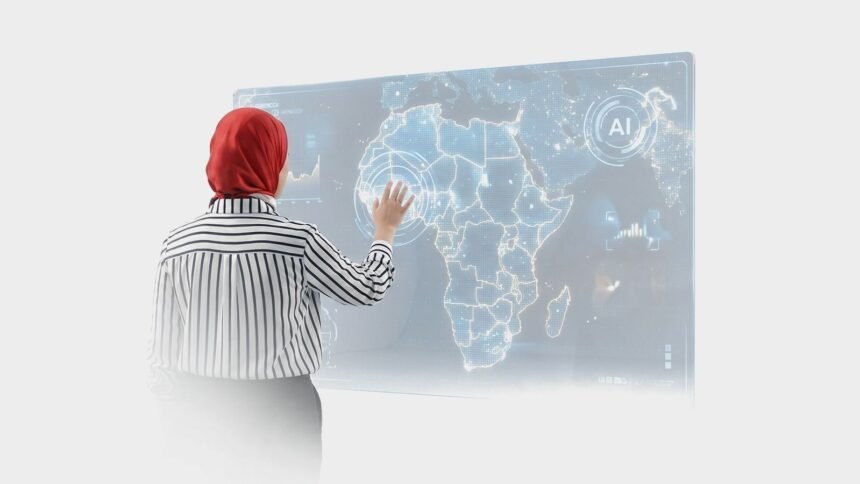
In mid‑March, in a drought‑prone Moroccan town, I watched engineer and entrepreneur Jihane Ouhejjou track a dashboard that did not exist a few years ago. Her team’s MAEIA platform, an AI‑powered water‑loss management system using sensors, IoT, and digital‑twin technology, scans water networks in real time, flagging leaks that once drained scarce resources without notice.
Supported through UNESCO’s African Women in Tech and AI (AWITAI) project, MAEIA is one of 30 ventures selected from 150 women entrepreneurs in 35 African countries to receive tailored grants and mentoring.
A few weeks later and a few hundred kilometers away, African ministers gathered in Tangier for the 2026 Conference of African Ministers of Finance, Planning, and Economic Development. In a ministerial policy dialogue on the African Women’s Decade on Financial and Economic Inclusion, officials spoke unusually bluntly: slow progress on women’s access to finance is now a macroeconomic liability, not a marginal social issue.
At the same time, YouthUp Global—a youth‑led organization—launched its DigitizeHer campaign, aiming to equip 10,000 young African women with digital skills, mentorship, and pathways into the digital economy.
This story matters now because UNESCO’s support for women tech innovators, COM 2026’s push on women’s financial inclusion, and YouthUp Global’s DigitizeHer campaign together signal a shift from broad empowerment talk to African women actively designing the technologies and financial systems that will shape the continent’s next phase of growth amid tighter global credit, climate stress, and rising digitalization.
I argue that what is emerging here is a quiet renegotiation of power: African women are not only asking for inclusion in existing systems of code and capital, they are starting to rewrite how those systems work.
Continental Foundations and Stakes
UNESCO’s recent feature on “African women driving innovation: From barriers to breakthroughs” makes clear that AWITAI is less a training scheme and more a deliberate intervention in who gets to build Africa’s AI future.
Implemented in partnership with the AI Movement at Mohammed VI Polytechnic University and the OCP Foundation, the project trains women entrepreneurs in AI and data science, offers tailored incubation, and connects them to a pan‑African network. From that pipeline, 30 entrepreneurs were selected for grants in the 10,000–30,000 dollar range, coupled with strategic mentoring and fundraising support.
Ouhejjou’s story shows why this matters. Across African water utilities, between one‑fifth and two‑fifths of piped water is often lost during distribution—non‑revenue water that translates into higher tariffs, more frequent cuts, and less resilience in drought‑prone areas.
MAEIA’s digital‑twin approach uses AI and IoT to detect and predict those losses, shifting utilities from reactive to predictive management.
UNESCO highlights it as a flagship example of an African woman technologist tackling a continental problem, water as a question of dignity, stability, and sovereignty, by building and owning the underlying AI system.
In Tangier, the ministerial dialogue on the African Women’s Decade on Financial and Economic Inclusion focused on the systems that must adapt if such innovations are to move beyond pilots. Co‑organized by the UN Economic Commission for Africa and the African Center for Economic Transformation, the event was explicit about its goal: to elevate women’s economic inclusion to a core macro‑fiscal priority using Africa‑led evidence.
Officials drew on tools such as the African Gender and Development Index, the Africa Gender Index, and the African Women’s Inclusion Index to show how gaps in women’s access to bank accounts, credit, digital services, and social protection are embedded in fiscal and financial architectures.
In public remarks, Moroccan officials in the Economy and Finance sector framed women’s exclusion as a governance failure. At the same time, ECA’s leadership argued that aligning financial reforms with women’s lived realities could unlock “a powerful engine of productivity, resilience and inclusive growth.” That language matters.
It signals that women’s finance is being pulled out of the “social” corner and placed squarely inside macroeconomic strategy. Dialogue outcomes are expected to inform follow‑up on the African Women’s Decade, providing finance ministers with a continental reference point when they revisit national reforms.
YouthUp Global’s DigitizeHer campaign adds a generational and bottom‑up layer to this picture. Launched via a virtual symposium under the theme “Closing the Digital Gender Gap in Africa,” the youth‑led initiative aims to empower 10,000 young African women with digital skills, mentorship, networking, and access to economic opportunities.
Organizers describe a pipeline: moving participants from learning to experience to income‑generating roles, rather than treating short courses as an endpoint. In doing so, DigitizeHer casts young women not just as future employees in the digital economy, but as potential founders, ecosystem builders, and sector leaders.
I have observed similar experiments across the continent, from fintech incubators in Lagos that deliberately recruit women founders to climate‑tech hubs in Nairobi and Accra.
What makes the AWITAI–COM 2026–DigitizeHer triangle distinctive is that it links three levels usually treated separately: women building code, ministers reshaping capital rules, and youth demanding pathways into the system.
Lived Realities of Women in Tech and Finance
For women like Ouhejjou, the promise of these initiatives cannot be separated from the constraints they confront every day. AWITAI participants work in contexts where connectivity is patchy, hardware is expensive, and specialized engineering talent is scarce.
Many focus on sectors that have long been underserved by both public and private investment—water and sanitation, smallholder agriculture, primary health services, or tools for people with disabilities. UNESCO’s package of training, mentoring, and grants helps bridge early gaps.
However, the path from prototype to scale still runs through banks, utilities, regulators, and procurement systems that do not yet instinctively see women‑led tech firms as natural partners.
In Tangier, I listened as ministers and experts described how deep some of those systemic barriers run. They warned that women’s limited access to formal finance narrows investment in small and medium‑sized enterprises, slows adoption of new technologies, and weakens resilience to shocks.
Recommendations ranged from redesigning digital and financial systems with women in mind from the outset, to investing in gender‑disaggregated data, to using Africa‑specific indices when setting policy targets.
For women building tools like MAEIA, those decisions are not abstract; the availability of tailored credit, insurance, and public procurement opportunities will determine how quickly such solutions can move from one town’s network to standard practice across utilities.
DigitizeHer operates at another point along this chain. Many of the young women it targets come from places where formal financial inclusion is incomplete and where digital access is uneven. Training and mentorship are designed to help them gain the skills and networks needed to enter or create roles in tech and data‑driven sectors.
But YouthUp Global is explicit: skills alone will not be enough if hiring practices, funding criteria, and regulatory frameworks remain unchanged. Without shifts in how employers recruit, how investors judge risk, and how states regulate platforms, new skills can still run up against old ceilings.
Across these three efforts, I see the same pattern: the link between code and capital is where women’s progress accelerates or stalls. MAEIA and other AWITAI projects show that African women can build advanced AI tools tuned to local realities.
The Tangier dialogue makes the case that financial systems must evolve so that these innovations can be financed, insured, and integrated at scale. DigitizeHer works to ensure a broader cohort of young women can enter this loop, as developers, analysts, entrepreneurs, or informed users.
The quietly revealing reality is that, right now, innovation and inclusion are not separate agendas for African women. Innovation only counts as progress when it changes how capital, risk, and decision‑making are distributed.
The Politics Behind the Promises
The convergence of AWITAI, COM 2026, and DigitizeHer also exposes policy tensions that will define how far they can go. One concerns pace. Technology programs like AWITAI can move relatively fast, delivering training, prototypes, and early deployments over a few years.
Financial and regulatory reforms often move slowly, constrained by fiscal pressures, risk perceptions, and political cycles. If reforms lag, women‑led innovations will keep colliding with credit rules, procurement norms, or risk models that were never designed with them in mind.
A second fault line lies between broad commitments and targeted interventions. Many African and international actors now reference women’s empowerment and STEM inclusion in strategies and communiqués.
What distinguishes AWITAI, the Tangier dialogue, and DigitizeHer is that each is anchored in specific levers: AI and data‑science training for a defined cohort of entrepreneurs; a ministerial dialogue rooted in African gender indices and the African Women’s Decade; and a numeric target of 10,000 young women for a youth‑led digital campaign.
The risk is that these become islands of excellence unless they are allowed to shape mainstream education policy, banking practice, and digital‑regulation debates.
A third tension concerns who defines success. UNESCO links AWITAI to the SDGs and Agenda 2063, and tracks outputs in terms of numbers trained, prototypes developed, and sectors addressed.
ECA and ACET frame the ministerial dialogue around macroeconomic transformation, fiscal policy, and evidence‑based decision‑making, tracking shifts in indices and policy commitments. YouthUp Global pays closer attention to whether participants can move from training into tangible opportunities.
Aligning these perspectives will require more than shared buzzwords; it will require feedback loops in which women themselves help set the benchmarks for what meaningful inclusion looks like in their sectors and communities.
As 2026 unfolds, I will be watching how these efforts interact. National treasuries and central banks will decide whether to integrate the recommendations of the Tangier dialogue into budgets, regulations, and financial‑sector reforms.
Education and innovation ministries will determine whether programs like AWITAI remain pilots or become blueprints for bringing more women into AI and frontier technologies.
The reach of DigitizeHer will depend on whether employers, investors, and public programs open doors for its graduates at scale.
By the end of the African Women’s Decade on Financial and Economic Inclusion in 2030, these choices will show up in places that rarely make it into ministerial communiqués: in how easily a woman can finance an AI‑enabled irrigation tool; in whether a young graduate can turn digital‑skills certificates into stable work; in the share of women whose economic contribution is visible in tax data and macroeconomic models.
The strategic question I keep coming back to is simple: will African women merely gain seats at the table of existing digital and financial systems, or will their growing presence in code, capital, and policy be allowed to redesign the table itself?