





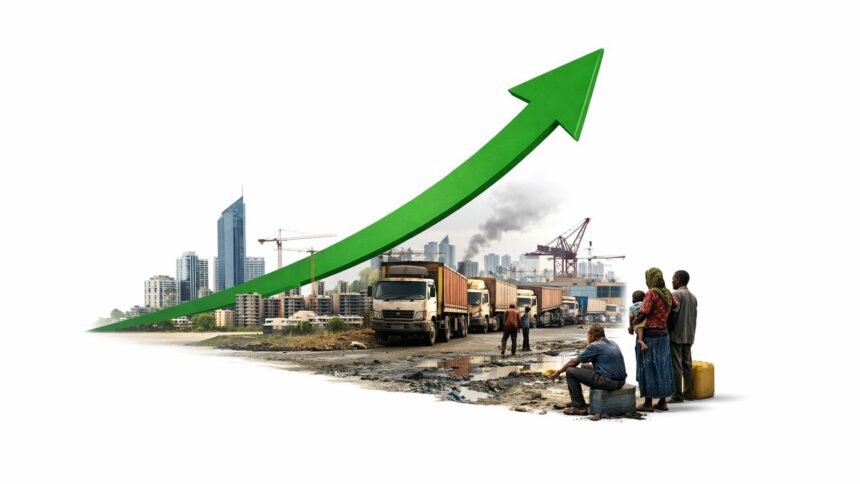
The IMF now sees the region expanding by 4.6 percent in 2026 and 2027, driven by larger economies such as Nigeria and Egypt. Turning forecasts into real gains will be far tougher.
On a recent morning in Lagos, container trucks idled for hours on the Apapa road, waiting to inch into Nigeria’s busiest port.
In Cairo’s satellite cities, cranes swung over new housing blocks stretching into the desert. Both scenes capture a moment of cautious optimism: two of Africa’s biggest economies are finally getting a brighter growth outlook from the world’s most influential lender.
In its latest projections, the International Monetary Fund raises its forecast for sub-Saharan Africa’s growth to 4.6 percent in both 2026 and 2027, up from 4.4 percent in 2025. The upgrade is modest on paper, but notable after years of shocks from the pandemic, global inflation, and tighter financing conditions.
It is anchored in improving prospects for major economies, including Nigeria, where gross domestic product is now expected to expand by 4.4 percent in 2026, and Egypt, forecast to grow by about 5 percent in the mid-2020s as reforms take hold.
The story behind those numbers is what matters: whether a fragile recovery can translate into jobs, lower poverty, and fiscal breathing room in countries still wrestling with debt, high borrowing costs, and political risk.
Background and Stakes
The IMF’s January 2026 update marks a clear shift in tone. “Growth is expected to accelerate in sub-Saharan Africa, from 4.4% in 2025 to 4.6% in 2026 and 2027, supported by macroeconomic stabilization and reform efforts in major economies,” the Fund says in a summary of the new forecast.
That represents roughly a 0.2‑percentage‑point upgrade for 2026 and a small upward revision for 2027 compared with its October 2025 projections.
Nigeria, the region’s most populous country and one of its largest economies, is central to that story. The IMF and World Bank now both project Nigerian growth at 4.4 percent in 2026, up from earlier estimates of around 4.2 percent, citing increased oil production, improved foreign-exchange liquidity, and a package of painful but significant reforms, including the removal of fuel subsidies and exchange-rate liberalisation.
Egypt, formally grouped by the IMF in the Middle East and North Africa region but often used as a bellwether for the continent’s economic prospects, is expected to grow by about 5 percent in its 2026/27 fiscal year as macroeconomic stability improves and structural reforms deepen.
For a region where per capita incomes have barely risen since the pandemic, a sustained 4.6 percent expansion could mark the difference between stagnation and gradual catching up. It would also narrow, but not close, the gap with global growth, which the IMF puts at about 3.3 percent in 2026 and 3.2 percent in 2027.
Human Stories on the Ground
What does a few tenths of a percentage point mean outside macroeconomic tables? In Nigeria, reform-driven growth is arriving at a high social and political cost. The removal of fuel subsidies and currency devaluations has pushed up transport and food prices, eroding living standards even as the IMF expresses more confidence in the medium term.
For small businesses in Lagos or Kano, higher input costs bite now, while the benefits of a more stable macro framework are promised for later.
In Egypt, where austerity and repeated currency adjustments have squeezed households, a 5 percent growth rate could help ease pressure if it translates into real wage gains and job creation. But with inflation still high and public debt elevated, many Egyptians remain wary of forecasts that do not immediately change their daily reality.
Across smaller economies from Mozambique to Rwanda, officials argue that the upgraded regional outlook validates years of work on tax reform, energy projects, and digital infrastructure. Yet they also warn that any new external shock, from commodity prices to climate-related disasters, could quickly knock the region off its 4.6 percent trajectory.
Policy, Debate, and Expert Views
The IMF attributes the improved outlook to “macroeconomic stabilization and policy reforms” in several large economies, while cautioning that global risks remain “tilted to the downside.” Analysts point to three fault lines beneath the headline number.
First, growth remains uneven. Nigeria’s 4.4 percent expansion would help lift the regional average. However, South Africa, still one of the continent’s economic anchors, is projected to grow at only about 1.4 percent in 2026, constrained by power shortages, logistics bottlenecks, and policy uncertainty.
That divergence raises questions about whether sub-Saharan Africa is converging as a region, or whether a small group of reformers is pulling ahead.
Second, the quality of growth is under scrutiny. Economists note that without faster productivity gains and diversification away from raw commodities, even 4.6 percent regional growth may not be enough to absorb a rapidly expanding labour force. In Nigeria, for example, higher oil output can boost GDP while leaving much of the non-oil economy and job market under strain.
Third, financing conditions remain tight. Many African governments are still locked out of international bond markets or face punishingly high interest rates, even as they try to invest in infrastructure, health, and climate resilience. The IMF itself underscores that debt vulnerabilities and limited access to concessional finance could constrain public investment, blunting the impact of better growth prospects.
There is also debate over how much weight to place on the new numbers. Supporters of the reform agenda in Abuja and Cairo see the upgrades as validation, arguing that difficult policy choices are finally paying off. Critics counter that headline growth forecasts risk masking distributional questions: who gains, who loses, and how quickly.
What Comes Next
For sub-Saharan Africa, a 4.6 percent growth forecast is both an encouraging sign and a test. It signals that, after years of crisis, the region is no longer seen primarily through the lens of shocks and vulnerability. But it also raises expectations among citizens, investors, and creditors that governments will turn macro stability into visible improvements in daily life.
Whether that happens will depend less on decimal points in IMF spreadsheets than on choices in capitals like Abuja, Nairobi, and Accra: how to share the gains of reform, how to manage political backlash, and how to invest in people rather than just output. The numbers, for once, are moving in the right direction. The real question is whether the lives behind them will follow.