




Pan African: The Borderless Paradigm of Transnational Insurgency
Across the African landscape, the contemporary consolidation of state sovereignty and human security is fundamentally challenged by the borderless expansion of asymmetric violent extremism. The Pan-African vision for regional integration and collective stability, codified within the African Union’s Agenda 2063, faces an existential threat from militant networks that systematically exploit porous frontiers and localized governance deficits. In West Africa, the security crisis has evolved from a localized rebellion in the Sahel to a complex, southward-migrating regional network. Reclaiming the continent’s stability requires a shift from fragmented, nationalistic defense strategies toward a unified, borderless framework of military and administrative cooperation, ensuring that peripheral states cooperate to insulate the West African economic corridor from systemic destabilization.
Ivory Coast’s Political Outlook: The Fragility of the Northern Shield
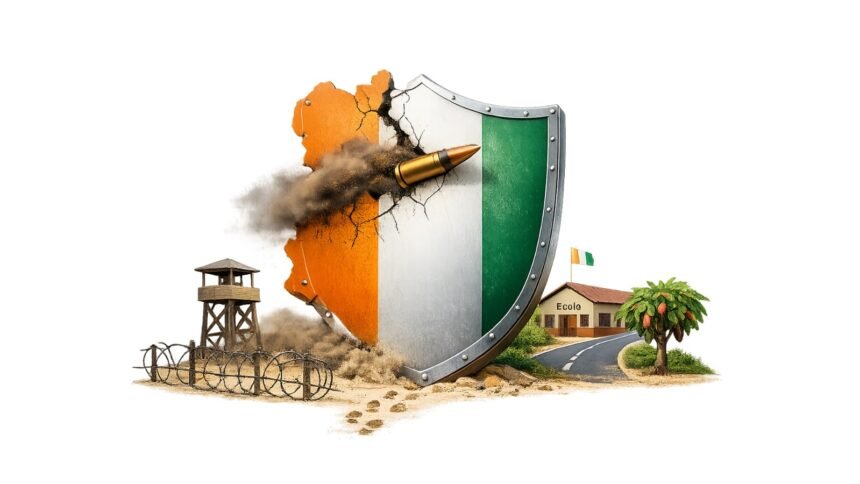
A precarious stabilization campaign defines the contemporary political and security outlook in Côte d’Ivoire, focused on fortifying its northern borders against encroaching militancy. Under the administration of President Alassane Ouattara, the state has positioned itself as a robust economic and military bulwark in coastal West Africa. However, this defensive architecture is under continuous strain as the security vacuum in neighboring Burkina Faso and Mali shifts the frontlines of asymmetric warfare directly to the Ivorian border. The northern districts, characterized by historic underdevelopment and ethnic configurations that span international boundaries, serve as the primary theater for this quiet struggle, requiring the state to maintain a permanent, high-velocity security posture to prevent external extremist cells from establishing permanent operational sanctuaries within the republic.
Jihadi Movements in West Africa: The Strategy of Coastal Penetration
The strategic orientation of jihadist movements in West Africa, principally driven by factions aligned with Al-Qaeda’s Jama’at Nusrat al-Islam wal-Muslimin (JNIM) and the Islamic State, has transitioned from territorial consolidation in the Sahel to the methodical infiltration of coastal littoral states. In May 2026, Côte d’Ivoire marks a decade since its first catastrophic exposure to this transnational threat: the March 13, 2016, assault in the historic port town of Grand Bassam, where gunmen executed a coordinated shooting spree across multiple beach resorts, resulting in 19 fatalities and profound national trauma. Ten years on from that major attack, while the southern coastline remains secure, the threat has mutated. Contemporary extremist strategies bypass high-profile urban strikes in favor of low-intensity infiltration along the northern borders, utilizing remote river crossings to conduct targeted ambushes against military patrols and plant improvised explosive devices, thereby testing the structural integrity of the state’s defensive shield.
AU-UN Counter-Terrorism Efforts: The Limitations of Externalized Enforcement
Bilateral and multilateral counter-terrorism interventions spearheaded by the African Union and the United Nations remain central to the regional stabilization matrix. Yet, their operational efficacy is heavily constrained by shifting geopolitical alliances and funding deficits. The systematic withdrawal of Western-led military missions from the Sahelian interior has forced a radical re-engineering of the regional security architecture. Multilateral efforts are increasingly focused on the Accra Initiative, a collaborative framework designed to enhance intelligence sharing and execute joint border operations among coastal states. However, these international mechanisms frequently encounter severe limits on the ground, as the fluid nature of asymmetric networks requires high-precision, localized intelligence and rapid-response assets that abstract regional mandates struggle to deploy consistently without robust, indigenous institutional support.
Economic Outlook & Debt Crisis: The Fiscal Cost of Permanent Defense
The macroeconomic stability of Côte d’Ivoire is increasingly caught in a structural squeeze between high-yielding development goals and the escalating cost of permanent national defense. While the country continues to project resilient gross domestic product growth driven by cocoa exports and infrastructure investments, its fiscal space is constrained by the wider global economic volatility linked to international conflicts. The state has been forced to allocate massive budgetary reserves to fund its northern counter-insurgency campaign, building fortified forward operating bases and deploying thousands of heavily armed troops along the frontier. This intensive defense spending occurs against a backdrop of rising global borrowing costs and complex debates over regional debt sustainability, underscoring how the need for permanent military readiness can drain the capital needed to fund critical social services and preserve long-term economic sovereignty.
Civil Wars & History: The Internal Echoes of Post-Crisis Polarization
The modern vulnerability of the Ivorian state to external extremist infiltration cannot be divorced from its historical context of past internal conflicts. The legacy of the civil wars that fractured the nation along a north-south axis in the early 21st century left deep-seated socio-economic grievances and political polarization that have taken decades to heal. Jihadist networks actively analyze these historical fault lines, attempting to exploit lingering feelings of marginalization among northern pastoralist and agricultural communities. By offering informal financial incentives and tapping into unresolved local disputes over land rights and resources, insurgent recruiters attempt to subvert national loyalty, demonstrating that the ultimate defense of the republic depends on fully resolving the historical contradictions that initially compromised the national social fabric.
Internal Politics: Re-engineering Security through Socio-Economic Inclusion
The ultimate resolution of the asymmetric threat along the northern border depends on the structural evolution of Côte d’Ivoire’s internal politics, away from a purely kinetic response toward a comprehensive socio-economic inclusion model. The administration has recognized that military dominance alone cannot neutralize a clandestine ideological movement. Consequently, current state policy integrates high-velocity security measures with targeted community-level development programs, investing in northern schools, healthcare facilities, and youth employment initiatives designed to formalize the local economy and eliminate the recruiting grounds of radical networks. Success will be defined by the state’s capacity to build a resilient, inclusive governance architecture that protects the fundamental dignity, human rights, and economic security of all citizens, ensuring a peaceful and sovereign future for the republic.