





Pan-African Borders: The Geopolitics of Contagion Management
Across the African landscape, the structural alignment of transnational health governance faces a definitive challenge from the externalization of biological containment. The Pan-African ideal of regional coordination and territorial self-determination is fundamentally compromised when external powers utilize sovereign African territory as geographical containment zones for infectious pathogens. In East Africa, this dynamic has created severe friction, as local populations reject the establishment of parallel, foreign-operated biocontainment infrastructures that operate independently of local oversight. Reclaiming the continent’s shared future requires a transition away from unequal, aid-dependent security arrangements toward a unified framework of public health diplomacy that prioritizes the structural safety and sovereign dignity of African citizens over external containment mandates.
The Epidemiological Matrix: Viral Resurgence in the Great Lakes Corridor
The contemporary public health landscape in East Africa is defined by a highly dangerous and rapid spread of the rare Bundibugyo Ebola virus, which has prompted the World Health Organization to declare a public health emergency of international concern. Officially declared on May 15, 2026, after circulating undetected for weeks, the epidemic has severely impacted regional healthcare structures. In the neighboring Democratic Republic of the Congo, confirmed infections have surged to 515 cases with 91 documented fatalities, while Uganda has registered 19 confirmed cases and two deaths. Although Kenya has maintained zero recorded cases, its status as a major regional transit hub puts its domestic population under continuous biosecurity pressure, as the lack of approved vaccines or targeted therapies for the Bundibugyo strain heightens the perceived risk of cross-border transmission.
The Laikipia Enclave: Institutional Fallout of Segregated Biocontainment
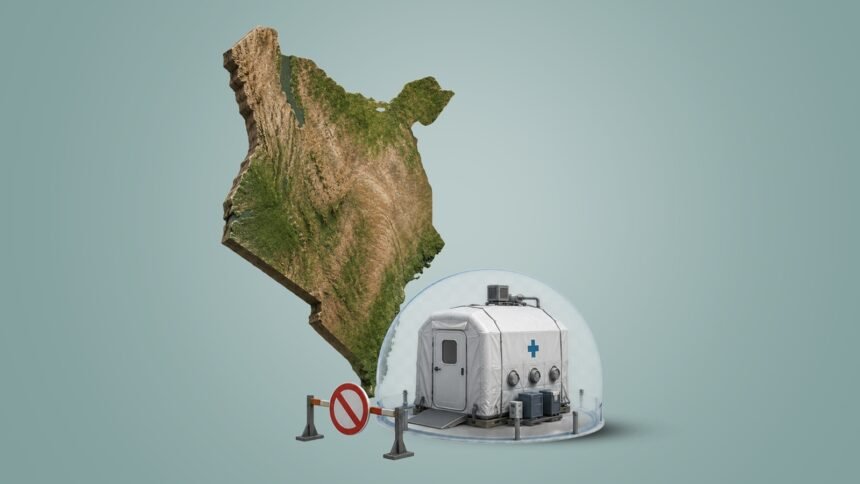
The United States government’s unilateral decision to construct a specialized, 50-bed field hospital at the Laikipia airbase in Nanyuki has created a profound crisis in bilateral state operations. Engineered exclusively for the isolation and treatment of American citizens exposed to Ebola, the facility is designed to be staffed by 30 US medical personnel. This exclusive model has triggered severe institutional pushback, with local civil society groups and legal experts characterizing the base as an extraterritorial medical enclave that operates outside the statutory framework of Kenyan public health laws. The establishment of a nationally segregated medical facility on domestic soil has fundamentally altered relations between the state and the public, transforming a global health response into a symbol of geopolitical asymmetry.
Structural Scapegoating: Civic Frustration and the Fear of Importation
The introduction of the proposed American quarantine facility has provoked intense domestic anger and widespread panic among ordinary citizens. Local communities have expressed sharp opposition to the project, arguing that importing individuals with high-risk biological exposures introduces an unnecessary and highly dangerous contagion risk to a country completely free of the virus. This widespread fear has fueled a structural scapegoating matrix within urban centers, where the local population views the state’s compliance as a direct threat to national biosecurity. Public anger is worsened by the perception that the local health system is being compromised to insulate a foreign superpower, transforming valid epidemiological concerns into a deeply personalized grievance against external intervention.
Battle on the Altiplano: State Force and Lethal Escalation in Nanyuki
This widespread societal anger has spilled over into active civil unrest, culminating in violent confrontations between security forces and local demonstrators in Nanyuki, located approximately 120 miles from the capital, Nairobi. Protesters gathered near the perimeter of the Laikipia airbase, with some wearing symbolic protective equipment and carrying a ceremonial coffin marked “Ebola” to voice their resistance. State security forces deployed anti-riot units, utilizing heavy teargas and live ammunition to scatter the crowds. During the escalation, a prominent local protest organizer, Patrick Wahome, confirmed that a demonstrator was shot dead after sustaining a catastrophic head wound from police gunfire, an incident verified by the Kenya Human Rights Commission, which also documented the arbitrary detention of 19 individuals by hooded police operatives. This lethal encounter marks a dramatic escalation of the crisis, following an earlier protest where two additional civilians were killed.
The Aid-Dependency Trap: Executive Compliance vs. Judicial Nullification
The ongoing confrontation has exposed a profound constitutional crisis within the Kenyan state, pitting executive policy directly against the rule of law. President William Ruto has vowed to press ahead with the American project, explicitly justifying his executive compliance by asserting that the republic owes an immense developmental debt to Washington for years of bilateral aid support. This position has been met with direct resistance from the country’s independent judiciary; following a legal petition by the non-profit Katiba Institute, a Nairobi court issued a decisive judicial order temporarily blocking the establishment of the Nanyuki facility and halting the entry of any Ebola-exposed individuals into the country. The court extended this ban, prohibiting the administration from proceeding with the plan before a full judicial evaluation, with the next critical hearing scheduled for June 23, 2026.
The Sovereignty Deficit: Human Rights and the Ethics of Segregated Healthcare
The operational parameters of the American quarantine center expose fundamental human rights contradictions regarding equitable access to medical infrastructure and national sovereignty. Legal and human rights organizations argue that allowing a foreign superpower to build a high-tech medical facility that excludes local citizens under identical biological risks violates basic constitutional protections against discrimination. This policy of exclusion creates an ethical deficit, transforming critical health infrastructure into an exclusive instrument of geopolitical insulation. True human rights and dignity cannot be sustained when a host nation’s executive branch overrides independent judicial rulings and deploys lethal force against its own citizens to protect an exclusive, foreign-only medical sanctuary, proving that when aid dependencies compromise legal sovereignty, public health infrastructure becomes a site of intense civic conflict.
Reclaiming the Constitutional Shield: Re-engineering Inclusive Health Governance
The path toward resolving Kenya’s internal crisis requires an immediate transition away from militarized policing and transactional diplomacy toward an inclusive model of public health governance. Reclaiming the integrity of the national social contract depends on the executive branch respecting the rule of law and halting all operations at the Laikipia airbase until the independent judiciary delivers a final ruling. To restore civic trust, any future emergency health facility deployed within the country must be fully integrated under the administration of local health authorities, ensuring equal medical access for both local first responders and international personnel. Success will ultimately be measured by the state’s capacity to build a transparent, rule-of-law-based health architecture that protects its citizens from both biological hazards and state-sponsored violence, securing a sovereign, dignified, and self-determining future for the republic.