





The Pan-African Struggle for Institutional Autonomy and Human Security
Across the African landscape, the contemporary configuration of governance operates under intense pressure as nations balance state security with their citizens’ fundamental liberties. The Pan-African vision for a self-sustaining, democratic continent depends heavily on the resilience of independent civic institutions, a transparent judiciary, and an active press corps. When statutory protections are rolled back within individual states, the resulting institutional vacuum compromises human security and disrupts regional stability. Reclaiming the continent’s shared future requires a comprehensive defense of civic spaces, ensuring that member states move past arbitrary legal enforcement to establish a governance framework anchored in the rule of law and the collective protection of human dignity.
Tunisia’s Restructured State and Executive Consolidation
The contemporary political outlook for Tunisia is characterized by a sweeping centralization of state authority that has fundamentally reshaped the nation’s institutional architecture. Following a decisive political shift in 2021, President Kais Saied dissolved the country’s elected parliament and initiated a transformative period of governance by executive decree. While the presidency maintains that these sweeping interventions are necessary structural corrections designed to preserve state stability, combat institutional corruption, and eliminate political gridlock, the resulting concentration of power has concentrated administrative oversight within a single executive office. This systemic realignment has altered the traditional separation of powers, placing the judiciary and legislative frameworks under direct executive influence and transforming the state’s relationship with civil society.
The Transformation of the Revolutionary Legacy
The ongoing restructuring of the Tunisian state marks a complex turning point in the country’s post-Arab Spring trajectory. Following the historic 2011 popular uprising that toppled the long-standing autocratic regime of Zine El Abidine Ben Ali, Tunisia emerged as a key symbol of democracy across the region, fostering an environment where independent journalism and open political debate flourished. However, the subsequent years of fiscal stagnation and factional division created significant societal strain, ultimately opening the door to contemporary executive interventions. Critics argue that the systematic consolidation of power over the last three years has dismantled the vital democratic safeguards established during the post-revolutionary era, transforming the legacy of the uprising into a highly contested political space.
Specialized Legal Codes and the Boundaries of Expression
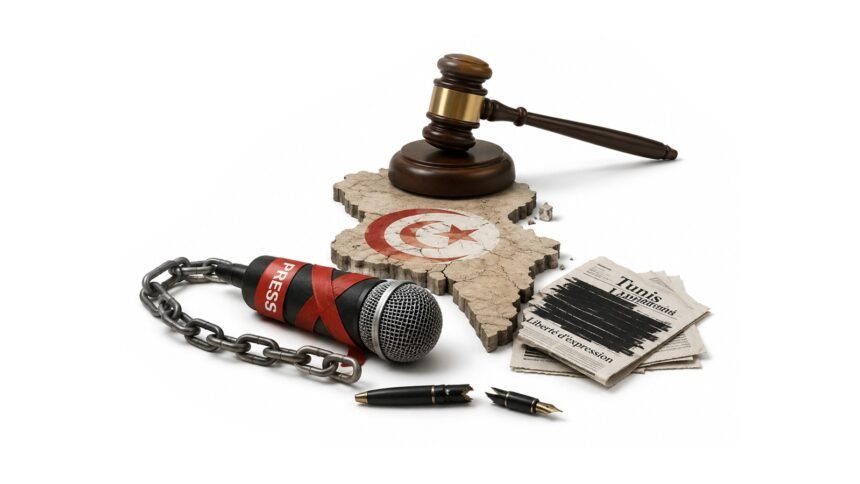
The implementation of specialized cybercrime legislation has heavily restricted the operational space for independent media and public commentary. Central to this regulatory tightening is Decree-Law 54, a sweeping legal framework enacted by executive decree in 2022 that introduces severe criminal penalties for online publication offenses. While state authorities defend the statute as an essential tool to combat digital misinformation, hate speech, and online abuse, international jurists and media networks warn that its broad provisions are increasingly used to prosecute government critics. The application of this cybercrime code has created a strict environment for public expression, where standard editorial analysis and online reporting can easily be reclassified as national security offenses.
Judicial Enforcement and Independent Media Deficits
The enforcement of these strict legislative measures has directly impacted prominent figures within the independent press corps, as demonstrated by the case of journalist Khaoula Boukrim. As the founder of the independent news platform TUMEDIA, Boukrim had consistently maintained a critical editorial stance regarding the presidency and its surrounding political network. In June 2026, a Tunisian court sentenced Boukrim in absentia to four years in prison, issuing two separate judgments against her under the provisions of Decree-Law 54. Having anticipated legal action, Boukrim fled to Paris in December to avoid detention. This high-profile ruling follows a broader pattern of judicial enforcement that has led to the imprisonment of several other prominent media figures, including Zied Heni, Mourad Zghidi, and Borhen Bsaies. It highlights a shrinking space for independent investigative journalism.
Factional Containment and the Dispersal of Civil Society
The judicial pressure facing the media landscape operates alongside a wider, systematic containment of the country’s formal political opposition. Over the past three years, law enforcement agencies have arrested and jailed the leaders of Tunisia’s main opposition parties, alongside dozens of prominent politicians, activists, and business representatives. These individuals face complex, high-level charges ranging from conspiring against state security to money laundering and corruption. While President Saied has repeatedly stated that these prosecutions are strictly legal anti-corruption measures and that fundamental freedoms remain guaranteed under his administration, human rights groups characterize the wave of detentions as a calculated campaign to stifle independent political dissent.
Restoring the Social Contract Through Judicial and Structural Reform
The path forward for Tunisia and its regional partners requires an immediate transition away from decree-based rule toward a sustainable, constitutional governance architecture. Reclaiming public trust and national stability depends on amending restrictive legislation, such as Decree-Law 54, to ensure that cybersecurity measures do not infringe on international standards of free expression. Furthermore, the state must restore a clear separation of powers, ensuring that the judiciary functions as an independent protector of constitutional rights rather than an instrument of political containment. Success will ultimately be measured by the country’s capacity to cultivate an inclusive civic space where journalists can work without fear of arbitrary prosecution, securing a dignified, transparent, and completely self-determining future for the republic.