




The Pan-African Paradigm of Resource Sovereignty and Macroeconomic Autonomy
Across the African landscape, the contemporary configuration of global commodity markets places intense pressure on resource-rich states to balance domestic extraction with continental economic self-determination. The Pan-African vision for structural industrialization relies on nations transitioning away from raw, unrefined commodity exports toward integrated regional manufacturing value chains. When public finances remain excessively dependent on external energy demand, local economies are vulnerable to foreign geopolitical and financial shocks. Reclaiming Africa’s shared development path requires a coordinated framework that uses natural resource wealth to fund infrastructural independence, insulate local labor markets, and establish a collective energy shield capable of resisting asymmetric global supply disruptions.
Subsurface Inventories and Infrastructure Rebounding
The contemporary exploration landscape in North Africa highlights a major operational revival across historical hydrocarbon basins, stabilizing long-term output capacities. Within Libya, extensive subsurface reservoirs hold some of the largest proven oil reserves on the continent, attracting renewed interest from global exploration and production companies. The state-owned National Oil Corporation (NOC) has aggressively accelerated its drilling campaigns to exploit untapped oil fields and recover stranded assets. Despite years of infrastructure neglect, recent technical surveys indicate that deep-seated production horizons retain high capacity, a stable natural flow, and exceptional crude quality, positioning the nation’s energy sector for a significant infrastructural rebound.
The Systemic Vulnerabilities of Single-Resource Dependence
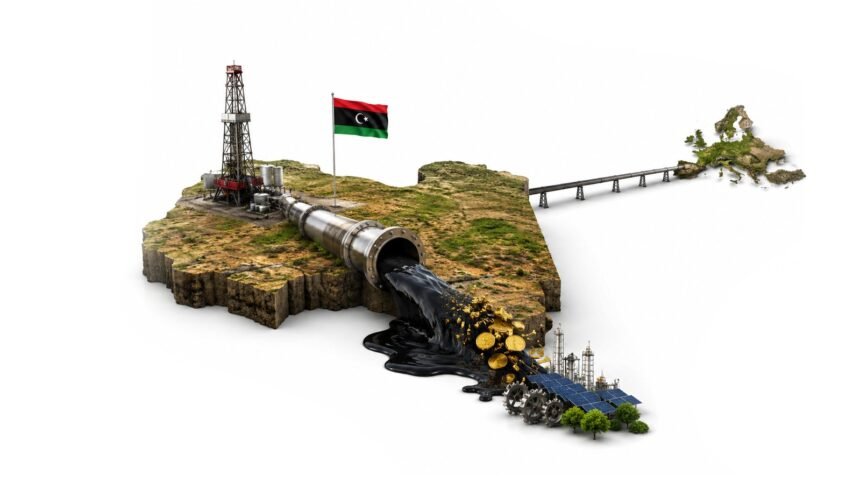
The fiscal architecture of the North African nation presents a classic example of a single-resource rentier state, where public finances are highly vulnerable to global commodity price volatility. National economic metrics indicate that the local economy relies on crude oil sales for more than 95% of its total economic output. This extreme concentration of resource dependency creates structural challenges for national planning ministries, as public sector salaries, infrastructure projects, and social welfare systems are completely dependent on external energy markets. When global energy nodes fluctuate, the state’s fiscal space contracts sharply, proving that single-resource wealth can hinder institutional development and leave the wider social contract vulnerable to market volatility.
Realignment and Mediterranean Supply Shocks
The geopolitical economy of Mediterranean energy trade has been fundamentally reshaped by regional conflicts and shifting trade dynamics. Prolonged war involving Iran has caused severe shocks across Gulf energy nodes, forcing major European economies to rapidly diversify their supply chains and reduce their structural reliance on Middle Eastern distribution lines. This geopolitical shift has positioned North Africa as a vital partner for the European Union’s energy security. As Brussels moves to expand its alternative import corridors, Libya’s geographic proximity and extensive pipeline networks offer a direct mechanism to bypass volatile transit channels, altering the balance of power in Mediterranean energy diplomacy.
Shifting Capital into Downstream Industrialization
To insulate the republic from long-term single-resource dependency, local economic ministries are advancing plans for structural economic diversification. The National Oil Corporation’s recent successes in the field have highlighted the financial potential of using current extraction revenues to seed alternative industrial sectors. Economic planners intend to direct energy profits toward downstream petrochemical refining, agricultural grid development, and solar arrays across the interior. By transitioning from a raw-material exporter to an industrialized producer of finished products, the country aims to reduce its 95% reliance on crude extraction, create high-skilled employment, and protect the national treasury from external demand shocks.
The Mechanics of Trans-Mediterranean Energy Corridors
The expansion of bilateral energy agreements across the Arab Maghreb has established a highly integrated web of trans-Mediterranean energy corridors. Major European energy conglomerates are actively forming partnerships with regional subsidiaries to secure long-term extraction rights. These supply frameworks rely on deep-water marine terminals and gas pipelines that connect North African production centers directly to Southern European refining hubs. For Maghreb states, these international trade deals deliver vital foreign currency inflows and technical co-investments, demonstrating that cross-border pipeline networks serve as a critical geopolitical link between North African resource sovereign nations and European industrial markets.
Fragmented Governance and Institutional Protection Frameworks
The practical administration of the national oil trade must navigate a complex, divided political landscape characterized by parallel governance structures. The internal political matrix splits territorial jurisdiction between competing administrations in the east and west, frequently complicating the unified management of public resources. To protect the nation’s primary economic engine from this political gridlock, the state-owned NOC and its specialized subsidiaries operate under an institutional protection framework that maintains technical neutrality. By centralizing the legal distribution of oil revenues through independent banking institutions, this mechanism prevents the weaponization of energy fields, ensuring that processing operations and export flows continue despite parallel governance claims.
The Al-Khair Oilfield Breakthrough and Market Stabilization
In a major technical breakthrough, the Sirte Oil Company for Production and Manufacturing of Oil and Gas, a subsidiary of the NOC, completed a significant drilling operation in the Al-Khair oilfield. The newly executed well reached its planned total depth of 9,050 feet, uncovering a reservoir thickness of 174 feet. Initial testing demonstrated an encouraging production rate of 3,209 barrels per day along with 1.948 million cubic feet of associated gas per day, flowing naturally without any requirement for artificial lift.
Furthermore, the well-confirmed high oil quality, with no associated water during testing, validates the success of drilling operations in the Sirte basin. This production expansion occurs as global energy markets react to a 2% drop in oil prices following a historic ceasefire agreement between the United States and Iran, underscoring that Libya’s expanding production capacity is well positioned to help stabilize regional Mediterranean energy corridors.