





The Pan-African Paradigm of Public Health Autonomy and Structural Interventions
Across the African landscape, the contemporary configuration of global health governance places intense pressure on developing nations to balance international biosecurity partnerships with the preservation of macroeconomic and territorial sovereignty. The Pan-African vision for long-term health security and structural transformation relies on building an inclusive domestic medical infrastructure that serves local populations without ceding administrative control to foreign powers. When external states build specialized medical centers within sovereign borders that exclude the host population, it directly challenges local constitutional guarantees and human dignity. Reclaiming the continent’s economic and biological future requires a unified approach to public health governance, ensuring that international clinical partnerships expand local capacities equitably rather than serving as isolated enclaves of externalized privilege.
Transnational Volatility and Epidemic Vulnerabilities
The contemporary public health profile of East and Central Africa is defined by persistent biological threats that test the structural resilience of national sanitation and bio-surveillance systems. High-consequence pathogens pose a continuous threat to regional stability due to localized transmission networks, weak rural healthcare networks, and delayed diagnostic response capacities. Managing these expanding epidemics requires high-velocity cross-border coordination to contain viral footprints before they destabilize regional trade corridors. Because unchecked outbreaks can strain infrastructure rapidly, regional states face immense pressure to maintain permanent readiness. However, when these containment strategies rely on externalized financing models, they frequently introduce complex geopolitical dependencies that complicate domestic emergency planning and public policy enforcement.
The Laikipia Air Base Quarantine Project
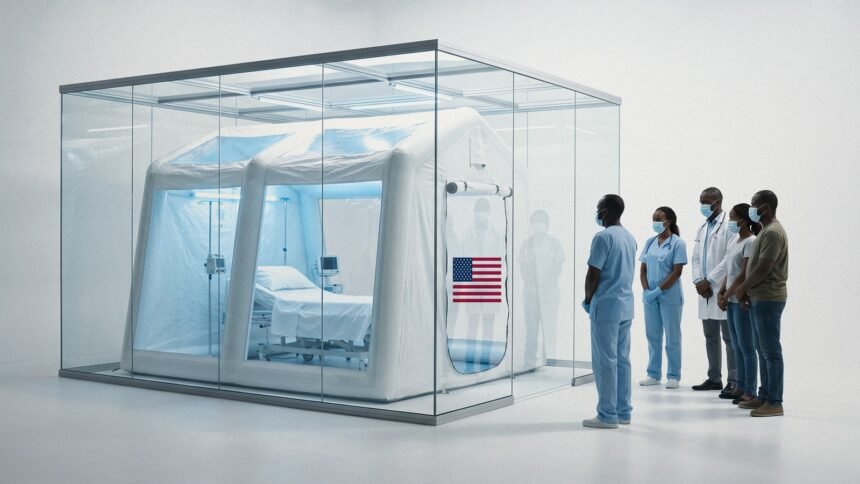
The intersection of state security planning and externalized biomedical infrastructure achieved definitive prominence following a controversial bilateral project initiated in Kenya. The central government permitted the development of a specialized, U.S.-backed Ebola quarantine facility located at a high-security military installation near the central town of Nanyuki. Satellite imagery from late June 2026 revealed a significant build-up of tents, an increase in paved staging areas, and progress in construction, including structures that appeared to be containers.
The facility is intended to host exclusively Americans exposed to Ebola during an ongoing outbreak in the Democratic Republic of Congo, which has recorded over 1,000 cases. This highly restricted operational scope effectively established a segregated medical zone within Kenyan territory, drawing sharp domestic criticism as local healthcare practitioners and legal analysts condemned the state for allowing a foreign power to operate a discriminatory health enclave. In contrast, local public hospitals faced severe resource shortages.
The Contempt Mandate and Executive Defiance
The domestic controversy quickly escalated into a landmark constitutional showdown within Kenya’s senior judicial architecture. Civil rights organizations and public health advocates filed emergency litigation challenging the segregation of the clinic, prompting a Kenyan court to issue an absolute injunction blocking the construction of the tented facility. Despite these clear suspension orders, flights carrying medical equipment and specialist staff continued to arrive at the air base, according to flight-tracking data and diplomatic sources.
This deliberate executive non-compliance led to a decisive judicial intervention. Justice Patricia Nyaundi Mande formally found Health Minister Aden Duale guilty of contempt of court for failing to observe the suspension orders. Concurrently, the state’s executive defiance served as an immediate catalyst for civil unrest, triggering deadly protests near the central town of Nanyuki as local communities clashed with security forces over the subversion of national judicial authority.
Ordering the Immediate Stand-Down
The judicial finding of contempt against the health minister forced an immediate, high-stakes political realignment within the executive branch. Appearing before the Kenyan court under intense legal pressure and facing severe public backlash, Health Minister Aden Duale officially announced that he had ordered an immediate halt to the construction of the U.S.-backed quarantine facility at the air base.
In her final sentencing, Justice Nyaundi Mande issued a stern warning to the minister against further institutional disobedience, though she ultimately discharged him with no punishment. While the minister’s public stand-down represents a major victory for the rule of law, the project remains a focal point of intense political debate, as local civil society networks continue to watch the site to ensure that domestic law enforcement agencies permanently enforce the construction halt.
The Standoff Over Bilateral Access Protocols
The halt to operations at the Laikipia Air Base has exposed a deep ideological standoff between Washington’s strategic priorities and Kenya’s constitutional mandates. A U.S. official confirmed that, despite ongoing legal friction, planes had continued to land carrying supplies. At the same time, personnel were being trained on site, emphasizing that the primary U.S. priority remained preventing the Central African Ebola outbreak from reaching the American mainland.
However, domestic legal frameworks require that any medical facility operating within the republic’s sovereign borders cannot legally deny treatment to individuals based on national origin. Public health advocates are demanding that the restricted facility be fully reorganized and opened to the general public, transforming it into a universal isolation center serving local citizens. This demand creates significant diplomatic tension, as Western entities remain reluctant to finance healthcare infrastructure that primarily serves their own citizens, highlighting the structural flaws of externally delivered medical aid.
Reclaiming Equality in Public Health Architecture
The struggle over the restricted quarantine facility underscores a profound ethical conflict between top-down technocratic diplomacy and the fundamental principles of human rights and dignity. Under international humanitarian frameworks and domestic constitutional bills of rights, access to life-saving medical care must be administered equitably, free from discriminatory exclusions based on citizenship or race. Permitting the operation of an exclusive, foreign-only medical compound on sovereign soil damages national dignity. It implies that the lives of host citizens are of lesser value than those of foreign nationals. Public health experts emphasize that segregated medicine undermines community trust in healthcare systems, proving that sustainable epidemic containment cannot be achieved by compromising the legal protections and basic dignity of the local population.
Cultivating Inclusive Restitution and Health Sovereignty
The long-term resolution of East Africa’s public health and diplomatic challenges requires a decisive transition away from ad-hoc, donor-dependent medical enclaves toward a comprehensive model of institutional inclusion and health sovereignty. Reclaiming national stability depends on the Ministry of Health establishing a transparent, data-driven roadmap for epidemic readiness that treats all patients equally and aligns fully with domestic judicial oversight. Central authorities must ensure that all future international medical agreements are subject to strict legislative review, public debate, and civic participation to prevent the fracturing of the underlying social contract. Success will ultimately be measured by the state’s capacity to build self-determining, publicly funded medical architectures, ensuring a stable, inclusive, and completely sovereign future for the republic.