





The Pan-African Paradigm of Freedom of Movement and Continental Integration
Across the African landscape, the contemporary configuration of intra-continental migration faces serious challenges as individual member states balance national security concerns with broader regional integration goals. The Pan-African vision for a self-determining, integrated continent depends heavily on the gradual elimination of colonial-era borders and the enforcement of protocols that protect the freedom of movement for all African citizens. However, when regional conflicts, economic disparities, and political instability persist, unilateral border enforcement frequently disrupts these shared goals. Reclaiming Africa’s economic and social future requires a unified approach to demographic management, ensuring that cross-border mobility is guided by humanitarian standards and transparent legal networks rather than reactionary containment policies that divide neighboring populations.
Fragmented Sovereignty and Parallel Governance Systems
The contemporary political architecture of Libya remains deeply divided, shaped by persistent factional conflicts that have split the North African nation since 2014. The collapse of the central state apparatus following the toppling of dictator Muammar Gaddafi in a 2011 NATO-backed uprising left a profound security vacuum that has yet to be resolved. Today, the country operates under a dual-governance matrix characterized by competing entities in the east and west.
The internationally recognized Government of National Unity, led by Abdulhamid Dbeibah, came to power through a UN-backed process in 2021 and maintains its administrative headquarters in Tripoli, the capital city. Conversely, a parallel eastern-based government led by Osama Hamad operates out of Benghazi, closely allied with military commander Khalifa Haftar, whose forces exercise control over the eastern territories and large areas of southern Libya. This fragmented sovereignty significantly complicates the enforcement of uniform national laws, customs regulations, and foreign policy directives.
Civic Strains and Nativist Rhetoric in Urban Hubs
The continuous accumulation of transit populations across major municipal zones has triggered notable civic strains and localized nativist rhetoric within the domestic public sphere. As economic competition increases and public infrastructure faces ongoing challenges from political division, local communities frequently voice frustration regarding the presence of undocumented populations. This social friction occasionally manifests as targeted public protests, labor market restrictions, and populist demands for immediate border closures. Nativist political groups frequently capitalize on these community anxieties, using the presence of foreign workers to explain municipal public service shortages and security deficits, thereby creating an increasingly difficult social environment for non-national communities residing in the country.
Unilateral Decrees and National Origin Exclusions
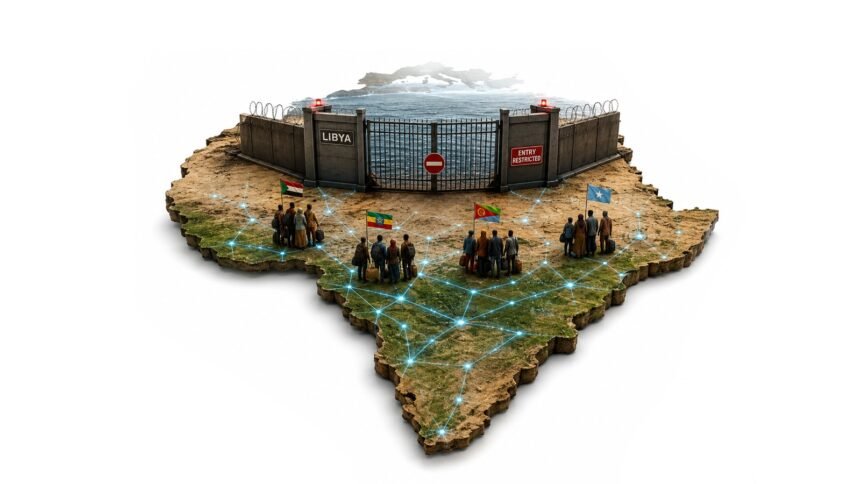
The institutional standoff over immigration took a decisive turn following a significant legislative move by the parallel administration in Benghazi. The eastern-based government issued a strict decree banning the entry of nationals from four specific sovereign African countries: Sudan, Eritrea, Ethiopia, and Somalia. According to the official government mandate, citizens from these targeted East African nations are completely prohibited from entering Libyan territory through all land, sea, and air ports controlled by eastern authorities.
While an eastern-based government source stated that the decision is part of an administrative reorganization of foreign nationals’ entry into Libya, the decree features narrow exemptions. It excludes accredited members of diplomatic and consular missions, their immediate family members, and specialized professionals in the education and healthcare sectors who possess valid work contracts and explicit regulatory approvals. By introducing exclusions based strictly on national origin, this decree sets a controversial legal precedent that reflects the parallel government’s efforts to use border control to assert its regional administrative authority.
The Mediterranean Transit Corridor to Europe
The implementation of strict entry bans is deeply linked to Libya’s established role as a primary maritime transit corridor for irregular migration toward Southern Europe. Since 2011, the country’s extensive, inadequately monitored coastline has served as a primary departure zone for hundreds of thousands of individuals fleeing protracted conflicts, political persecution, and deep structural poverty across sub-Saharan Africa and the Horn of Africa.
Smuggling networks exploit the country’s divided governance to organize dangerous maritime crossings across the Mediterranean Sea. This irregular mobility corridor has drawn intense interest from European Union policy managers, who look to externalize European border enforcement by financing local marine assets to intercept small boats before they reach European waters, turning North Africa into a contested containment zone for trans-Mediterranean migration.
Controlling Strategic Points and Trans-Desert Gates
Enforcing the new entry bans poses significant operational challenges due to the vast, porous nature of the country’s desert borders and maritime ports. Commander Khalifa Haftar’s forces are tasked with monitoring sprawling trans-desert gates and remote land borders that have historically seen unregulated cross-border movement. To achieve the goals of the Benghazi decree, security forces are increasing checkpoints along key migration trails and expanding surveillance networks near the Egyptian border. However, because the country lacks a centralized border security infrastructure, these localized enforcement operations frequently struggle to seal the extensive desert interior, highlighting a persistent gap between formal political decrees and the practical realities of border control.
The Socioeconomic Realities of a Distressed Labor Force
Despite severe political risks and shifting regulatory frameworks, the country remains a major destination for a large, highly active African diaspora. United Nations data collected early this year indicates that Libya is home to more than 900,000 migrants who participate across various sectors of the domestic economy. For many impoverished individuals, the country’s oil-dependent marketplace offers vital labor opportunities in construction, agriculture, and municipal services that are unavailable in their home states. This large diaspora labor force functions under highly precarious conditions; the lack of formal legal recognition means that thousands of essential foreign workers face ongoing vulnerabilities, including arbitrary detentions, sudden wage reductions, and systemic exclusion from basic social safety nets.
Reforming Accountability and International Human Rights Laws
The implementation of targeted entry bans and the parallel containment of nearly a million mobile individuals present serious challenges to international human rights laws and regional humanitarian protections. Under established global conventions, individuals fleeing conflict and persecution possess a non-negotiable legal right to seek asylum and be protected from refoulement. The implementation of broad bans based on national origin risks exposing vulnerable refugees to unlawful detentions and unsafe expulsions.
The path forward requires both Libyan administrations to realign their immigration policies with global human rights standards and to transition away from arbitrary detention grids toward transparent, rights-based immigration processes. Success will ultimately be measured by the region’s collective capacity to protect vulnerable lives, guarantee fair labor standards for the diaspora workforce, and establish a transparent, unified immigration system that respects the human dignity of all mobile populations.