




Extractive Legacies and the Defense of Local Ecosystems
Across the African landscape, the exploitation of subsoil resources represents a foundational point of tension between global capital flows and local socio-ecological survival. The structural narrative of petroleum extraction in Africa has long been defined by a deep macroeconomic irony: while crude oil exports serve as a primary source of foreign exchange and national revenue for state elites, the localized communities inhabiting the extraction zones bear an uncompensated ecological debt. True Pan-African agency demands a fundamental departure from this neo-colonial model of resource extraction. Reclaiming continental sovereignty requires a transition away from exploitative extraction toward a governance model that prioritizes local ecological preservation, enforces community land rights, and ensures that resource wealth directly protects the lives, environments, and futures of the African people.
The Macroeconomic-Peripheral Divide
The macro-political economy of Nigeria is characterized by a stark structural divide between the state’s dependence on the petroleum trade and the systematic marginalization of its oil-producing periphery. For decades, the national budget and foreign reserves have been heavily powered by downstream crude exports, positioning the state as a dominant player in the global energy market. However, this macroeconomic integration operates via an unequal spatial arrangement: the financial capital generated from oil concessions is centralized within urban elite networks, while the physical costs of extraction, including pipeline failures, toxic discharges, and industrial blowouts, are permanently outsourced to the coastal rangelands and riverine communities of the Niger Delta. This ongoing landscape of neglect highlights a deep institutional failure to transform resource wealth into equitable local development.
The Destruction of the Ilaje Coastline
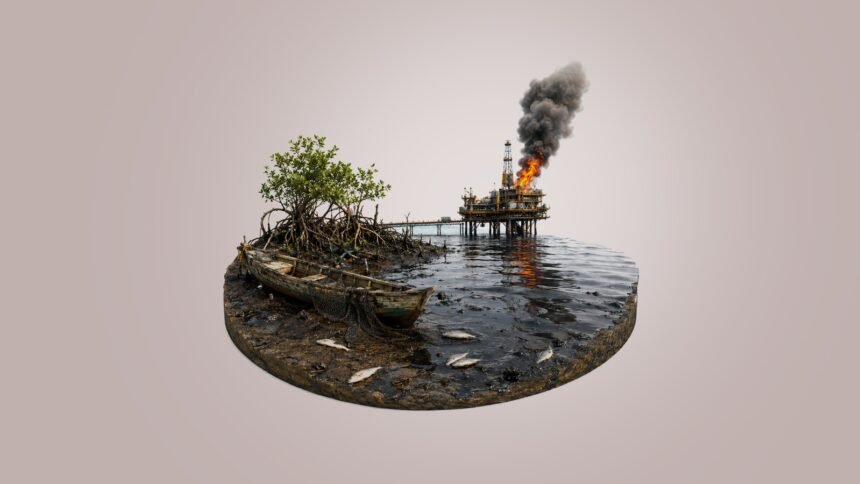
The devastating interface between international oil trade and local environmental integrity is vividly apparent along the Ilaje coastline in Ondo state. Within these riverine and coastal ecosystems, the physical infrastructure of offshore extraction has systematically compromised the open water matrix and surrounding mangrove habitats. Oil contamination frequently forms thick, slick layers over the ocean surface, creating a physical blockade that restricts vital oxygen exchange and destroys the primary breeding grounds of marine life. As a direct consequence of this severe habitat degradation, local fishing livelihoods are collapsing. Fishers who historically returned from the Atlantic with baskets full of croaker, shiny nose, mackerel, and barracuda now cast their nets into polluted waters, frequently retrieving catches that reek of crude oil or finding dead fish washing up along the shoreline during periods of heavy chemical discharge.
Six Years of Continuous Contamination
The most visible and destructive monument to this environmental collapse is the offshore oil well known as Ororo-1, located in the coastal waters near the village of Awoye. Originally drilled by Chevron Corporation, which subsequently capped and abandoned the field, the asset was later reallocated by the Department of Petroleum Resources to indigenous firms, including Owena Oil and Gas and Guarantee Petroleum. In April 2020, a severe industrial blowout ignited the facility.
Six years later, the well continues to burn completely unchecked, releasing a constant, toxic cocktail of smoke, soot, and chemical fumes directly into the atmosphere of nearby coastal settlements. Residents recall the initial explosion shaking the ground like thunder, introducing a permanent state of precarity. Today, black soot settles inside domestic water containers and over uncovered food, forcing communities to live in the permanent shadow of an uncontained environmental disaster.
The Institutional Absence of the State
The protracted nature of the Awoye well disaster exposes severe structural failures and deep institutional gaps within Nigeria’s environmental governance and regulatory enforcement frameworks. Despite the existence of national agencies tasked with monitoring oil spills and regulating corporate operations, the state apparatus remains largely absent from active extraction frontiers. No comprehensive public health assessment or bio-monitoring regime has been carried out by governmental bodies to evaluate the long-term toxic risks faced by the coastal population. This regulatory vacuum leaves local communities completely isolated, as private operators and state entities routinely ignore repeated pleas for intervention, demonstrating how corporate interest and bureaucratic inertia can effectively paralyze the enforcement of domestic environmental protection laws.
The Biological Cost of Toxic Exposure
The persistence of unchecked petroleum pollution has introduced a severe public health crisis across the Niger Delta, transforming environmental contamination into direct biological damage. Continuous combustion of crude oil at the Ororo-1 site releases highly hazardous substances into the local airshed, including benzene, sulfur dioxide, and particulate matter. Public health experts warn that chronic exposure to these toxicants is directly associated with elevated risks of cancer, skin lesions, and deep cardiovascular and respiratory illnesses.
Across communities like Awoye, the human toll of this toxic exposure is systemic:
- Pediatric Vulnerability: Young children suffer from sudden, acute respiratory distress; clinical cases show infants presenting with uncontrollable coughing fits, severe throat irritation, shivering, and a sudden loss of speech after inhaling the soot-laden air.
- Systemic Contamination: Empirical studies of women living in historical oil-producing zones reveal alarming concentrations of polycyclic aromatic hydrocarbons (PAHs) in their blood and tissues, driven by continuous ingestion of contaminated soil and groundwater.
- Medical Isolation: Affected families are left with virtually no access to specialized medical infrastructure, forcing rural households to spend their dwindling incomes on basic local medicine vendors and poorly equipped rural clinics that lack the diagnostic tools required to treat chronic toxicant exposure.
Re-engineering Resource Governance and Accountability
The resolution of the Niger Delta’s environmental crisis requires a comprehensive shift away from speculative extraction toward an accountable, high-integrity governance model that prioritizes human life and ecological restoration. Immediate operational priorities must mandate that state authorities and international engineering firms deploy specialized containment teams to permanently cap the burning Ororo-1 well, ending six years of continuous atmospheric poisoning. To prevent future institutional failures, the federal government must establish a fully independent, well-funded national bio-monitoring system tasked with executing regular, transparent health audits across all oil-producing municipal zones.
Furthermore, the legal frameworks governing corporate liability must be overhauled to mandate automatic, heavy financial penalties for operators that fail to immediately contain blowouts, with the resulting funds channeled into local community trusts to finance specialized healthcare facilities and compensate fishmongers and fishers for their lost livelihoods. Only by subordinating the short-term profits of the petroleum trade to the constitutional rights of environmental safety and human health can Nigeria build a sustainable, self-reliant future for its coastal peoples.