



The Pan-African Paradigm of Resource Extraction and Environmental Accountability
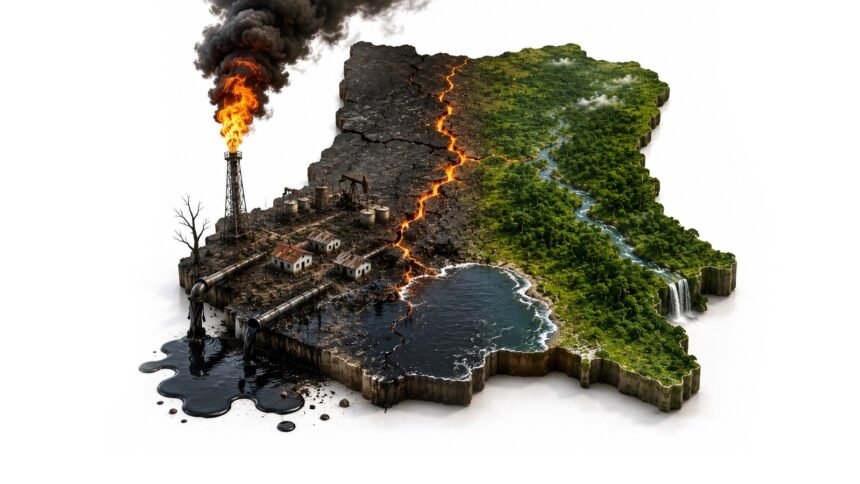
Across the African landscape, the extraction of natural resources by foreign-linked corporations continues to expose a structural asymmetry between the wealth generated for shareholders abroad and the health burdens absorbed by communities at the extraction site. In the Democratic Republic of Congo’s coastal town of Muanda, residents living alongside the operations of French-British oil firm Perenco now find themselves at the center of this asymmetry, following a Human Rights Watch report documenting pollution linked to flaring, oil spills, and contaminated soil near their homes. Perenco, the country’s sole oil producer, pumps some 19,500 barrels daily along a modest 37-kilometer stretch of Atlantic coastline, a concentrated extractive footprint whose environmental and health consequences fall disproportionately on a population with limited institutional recourse. The episode reopens a familiar continental question: whether African states can assert genuine regulatory sovereignty over extractive industries operating within their borders, or whether resource wealth continues to flow through an architecture in which accountability remains perpetually deferred, reclaiming environmental justice as an unfinished dimension of postcolonial self-determination.
A Community Breathing Toxins
Human Rights Watch’s investigation, based on interviews with 45 residents, oil workers, health professionals, and officials, along with satellite imagery and photographic evidence, documents flaring at five sites between January 2025 and March 2026, including one location less than 80 meters from residential homes. Gas flaring, largely prohibited under Congolese law, releases a cocktail of pollutants linked to respiratory illness, and residents interviewed by the rights group described chest pain, headaches, and nausea consistent with sustained exposure. The proximity of flaring infrastructure to inhabited homes represents not merely a regulatory oversight but a structural failure of enforcement, a gap between the letter of Congolese environmental law and the operational reality on the ground. For a population already navigating the DRC’s broader infrastructural deficits, the added burden of industrial pollution compounds vulnerabilities that extend well beyond respiratory health, touching water security, soil viability, and long-term community wellbeing in a region with few alternative economic options beyond the oil sector itself.
A Pattern Documented Across Years
The current findings do not stand in isolation but extend a documentary record stretching back more than a decade. A 2013 investigation by Congo’s Senate found lead and mercury levels near Muanda exceeding World Health Organization drinking-water guidelines, while a 2025 academic study conducted by researchers from universities in Congo and Cameroon identified hydrocarbons and other pollutants in soil near the town, flagging potential human health risks. Human Rights Watch’s latest report adds another layer, alleging that Perenco has failed to adequately prevent oil spills from wells and pipelines from contaminating surrounding soil and riverbeds. This accumulating evidentiary matrix, spanning government investigation, independent academic research, and now international human rights documentation, suggests a persistent pattern rather than isolated incidents, strengthening the case for structural regulatory intervention rather than case-by-case remediation. Yet the recurrence of similar findings over more than a decade also illustrates how difficult it has been to translate documented harm into enforceable institutional consequences.
An Unreleased Audit and Institutional Opacity
Central to Human Rights Watch’s demands is the DRC government’s own unreleased environmental audit of Perenco, commissioned in 2024 but never published, with authorities providing no timeline for either interim findings or a final report. This institutional opacity sits at the heart of the accountability gap: Kinshasa possesses the regulatory tools and, apparently, the audit data necessary to assess Perenco’s environmental compliance, yet has withheld that information from the public it is meant to protect. The rights group’s call for the audit’s publication represents a relatively modest structural demand, transparency rather than punitive action, yet even this has proven elusive. For Muanda’s residents, the gap between government capacity and government disclosure translates directly into an inability to hold either the company or the state accountable, leaving affected communities dependent on international rights organizations to document harms that domestic institutions are, in principle, already positioned to address.
Perenco’s Denial and the Corporate Counter-Narrative
Perenco has firmly denied that its operations have caused air, soil, or water pollution, or any acute health impacts, according to the Human Rights Watch report, asserting instead that the company has invested in pollution prevention and infrastructure maintenance. Neither Perenco nor Congo’s hydrocarbons ministry responded to requests for comment on the specific findings, leaving the rights group’s allegations, for now, without any detailed rebuttal beyond the company’s general denial. This asymmetry, a well-documented, multi-source allegation set against a brief corporate denial, reflects a familiar dynamic in extractive-industry accountability disputes across the continent, where the resource and legal capacity available to multinational operators typically outstrips that available to affected communities or even to under-resourced regulatory ministries. The absence of a substantive ministry response further underscores the institutional asymmetry at play, leaving Muanda’s residents without a clear avenue for either independent verification of the company’s claims or enforcement of existing environmental statutes.
Reclaiming Environmental Sovereignty in the Extractive Economy
Muanda’s plight is a microcosm of a challenge replicated across Africa’s extractive economies, from the Niger Delta to Zambia’s Copperbelt: the persistent gap between the sovereign authority African states nominally hold over resources within their territory and the practical capacity to enforce environmental and health protections against well-resourced multinational operators. The publication of the DRC’s 2024 environmental audit would mark a modest but meaningful step toward closing that gap, offering Kinshasa an opportunity to demonstrate that regulatory sovereignty extends beyond statute books into enforceable practice. More broadly, Muanda’s case adds to a growing continental archive of extractive-sector accountability struggles that, taken together, are gradually reshaping expectations around what genuine resource sovereignty requires, not merely control over licensing and revenue, but sustained institutional capacity to protect the health and environment of communities living alongside extraction. Reclaiming that fuller conception of sovereignty remains an unfinished continental project, one in which Muanda’s flares now stand as both evidence and urgent reminder.