




The Pan-African Paradigm of Security, Sovereignty and Institutional Renewal
Across the African landscape, the question of whether fragile states can reclaim contested territory from armed non-state actors has become the defining test of post-colonial governance. Nigeria’s rescue of 308 hostages from the forests of Kainji Lake National Park, described by President Bola Ahmed Tinubu as the largest single-day hostage recovery in the nation’s history, arrives as a rare and consequential data point in that broader continental struggle. For a country whose north has become a byword for kidnapping-for-ransom economies and jihadist insurgency, the operation represents more than a tactical victory; it is a claim, however provisional, that the Nigerian state retains the institutional capacity to project force, coordinate intelligence, and physically reclaim citizens from territory long ceded to bandit and extremist networks. The rescue does not erase the structural conditions that produced the crisis, nor does it resolve the asymmetric contest between an underfunded military and increasingly sophisticated armed groups operating across the Lake Chad basin. But it does signal a recalibration of institutional confidence at a moment when Nigeria’s security architecture has been widely derided as hollowed out. As the country approaches a pivotal presidential election, this operation is being presented as evidence of a state reclaiming sovereignty over its territory and its citizens.
An Intelligence-Led Operation and Its Human Toll
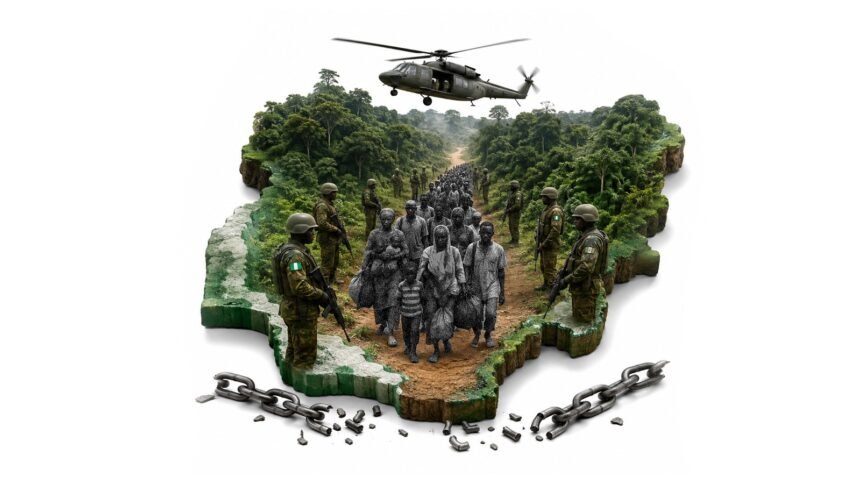
The joint operation, conducted by Nigeria’s armed forces, police, and intelligence services, freed victims held for months in the dense forest cover surrounding Kainji Lake National Park in the north-central region. Among the 308 rescued were 163 people abducted in February during a raid on the village of Woro in Kwara state’s Kaiama district. This attack killed at least 170 others and stands as one of the deadliest assaults by gunmen this year. A further 145 hostages were recovered from neighboring Niger state. All survivors are undergoing medical evaluation at an army installation ahead of reunification with their families. Tinubu framed the operation in explicitly institutional terms: “The successful execution of this intelligence-led operation demonstrates the growing efficiency and collaboration among our security services,” he said, adding a commendation for “our gallant men and women in uniform for their bravery and unwavering commitment to safeguarding Nigerian lives.” Presidential spokesperson Bayo Onanuga described the rescue as part of a deliberate effort to “restore lasting peace across every corner of the nation,” language that positions the operation not as an isolated success but as evidence of systemic institutional recalibration.
The Economics of an Endemic Kidnapping Crisis
The scale of Nigeria’s kidnapping economy provides essential context for why a single rescue, however large, cannot be read as a resolution. According to the Lagos-based geopolitical advisory SBM Intelligence, at least 4,722 people were kidnapped across 997 separate incidents between July 2024 and June 2025 alone, resulting in at least 762 deaths. Abductors demanded a staggering ₦48 billion, roughly $35 million, in ransom demands during that period, with families and communities ultimately paying out at least ₦2.57 billion to secure the release of loved ones. This is the structural matrix within which the Kainji rescue must be understood: an entrenched, semi-industrialized abduction economy operating across forests and shrublands too vast for the Nigerian military to fully police, sustained by armed groups ranging from opportunistic bandit gangs to organized jihadist factions. The asymmetry between the resources these networks command and the historically underfunded state apparatus meant to counter them remains the central obstacle to durable security sovereignty in northern Nigeria.
Boko Haram, ISWAP, and the Regional Threat Matrix
The rescue’s timing coincides with a broader military escalation against the Islamic State West Africa Province, the Boko Haram offshoot operating primarily around the Lake Chad basin, a body of water straddling Cameroon, Chad, Niger, and Nigeria. In the same week as the Kainji operation, the Nigerian army formally declared wanted the group’s governor, Abu Musa al-Mangawi Baa Shuwa, and his deputy, Amirul Jaish Muhammad Jidda, signaling an intensified push against the organization’s command structure. This follows a pattern of incremental recoveries, including the July release of at least 40 students and teachers abducted in May from a school in Oyo state, southwestern Nigeria. Taken together, these operations suggest a security establishment attempting a systemic institutional pivot, from reactive containment toward proactive disruption of the command-and-control networks sustaining insurgent and criminal violence across multiple, interconnected theatres.
Investment, Morale, and the Trajectory Toward Reform
Underpinning this operational tempo is a deliberate investment in institutional morale. Days before the Kainji rescue, Tinubu approved a pay increase of 30% to 80% for members of the armed forces, the largest such hike in years for a military widely regarded as underfunded and ill-equipped to suppress the multiple insurgencies it is expected to confront simultaneously. The timing, ahead of a January presidential election in which Tinubu is seeking a second term, invites scrutiny over whether security gains are being sequenced for political effect. Yet the substance of the reform, addressing chronic underinvestment in personnel welfare, speaks to a genuine institutional recalibration rather than a purely symbolic gesture. Whether elevated compensation translates into sustained operational capacity, rather than a short-term morale bump ahead of an election cycle, will determine whether Nigeria’s security architecture can durably close the gap between state capacity and the scale of the threat it faces.
Toward a Reclaimed Territorial Sovereignty
The liberation of 308 Nigerians from the forests of Kainji Lake is, in the final analysis, a single data point in a far longer struggle over whether the Nigerian state can reassert command over territory ceded to non-state armed actors across more than a decade of insurgency. It does not resolve the structural poverty, weak rural governance, and porous regional borders that continue to feed recruitment into bandit and jihadist networks. But as a demonstration of intelligence-led, multi-agency operational capacity, it offers a template that Nigerian security planners may seek to replicate at scale. For a continent watching whether fragile post-colonial states can outlast the insurgencies that have metastasized within their borders, Nigeria’s rescue operation stands as a cautious argument that reclaiming territorial and human sovereignty, one forest, one community at a time, remains within reach.